Showing posts with label Political Status. Show all posts

Sunday, April 03, 2016

Calvo Pushes Political Status Vote in Annual Address

Published on April 1, 2006 by Pacific Daily News

By Shawn Raymundo

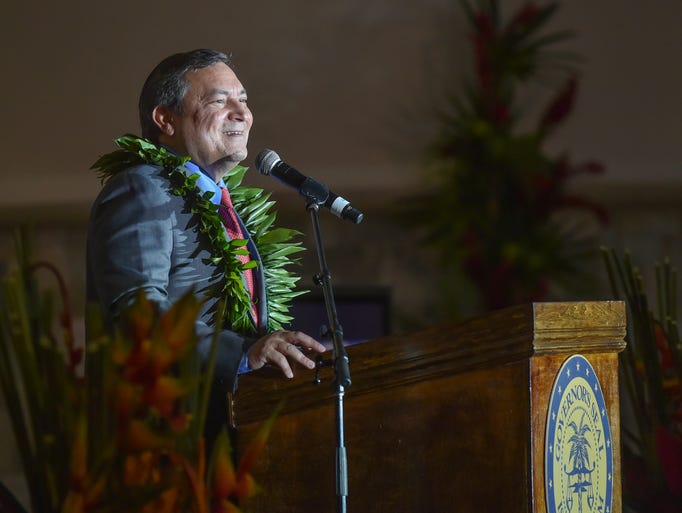
Standing at the entrance of the nearly completed Guam Museum in Hagåtña on Thursday evening, Gov. Eddie Calvo delivered his annual State of the Island address.

The location of this year’s address symbolized the theme of Calvo’s speech. With the past behind him — a building that will soon be filled with artifacts from another time — Calvo spoke of the island’s future.

The Republican governor, now midway through his second term, made several announcements in his speech, including a strong, immediate push for a political status vote, the release of $40 million in tax refunds this month and a proposal to help the financially strapped Guam Memorial Hospital.

Toward the end of his more than 6,000-word speech, Calvo announced Guam’s native inhabitants might “finally” be able to vote in a plebiscite to determine the island’s political status.

The governor said on Friday morning, he will “submit a draft measure to petition for the referendum of the political status plebiscite.”

Calvo said he’s already organized a campaign to secure the required number of signatures to get the referendum on the November ballot.

“We will aggressively seek the required number of signatures, making this a grassroots decolonization effort,” he said.

If, by mid-July, depending on how an education campaign to inform the native inhabitants of their political status options is going, Calvo said he would file the petitions.

On the topic of tax refunds, Calvo announced that residents could look forward to roughly $40 million in tax refunds being released this month, covering 13,000 checks.

The state of the island is confident partly because the state of your government is strong,” Calvo said. “It is a government that manages its resources and finances responsibly, values its employees, and delivers services better as a result.”

The governor’s tax refund announcement was met with criticism from the Democratic Party of Guam, which issued several press releases to the media Thursday night, responding to Calvo’s speech. The party pointed out that the Calvo administration’s pace to pay out tax refunds has slowed substantially in the past couple of years.

Referring to the government’s bank account used to set aside income tax revenue for tax refunds, the party stated that the government hasn’t kept up with the mandatory amount of deposits that should have been collected by now.

“The truth is that the tax refunds are $26 million behind; he is fighting our taxpayers in the U.S. Supreme Court, and we owe millions of dollars to our people just as we did before he started,” the Democratic Party wrote.

Touching on the financial burdens facing the government-run hospital, Calvo noted the Guam Memorial Hospital Authority is “bleeding cash and needs a transfusion right away.”

Earlier this year, amid bickering between the Guam Legislature and the governor’s office, Adelup submitted a measure to lawmakers that would use $1.3 million in legislative lapsed budgetary funds to assist the hospital.

Legislative officials, however, said that money already had been adopted into the senator’s operating budgets.

During his address, Calvo said he’s now withdrawing the bill and urging the lawmakers to back a partnership between Sen. Dennis Rodriguez Jr. and Adelup in financing $120 million capital improvements. The endeavor, he explained, would yield $30 million.

“This is on top of revenue-generating programs we are implementing. We can secure a low interest rate if we do this now, and we identified the repayment source,” he said. “If we do this, along with Sen. Rodriguez’s bill that authorizes public-private partnerships, we will stabilize GMH for the foreseeable future.”

Rodriguez said he’s happy to work with the governor to find solutions that would address the hospital’s outstanding vendor payables, which are around $26 million.

“I’m glad that was part of his speech. And I’m going to work together to really develop a long term sustainably plan,” Rodriguez said. “He talked about financing for the immediate needs and I want to see the details on that and based on that we need to move forward, even if we look at the long term plan for the hospital we have these needs now.”

As for other plans, Calvo said, over the next few days he will introduce a bill to assess fees from major real estate transactions, which in turn will be used to infuse the Guam Housing Corporation so it can issue more mortgages to families who have been denied by the banks.

The governor also plans to improve the health and wellness of the island by pushing more resources toward programs and facilities that encourage fitness. Along those same lines, Calvo said he would work with Guam lawmakers to construct more athletic facilities and get more streets paved throughout the villages.

Gov. Eddie Calvo delivers his annual State of the Island

Editor's Note: Sen. Dennis Rodriguez Jr. did not issue a media release following Gov. Calvo's State of the Island address Thursday night. The quotes in the story came from an interview Rodriguez had with Pacific Daily News following the address. The senator was also misquoted as saying he was happy the governor mentioned him in the address. The senator actually said he was happy the governor spoke about the financial troubles of GMH. This article has been corrected and updated.

Sunday, September 18, 2011

Commission on Decolonization Meets this Week

By Nick Delgado from KUAM.com

Guam - It was established 15 years ago and for the first time in several years the Commission on Decolonization will be meeting. The 24th Guam Legislature created the Commission to examine the various political status options for Guam, which included status quo, statehood and commonwealth.

The meeting will be held at Adelup Friday, September 23 at 9 in the morning. Island leaders have long argued Guam must settle the question of its political status.

Saturday, October 02, 2010

New Political Status Options

FRIDAY, 01 OCTOBER 2010 04:23 BY THERESE HART | VARIETY NEWS

A bill funding an education program to enable Guam to explore other political status options is now headed to the president’s desk after the U.S. Congress passed the amended version of H.R. 3940 that Congresswoman Madeleine Bordallo sponsored.

Guam has been an unincorporated territory of the United States since 1950.

The U.S. House and the Senate passed on Tuesday the bill which had since been transmitted to President Barack Obama.

Bordallo said the Obama administration supports her bill. So did other federal and local officials, including cause-oriented groups and decolonization and indigenous rights advocates on island.

“I look forward to President Obama signing the bill into law. As soon as it becomes law I will request Assistant Secretary Tony Babauta to follow Congressional intent and provide federal funds to Guam for a political status education program,” she said in a statement.

Bordallo introduced the bill on Oct. 27, 2009 and originally passed the full House of Representatives on Dec. 7, 2009 by voice vote.

On Tuesday, the House passed the amended version by a vote of 386 ayes to 5 noes. The Senate passed the amended measure by unanimous consent late Tuesday.

"The passage of this bill by the Senate and the House recognizes the importance of political self-determination for the people of Guam. The bill makes it clear that the Secretary of the Interior has the authority and should provide federal funding for political status education for a future self-determination vote,” said Bordallo.

Speaker Judi Won Pat said she’s happy to learn that the bill passed Congress but raised concern on funding issue.

“Of course, we're very happy. My concern here is the funding. I believe that $300,000 to fund this education program was identified at one time. However, according to the Commission on Decolonization, they said it would cost at least $500,000 and so, if we get $300,000, it's shy of what we're going to need,” she told the Variety.

With the military buildup progressing, the speaker said: “It’s important that we do a thorough, extensive education program on self determination on the different choices that we have. We really need to do a good job on this one.”

Firing Range

In related news, Bordallo also questioned Deputy Secretary of Defense William J. Lynn on the proposed firing range location on Guam during a House Armed Services Committee hearing.

“I urged Secretary Lynn and the Department of Defense to strongly consider proposed alternatives to Marine training requirements like moving the proposed firing range to Tinian or using existing DoD lands on Guam,” the congresswoman said.

The House Armed Services Committee held two hearings in September and another will be held on Oct. 1, Washington time, on H.R. 5136 or the National Defense Authorization Act which will appropriate funds for military activities of the Department of Defense, for military construction and for defense activities of the Department of Energy, to prescribe military personnel strengths for the fiscal year and for other purposes.

The bill mentioned Guam and the Committee’s commitment to the international agreement between Japan and the United States, including the movement of Marine Corps forces to Guam.

“This bill includes several key provisions to assist in a smooth implementation of this strategic realignment, including allowing the administration to spend up to $500 million to provide community infrastructure on Guam to support this move and a process to unify the utility systems on the island,” according to the bill.

Bordallo expressed her belief that acquiring additional land on Guam for a firing range is unlikely and that, in order to get the military build-up done right, all other options be considered.

Lynn stated that the DoD will examine alternatives to the proposed firing range location, including a location on Tinian, and agreed that a resolution beneficial to the civilian and military community must be reached.

“I appreciate the DoD's willingness to seriously consider other alternatives for the proposed firing range location and I will continue to work with my colleagues and stakeholders on this important issue,” added Bordallo.

Saturday, February 20, 2010

Historian backs ‘Guahan,’ senator bats for self-rule

Historian backs ‘Guahan,’ senator bats for self-rule

Wednesday, 17 February 2010 03:32
by Tiffany Sukola | Variety News Staff

A LOCAL historian stands behind Gov. Felix Camacho’s initiative to adopt “Guahan” as the island’s official name, despite harsh criticism from some local residents.

Camacho signed an executive order on Monday after delivering his final state of the island address that calls for all “Guam” references in official documents to be replaced with “Guahan,” the island’s indigenous name. The governor also asked legislators to enact a similar measure to adopt the name-change as well.

University of Guam Chamorro professor Peter Onedera said critics of the governor’s initiative are missing the point of this unprecedented move. He said he has heard opponents of Camacho’s decision say that the name-change will have no effect on the Chamorro people.

However, Onedera said he fully supports Camacho’s move because he sees this is a chance for the Chamorro people to finally have a say in what happens to their island. “This is a step in the right direction,” said Onedera. “It’s about time the Chamorro people are empowered.”

Onedera said local residents should not let this opportunity to give the island its proper name back. “Other names were given through time, from the Spanish, the Japanese and the Americans,” he said. “But no one ever asked the native people if it was ok or got permission from them to use these new names.”

According to Onedera, “Guahan” and “Guam” have both been used in historical documents referencing the island. However, the natives called their island “Guahan.”

Americans started calling the island, ‘Guam’, when they arrived in 1898, said Onedera. The name stuck after the island was referenced as “Guam” in the Treaty of Paris.

The first naval governor, Richard Leary, requested that the island be officially named, “Isle of Guam.”

Onedera added that residents should feel empowered because they finally have a chance to voice their opinion on the matter.

However, Sen. Judi Guthertz said that while Camacho’s intentions are all well and good, changing the name of our island is not a legacy.

“A legacy is achieving something really remarkable on a significant issue,” said Guthertz in a press release yesterday. “I would suggest that the Governor concentrate…on establishing a new and improved political status as his legacy.”

Guthertz added that Camacho should convene the Commission on Decolonization and the Guam First Commission to address the issue of political status.

Onedera also said that he would like to see the next administration take a more proactive role in preserving the island’s culture and language.

“We are losing things of value to our culture,” said Onedera. “I hope the next administration has more cultural sensitivity.”

Onedera said he believes the Chamorro language is not used nearly enough throughout the island. The Chamorro language, he said, should be used more in official documents and during public speeches.

Saturday, January 30, 2010

Still no word on Guam demands

Still no word on Guam demands

Wednesday, 27 January 2010 05:22
by Therese Hart | Variety News Staff

COMPACT impact reimbursements, the military buildup, war reparations and political self-determination seem to be very touchy subjects in Washington D.C. but all Sen. Frank Blas Jr. wants to know is why Congressman Nick Rahall won't make a statement on compact impact after he had promised to do so.

During a congressional delegation visit to Guam in August last year, Blas was told that the congressman had a prepared statement regarding the matter and that he would be making it at some point during his visit.

Immediately after Rahall made his presentation during one of the lecture series held at the University of Guam, Blas asked one of Rahall's senior staff members about the promised discussion on Compact Impact. “I was informed then that a decision was made not to discuss the matter and that I was not to be told as to why,” said Blas.

Blas had brought this issue to the attention of Congresswoman Madeleine Z. Bordallo who assured him that a response will be forthcoming. However, Blas has yet to receive any response.

“I believe there has been sufficient time to gain a response as to why the Compact issue was not discussed during Mr. Rahall's visit and would appreciate an answer as promised,” wrote Blas to Bordallo.

Tuesday, January 26, 2010

On Guam, military’s roots run deep

On Guam, military’s roots run deep

Story and photos by Teri Weaver, Stars and Stripes
Pacific edition, Saturday, January 23, 2010

BARRIGADA, Guam — At a deployment ceremony at Guam’s National Guard headquarters last week, Maj. Gen. Donald Goldhorn gave out his personal cell phone number.

It’s the 27th time he’s done that for the families of the island’s Air and Army National Guard members. And it marked the 27th time a unit has deployed from the island since 2003.

About 1,500 members have deployed at least once to either Iraq, Afghanistan, the Horn of Africa, Djibouti or the Philippines, about the same number as total membership in the Guard.

"It has consumed us, quite frankly," said Goldhorn, the Guard’s adjutant general.

The military, in many ways, also consumes Guam.

Already the Air Force and Navy occupy about a third of the 212-square-mile island. The Pentagon wants to add at least 9,182 more troops — including at least 8,000 Marines from Okinawa — more than doubling the current military population of 6,800.

But the island’s relationship with the military runs much deeper. Of the 178,000 residents, more than 10,000 are currently in uniform, according to a report released last week by the island’s Chamber of Commerce.

Another 12,000 veterans live on the island, according to Carl Peterson, a veteran who chairs the chamber’s military affairs committee.

Some members of the Guam guard’s Matua Platoon — officially the 4th Platoon, Company B, 1st Battalion of the 294th Infantry — said Jan. 13 that they’ve been too busy to attend recent public hearings on the buildup.

Instead, they were preparing for a six-month deployment to the southern Philippines to work with Joint Special Operations Task Force-Philippines, which is training the local military and advising it in its fight against al-Qaida-linked terror groups. Two U.S. soldiers were killed there in September from a roadside bomb laid by a group linked to al-Qaida.

Army 2nd Lt. Olin Yaopoqa, the platoon’s leader, said the buildup could bring "a whole spider web of work here." He also noted it could come at a cost.

Guam is less than nine miles wide and a little more than 30 miles long, and "there will be tension, frictions," he said. "There is only so much room to go around."

On Jan. 12, Guam Legislature Speaker Judi WonPat helped hand out USO care packages to the platoon.

Later that night, WonPat spoke at a public hearing in support of "We Are Guahan," a local coalition fighting against the military’s expansion plans. "This military buildup is another example [of Guam] being taken for granted," she said at the hearing.

At the Jan. 12 deployment ceremony, Pete Alvarez sat beside his son, Spc. Peter Alvarez. The senior Alvarez has a daughter serving in Afghanistan.

Alvarez says he’s followed news of the military’s proposed buildup on Guam, but he hasn’t attended the public meetings.

"It’s good for the economy," he said, but he worries about fights among the incoming troops and young men on the island.

For now, "I’m more worried about my kids," the Vietnam veteran said. "Right now, they are more of my priority."

About 200 Guam guard members are deployed around the world, including a squadron with the Guam Air National Guard currently in Baghdad, according to Army Capt. Kenneth Ola, spokesman for the guard.

Staff Sgt. Carl Santos estimates he’s been gone nearly four of the seven years he’s been in the Guard. He said he likes being able to serve and to come home to his home in Dededo.

Santos said he’s followed the complaints about the buildup.

"They are entitled to their opinions," he said.

Yet Santos sees it more from a military vantage point.

"We’re such a strategic location," he said.

For some in Guam, the military’s ability to move in without asking for permission lies at the heart of their opposition to the move.

"We hate being possessions to the federal government," said Carmen Artero Kasperbauer, 74, whose family once owned land now part of Andersen Air Force Base. "That’s why people are angry."

Her anger, she said, is mostly toward leaders in Washington. Guam was originally won by the United States after the Spanish-American war. It remains a territory with a non-voting member of Congress. Registered voters on the island cannot vote for president.

"I’m not talking about the uniformed military. We love the uniformed military," she said, and began listing a family tree that includes her son, an Air Force pilot, her grandson and granddaughter, who are deployed, her brother, a retired submariner, and another brother who was wounded in Vietnam.

"Our son … helped liberate the Kuwaitis," she said. "But he can’t help liberate me."

US military build-up on Guam worries islanders

US military build-up on Guam worries islanders

Fri, Jan 22, 2010
By Mar-Vic Cagurangan

HAGATNA, Jan 22, 2010 (AFP) - Residents of the US territory of Guam fear the planned influx of thousands of American troops and their families will leave their Pacific island home swamped.

Around 19,000 personnel and their families are set to relocate to Guam from southern Japan in a move that will treble the US military presence on the island.

But despite proclaimed economic benefits, not all of the 178,000-strong population is looking forward to the troops' arrival.

"This proposed military build-up, with our current political status, will result in the cultural and racial genocide of the Chamorro people," said Frank J. Schacher, chairman of the Chamorro Tribe Inc., a group representing the island's indigenous people, who make up a third of the population.

"It is our island, our ancestral remains, our sacred artifacts, our waters, our culture, and our right to exist as a race that would be destroyed by these intended actions."

It is a long time since the Chamorro have been masters of their own destiny: Spain controlled the island for more than two hundred years until the late 19th century, when it was taken over by the United States, and it was occupied by Japan during World War II.

In 2006, Washington and Tokyo agreed to shift thousands of marines from Okinawa after complaints that, with half of the country's 47,000 US military personnel, the island was over burdened.

Guam's US Congress delegate, Madeleine Bordallo, hailed the plan as a great opportunity for the territory. The local government and the business community have also welcomed an expected economic boom fuelled by the build-up.

"We acknowledge the unprecedented growth that lies ahead," Guam Governor Felix P. Camacho said recently.

"Our future, however, will test our resolve and we will be called upon to display our commitment to doing what is good and right for our people."

An 11,000-page US Defense Department draft environmental impact statement said the military expansion would strain the island's limited infrastructure, healthcare, and ecology.

The study says the relocation, costing up to 15 billion dollars, would bring 8,600 marines, 630 army personnel, and about 10,000 dependents to Guam.

More than 33,000 foreign workers would also be needed to build wharves, aircraft carrier berths, roads, military barracks, and homes.

The Guam Chamber of Commerce, an early supporter of the relocation, said it was not oblivious to growing scepticism within the community.

"We're the voice of the businesses, but our members all live in Guam too. So we're looking out for the best interests of our businesses and the community at large and so we're looking at everything," Chamber president David Leddy said.

"There are positive and negative impacts. We just have to weigh the positive and negative and see what's good for the people."

About a third of Guam's 549 square kilometres (212 square miles) is already owned by the US government, mainly for military use, and it wants to buy another 2,200 acres (890 hectares) as part of the troop transfer.

"Lands that our ancestors fought for are passed down from one generation to the next until they are indiscriminately taken away for purposes other than sustaining and nourishing the family clan," said Gloria B. Nelson, whose property is being eyed by the Department of Defense.

Melvin Won Pat, one of the founders of a new activist group opposed to the build-up, said it was false to suggest the move was supported by the wider community.

"I think a lot of our people have been misled into believing the general population is in full support of this move," he said.

The Department of Defense's Joint Guam Project Office, which is in charge of the relocation, has held a series of public meetings to discuss the draft report, but some locals remain sceptical.

"I refuse to dignify this whole charade," resident Filamore Alcon Palomo said.

"Attending public hearings would just be a waste of time because I know - everybody knows - this is a done deal. The military won't listen to us. They will do what they want to do."

Wednesday, January 13, 2010

Guam Senator Challenges DOD's Draft EIS Intentions

Guam Senator Challenges DOD's Draft EIS Intentions

Written by Guam News Factor Staff Writer
Tuesday, 12 January 2010 21:29

Blas Tells DOD To Deal With Guam's Unresolved Issues First

GUAM - Language in the Draft Environmental Impact Statement (DEIS) suggests the military is intentionally sabotaging efforts to resolve Guam's political status and uphold indigenous rights, Senator Frank Blas Jr. testified at a public meeting Tuesday night.

Blas made the accusation based on language in the draft, which states that "an expansion in non-Chamorro voting population could... affect outcomes of any future plebiscites about Guam's political status." The report also notes that budgets for cultural activities, the number of native Chamorros in government offices or leadership positions, and activities dedicated to cultural issues could also be affected by the population shift.

"Is it part of your military buildup plans to inundate our island with people who will have no appreciation or consideration of our culture and beliefs?" Blas asked in his testimony. "Do you firmly believe that we are going to sit back and let you take over our lives and force us to forget who we are?"

The senator also demanded that the Department of Defense and the federal government address war reparations and political status questions as part of the preparation process. The offensive and inflammatory language in the DEIS raises these issues despite the military's insistence that these concerns are not associated with the buildup, Blas added.

Another mention of Guam's efforts to hold a Chamorro plebiscite also suggested the military fully intends to ignore decades-old concerns about Guam's status, Blas noted.

According to the draft, "the political importance of some Chamorro issues would likely recede as the 'militarization' of Guam is stabilized at something close to present levels," the draft states. Blas called the characterization "both disturbing and highly offensive" and said the promise of economic activity in no way compensated for all that Guam has lost due to military activity.

Blas' message to the Department of Defense? "Deal with our issues first, then come back to me with your EIS!"

Hundreds of residents have testified at a series of meetings to inform the public about the military's upcoming buildup, and to collect comments on a draft impact statement that is federally required as part of the development process. In addition to the concerns raised by Blas, residents have formed numerous groups and organizations to protest environmental issues, proposed land acquisition, and other impacts that will result from increasing military activities in coming years.

Senator Frank Blas Jr.'s Testimony

My name is Frank Flores Blas, Jr., a Senator in the 30th Guam Legislature and this is my testimony:

In 2005 during the initial discussions concerning the anticipated military buildup, I had the opportunity to speak with Air Force Lieutenant General Daniel Leaf on the need to address quality of life issues for the people of Guam in order to gain its acceptance by the people. Two issues directly related to the quality of life for our people are war reparations and the amounts spent by the people of Guam to provide services relating to the Compacts of Free Association. We were informed then that those matters as well as any other unresolved issue that didn't relate to the construction of the needed military facilities would have to be brought up with other federal entities other than the Department of Defense.

In conversations I have had with Major General David Bice and Mr. John Jackson, they too further related that the Department of Defense was in no position to deal with Guam's unresolved issues and that DoD's plans relating to the military buildup will be presented and discussed in the DEIS. I was also informed that although the issues were important, it had no relevance to the tasks they were directed to perform.

I believe that before we can have any meaningful conversation concerning the impact that the proposed buildup will have on our island or the requirements that need to be fulfilled in order to accomplish this action, Guam's unresolved issues pertaining to war reparations, compact impact reimbursement, the return of excess lands, the unfretted access to private lands blocked by federal installations, political status, and true representation in Congress have to be addressed and determined.

In Chapter 3 of Volume 7 of the Draft EIS, more specifically on Page 3-55 under the sub-heading "Sociocultural Impacts," it states, "The political importance of some Chamorro issues would likely recede as the 'militarization' of Guam is stabilized at something close to present levels."

I find this statement both disturbing and highly offensive as to suggest that the promised economic activity as a result of the buildup will cause us to forget the sufferings and the killing of our people because of their loyalty to the United States during World War II. I don't appreciate the suggestion that we will forget the hundreds of millions of dollars that we have had to spend to fulfill the mandate imposed upon us as a result of the Compacts of Free Association. Your promise of economic activity does nothing for the many people who had their lands taken from them for military purposes only to see that those lands now sit dormant and selfishly held for no compelling reason. And like your fore-fathers who established the United States of America because they firmly believed that it was unconscionable to have no representation in a Parliament that was making decisions for them without their representation, I am offended that you would believe that the militarization of Guam will cause me to continue to accept my status as a third class citizen and let you continue to impose your will without a discussion with me.

Or maybe this is part of your plan.

In the same chapter of the same volume, but now on Page 3-64 under the sub-heading of "Chamorro Issues," it states, "Guam's indigenous Chamorro population has strong concerns about whether incoming military populations would recognize them as both American by nationality and also a unique ethnic culture worthy of respect and preservation." It goes on to say, "However, an expansion in non-Chamorro voting population could eventually affect the population of Chamorro office-holders and government workers; thereby affecting the current government budgets and activities dedicated to cultural issues and practices. It could also affect outcomes of any future plebiscites about Guam's political status."

What are you telling me?

Is it part of your military buildup plans to inundate our island with people who will have no appreciation or consideration of our culture and beliefs so as to derail us from our inherent and moral responsibility to protect our homes and our dignity? Do you firmly believe that we are going to sit back and let you take over our lives and force us to forget who we are and where we came from? That's never going to happen!

I have always said that before we have any discussion with what you further want to do on our island, we first deal with those issues that have been unresolved for too many years. Although it had been initially stated that those issues were not relevant nor connected to the buildup, the statements made on Pages 55 and 64 just made their relevance very significant. You opened the door on this, and now we're not going to let this go.

Where I have said, now I demand! Before you tell me of your plans to widen my roads, lease my property, strain my healthcare system, or overcrowd my schools, and how you intend to help me help you, deal with our issues first, then come back to me with your EIS!

Thank you.

Thursday, December 24, 2009

2010 plebiscite?

2010 plebiscite?

Retired decolonization director says voters ready for political status vote

Thursday, 24 December 2009 05:47 by Mar-Vic Cagurangan | Variety News Staff


SAYING that Guam has waited long enough to resolve the political status issue, former Decolonization Commission executive director James Underwood has recommended that the legislature amend the local statute to set the self-determination plebiscite in time for next year’s general election.

Underwood also said scheduling the plebiscite for next year would also entail the removal of the requirement for a “native inhabitants” registry that accounts for 70 percent of eligible voters.

Under the local statute, only those who fall in the category of “native inhabitants” as defined by law are qualified to vote in the self-determination process.

Extremely high

“Seventy percent is extremely high; it’s equivalent to 30,000. That’s an extreme burden on the people to have to wait; I don’t think that’s necessary. People should be allowed to vote in the plebiscite now,” Underwood told Variety.

“The legislature has this opportunity to amend the law to set the date for the plebiscite and delete the 70 percent threshold at the same time,” said Underwood, who retired from public service on Sept. 30. “I made the recommendation to the governor to direct the legislature to hold the plebiscite next year.”

Not too fast

Senator Ben Pangelinan, on the other hand, said it would not be fair to push the people of Guam into making a hasty decision just because the registry requisite has not been met soon enough.

“Just because we waited so long doesn’t justify that action. It would be a big disservice to the people of Guam,” the senator said.

“It is important that we get the widest participation as possible and that we have well-planned and well thought-out education program to allow the people to make an honest and informed decision,” Pangelinan said, stressing that the self-determination plebiscite requires a comprehensive preparatory work.

Federal grant

Pangelinan noted that Guam stands receive $2 million under Congresswoman Madeleine Bordallo’s bill that provides technical assistance grants and other forms of help to facilitate the political status public education programs on Guam, American Samoa, and the U.S. Virgin Islands.

The U.S. House of Representatives approved the Bordallo’s H.R. 3940 on Dec. 8.

“Once we find out what kinds of resources we can count on, then we develop the process for the education campaign and set the plebiscite date when we’re ready,” Pangelinan said.

Eligible voters

Eligible voters are allowed to redesign Guam’s political relationship with the U.S. government by choosing one of the three identified options: free association, statehood and independence.

The Decolonization Commission is subdivided into three task forces assigned to conduct an education campaign that correspond to each option.

“I think the people are ready to make a decision and there’s ample time for the commission and that task forces to continue the education campaign between now and next year,” Underwood said.

The local law defines “native inhabitants of Guam” as those “who became U.S. citizens by virtue of the authority and enactment of the 1950 Organic Act of Guam and descendants of those persons.”

When asked about his opinion on the possibility of expanding the voting eligibility criteria, Underwood replied, “I’d like to see that but the law is clear on who can vote. That is a very delicate issue.”

Chamorro registry

To expedite the registration process, Pangelinan has introduced a bill that requires the inclusion of those whose names are listed in Chamorro Land Trust registry into the roster of “native inhabitants.”

“That will take us close to 50 percent of eligible voters,” Pangelinan said. The bill has been public heard and is awaiting committee action.

Pangelinan, who is one of the vocal advocates of self-determination for Guam is not eligible to vote. He is a native of Saipan.

“I have no personal agenda here. I am not even qualified to vote. I just want to see the people of Guam,” he said.

Inactive

Underwood acknowledged that the commission, which receives an annual appropriation of $100,000, has been dormant.

Governor Felix P. Camacho, who chairs the commission, has never convened the body since its creation.

“I cannot speak for the governor. I don’t know why he never called a meeting,” Underwood said.

Monday, December 07, 2009

Political Status Education Bill Clears U.S. House

Political Status Education Bill Clears U.S. House

Guam - Congresswoman Madeleine Bordallo has announced that the political status education bill has passed the House.

The U.S. House of Representatives passed H.R. 3940 which would authorize the Secretary of the Interior to extend technical assistance grants and other assistance to facilitate a political status public education program on Guam, American Samoa, and the U.S. Virgin Islands.

H.R. 3940 passed on a voice vote one month after Congresswoman Bordallo first introduced the bill and two weeks after it was approved by the House Committee on Natural Resources. H.R. 3940 will now be transmitted to the U.S. Senate for consideration in their chamber.

“The passage of H.R. 3940 by the U.S. House of Representatives today advances the issue of political self-determination in the non-self-governing territories by providing federal funding for political status education,” Congresswoman Madeleine Z. Bordallo said today. “H.R. 3940 now goes to the Senate for consideration and I hope that they will act on it with the same sense of priority that the House has viewed this issue.

This bill is supported by the Obama Administration, elected officials from Guam, and decolonization and indigenous rights advocates on Guam. I will continue to work with my colleagues in Congress and with Assistant Secretary Tony Babauta to pass this legislation in the Senate.”

Written by :
News Release

Wednesday, December 02, 2009

DEIS States Marines Won't Increase Crime but Micronesian Migrants Will

DEIS States Marines Won't Increase Crime but Micronesian Migrants Will


Guam - Along with the Draft Environmental Impact Statement the military also conducted a stand alone study on the socio-economic impact of the military buildup. A section of the report covers how the buildup will impact crime and how the military believes young local men will test themselves against marines in fights.


The Department of Defense has identified several likely social impacts of the military buildup. According to the Draft EIS socio economic study marines will not have an impact on Guam's overall crime and social order. Instead the report states that other factors related to the buildup may cause this. In fact the report blames in-migrants from the Freely Associated States of Micronesia as the likely cause. Their numbers are expected to increase due to more job opportunities. According to the DEIS these migrants from within Micronesia "have high crime rates associated with adapting to less traditional social structures"


University of Guam instructor Victoria Leon Guerrero says this is a surprising take on the marines impact to crime considering the fact that many Okinawan protests against the marines were fueled by instances of rape and violence. She says that by not taking any responsibility for the possible increase in crime instead blaming Micronesian immigrants the DEIS is “...insulting to our region”.


University of Guam instructor Michael Lujan Bevacua says that the assumption that Micronesians will raise the crime rate rather than the marines even borders on racism. In fact he says “In some places it would be considered racist”. Bevacua adds that this is obviously scapegoating certain populations and that finding a scapegoat is one of the roots of racism.


While the report lays most of the blame of crime on Micronesian migrants in the very next paragraph it admits that there is “...a potential for more prostitution, alcohol or substance abuse and family violence associated with young military populations (including sailors taking shore leave after weeks at sea)”.


As for the potential of violence and fights the Department of Defense attributes most of the blame to the local population. The DEIS states "The particular reputation of marines as fighters could well trigger a transitional period of adjustment in which local young men test themselves against marines in fights" Bevacua says this too is borderline racism adding that he's surprised that they can make these statements with a “..straight face”.


While the DEIS doesn't appear to own up to increased crime and violence it does admit that the expansion of non-chamorro voting populations could affect the proportion of chamorro office-holders and government workers. This could also affect the outcomes of any future votes about Guam's political status. Leon Guerrero says it's simply unjust to allow a transient population that is only here for a couple of years to affect the political status of and island like Guam. She adds that it takes away a human right that is reserved for the native Chamorro people.


Leon Guerrero encourages everyone to read as much of the Draft EIS as possible and then provide comments during the EIS comment period.


Written by :
Clynt Ridgell

Social Impact - PNC News

Thursday, November 19, 2009

US Congressional Committee Approves Self-Determination Assistance to Territories

US Congressional Committee Approves Self-Determination Assistance to Territories

Pacific News Center
Guahan (Guam)
19th November 2009

Guam - The House Committee on Natural Resources has approved a bill that would authorize the Secretary of the Interior to extend technical assistance grants and other assistance to facilitate a political status public education program on Guam. It will now go onto the full house for approval. The bill was sponsored by Congresswoman Madeleine Bordallo.

In a release, Bordallo says the full committee approved her amended bill that would allow for Interior to also extend assistance to American Samoa and the U.S. Virgin Islands for their own political status education programs.

The amended version of H.R. 3940 was voted on by unanimous consent.
The mark up of H.R. 3940 comes two weeks after Congresswoman Bordallo chaired a hearing on the bill in the Subcommittee on Insular Affairs, Oceans, and Wildlife.
H.R. 3940 may be taken up for consideration in the near future.

In a release, “The full committee’s approval of H.R. 3940 signals that political status education for non-self-governing territories is a priority for the committee that has jurisdiction over the territories."

"The amended bill now includes authorization for political status education grants for Guam, American Samoa and the U.S. Virgin Islands at the request of Congressman Eni Faleomavaega of American Samoa and Congresswoman Donna Christensen of the U.S. Virgin Islands."

"While each territory may approach this issue in a manner appropriate to their circumstances, we can all agree that there is a federal responsibility to assist the territories in self-determination, and that this process cannot be successful without a robust political status education component."

"I also appreciate the testimony of our local leaders including Governor Felix Camacho, who testified in person at the hearing, and Speaker Judith Won Pat and Senator Ben Pangelinan who provided written testimonies. This bill was also supported by a coalition of ten organizations on Guam that support decolonization. The testimonies provided by our local leaders and our indigenous rights community representatives helped to make the case of the importance of a path to decolonization for the people of the U.S. territories that are still listed by the United Nations as non-self-governing." (emphasis added)

"The Obama Administration’s support for this political status education bill was also encouraging, and I will be requesting Assistant Secretary Tony Babauta’s leadership to help Guam and the other non-self-governing territories with this process. I will continue to work with my colleagues in Congress on the issue of political development for our community, and I am hopeful that this bill will help to provide resources to Guam and the other non-self-governing territories for political status education.”


Editor's Note: The Bordallo legislation was also supported by organisations of civil society in Guahan (Guam) which forwarded collective testimony to the US Congress in favour of the measure. Their presentation in support of the bill provides important context to this initiative, and should serve as a guide to the implementation of the measure.

It is to be noted that a number of their recommended amendments have been included in the final version of the bill adopted by consensus in the House Natural Resources Committee, such as the expression of support for the inclusion of the other two US-administered territories presently on the United Nations List of Non Self-Governing Territories, namely American Samoa and the US Virgin Islands. This broader focus is highly commendable, and also has the effect of heightening its importance as the measure proceeds further through the legislative process in Washington. Congress may now recognise that Puerto Rico is not the only US-administered territory in need of a self-determination process.

The active participation of civil society sector in the territories is critical to the successful implementation of this measure to ensure an unbiased and fair process of self-determination based on the legitimate status options of political equality confirmed year after year by the United Nations with United States concurrence. The recent forum held in St. Croix by the United Nations Association of the Virgin Islands last month (October) initiated an important public dialogue in that Caribbean territory - for the first time in over a decade - on the political future of that US-administered territory, and American Samoa's political status commission report completed several years ago and the subsequent initiatives being undertaken by the Governor of that territory, are further illustration.

OTR will shortly publish the relevant excerpts of the United Nations Fourth Committee resolutions concerning the self-determination of the territories adopted as recently as last month (October).

The joint testimony of the Guahan (Guam) civil society follows:


Joint Testimony in Support of H.R. 3940
November 11, 2009On behalf of the following organizations:


Chamorro Studies Association
Chamoru Cultural Development and Research Institute
Commission on Decolonization: Independence Task Force
Famoksaiyan
Guahån Coalition for Peace and Justice
The Guahån Youth
Guam Community College's Center for Civic Engagement
I Nasion Chamoru
National Association of Social Workers: Guam Chapter
Taotaomo’na Native Rights Group

The political and social climate of Guam is changing rapidly, yet the island’s people have yet to determine whether or not this change is the future they desire. With an unresolved political status, the people of Guam have been denied the human right to determine their future. This human right to self-determination can no longer be ignored. Therefore, our non-governmental organizations have come together to support H.R. 3940, which “authorizes the Secretary of the Interior to extend grants and other assistance to facilitate a political status public education program for the people of Guam.” We support this bill for the following reasons:

• As noted by Congresswoman Madeleine Bordallo in her remarks introducing this bill, the political status of Guam remains unresolved. Over the course of Guam’s 111-year relationship with the United States, only few significant changes have been made with regards to the island’s political status. These changes, however, have not been sufficient, as Guam remains in an ambiguous political position, without a path to self-determination. Guam is an organized, unincorporated territory – it belongs to the United States, but it is not a part of the nation.

• The people of Guam have expressed their desire for a new political status in the past; however, our aspirations have not been realized despite efforts by Guam’s representatives, the administration and Congress. H.R. 3940 could provide an important catalyst in terms of reinvigorating the process of self-determination on Guam; first by helping to educate its people about the options available to them in their political evolution, and secondly by placing the issue of self-determination itself back on the Federal agenda in Washington D.C.

• To our knowledge this is the first time that a Guam Delegate has sought to clarify the role and responsibility of the Department of Interior to ensure the economic, social and political development of Guam. As Bordallo notes, federal funding for political status education is not without precedent. We support this bill because federal assistance for political status education has never been provided to Guam despite the legal and moral responsibility of the United States, as a signatory to the United Nation’s charter, to support the movement of its non-self-governing territories towards full self-government via a referendum consistent with international standards for decolonization.

• In recent years the United States Federal government has drifted towards disengagement and silence as to its position on territorial self-determination, and has both metaphorically and physically removed itself from its seat of obligation in the United Nations. This bill can be an important step towards helping the United States towards charting a clear and transparent course of action in order to fulfill its legal and moral responsibility as the administering power of a number of non-self-governing territories as mandated by the United Nations.

• To this end, we recommend that the bill be revised so that the Department of Interior may extend such funding and assistance to American Samoa and the US Virgin Islands, whose political status also remains unresolved.

• At present, the Guam initiated Commission on Decolonization for the Implementation and Exercise of Chamorro Self-Determination (1GCA Chapter 21) has yet to undertake its mission due to a lack of funding for a public information program.

• We believe that the unprecedented military buildup which has been initiated in Guam poses a serious threat to the realization of political self-determination. The plans contained in the bilateral agreement signed by the United States and Japan to relocate US Marines from Okinawa to Guam by 2014 makes the need for political status education funding necessary for this purpose, and a realistic time table for a self-determination plebiscite more critical than ever.

• We believe that the exercise of our human right to self-determination can only be achieved through the concerted and coordinated efforts of the people of Guam, our elected leaders, the federal government and the United Nations. To this end, we are mobilized and committed as non-governmental organizations to seek and support such multilevel action.

• While it is the obligation of the United States, as the administering power that placed Guam in its current political status, to fund a political status education program, it is important to note that the materials and parameters of the program must be made and decided by the people of Guam. The U.S. is mandated under international law to monetarily support and respect the self-determination of the peoples of its non-self governing territories; however, the U.S. must not impose its desired path on the people. Instead, we recommend that Congress make funding for this program available to an unbiased institution like the University of Guam, which can design and carry out an effective and relevant education program.

We commend Congresswoman Bordallo for placing this issue on the Congressional agenda at this critical moment in the shared history of the United States and our island.
We also urge Congresswoman Bordallo and all members of the Committee on Natural Resources to take every opportunity to impress upon all members of Congress the essential links between any plan for increased militarization of our island and the unresolved issue of political status.

In his 2008 campaign, President Barack Obama committed to supporting “full self-government and self-determination for the people of Guam, American Samoa, the Northern Mariana Islands, and the Virgin Islands, and their right to decide their future status.” While we believe that this bill can be a crucial first step towards realizing this commitment, as the United States moves to increase its military presence in this region of the world, it is imperative that the issue of self-determination and political status remain front and center, not an afterthought.

We believe the success of any plan to position Guam as “The Tip of the Spear” for US forward defense in the region must follow, not precede, resolution of Guam’s political status, and the fulfillment of the United States’ legal and moral obligation to promote the inalienable right to self-determination of the people of Guam. This will ensure that any militarization which takes place in Guam or other territories will be based on the principles of genuine security, and on respect for human needs and rights.

Si Yu’us Ma’åse

House OKs political status education bill

House OKs political status education bill

By Dionesis Tamondong • Pacific Daily News • November 20, 2009

The House Committee on Natural Resources yesterday unanimously approved a bill that would extend federal assistance to Guam and other territories for a political status education program.

"The full committee's approval of H.R. 3940 signals that political status education for non-self-governing territories is a priority for the committee that has jurisdiction over the territories," said Delegate Madeleine Bordallo, who sponsored the bill.

The measure authorizes the Department of the Interior secretary to extend grants and other assistance to facilitate a public education program on Guam's political status. Other forms of assistance include research, planning assistance, studies and agreements with federal agencies.

The bill was amended to extend the proposed federal assistance to American Samoa and the U.S. Virgin Islands, Bordallo said.

"While each territory may approach this issue in a manner appropriate to their circumstances, we can all agree that there is a federal responsibility to assist the territories in self-determination, and that this process cannot be successful without a robust political status education component," she said.

Guam remains under the 1950 Organic Act model of territorial administration, with limited local powers of self-government over the civil affairs of the territory. Efforts to pursue greater self-government and a permanent political status have failed.

Wednesday, November 18, 2009

Guam, CNMI reunification recommended

Guam, CNMI reunification recommended

Wednesday, 18 November 2009 05:21
by Jude Lizama | Variety News Staff

THE concept of unifying Guam and the CNMI in order to achieve more progress on political self determination is “very valid and realistic,” according to United Nations advisor, Dr. Carlyle Corbin, who spoke during a public forum held last week at the University of Guam in Mangilao. “It’s a very important initiative to bring together the CNMI and Guam notwithstanding the history. The history, I have been told, is delicate,” Corbin added. “Certainly, in the end, it is a very good opportunity. The question is: What will the unified entity become?”

Corbin said some feel that the unification of Guam and the CNMI would create greater opportunities to become the 51st state of the United States, while others feel unification would allow for a more autonomous society closer to that of free association.

On the issue of privatizing the island’s various assets such as its utility agencies and the Port Authority of Guam, the U.N. advisor stated that “These are essentially political decisions of the political leadership,” and added that “The political democratic process of bringing these issues to the leadership is the way to deal with that.”

“It would be the way to deal with it if the status was different; you’d still have to deal with the elected leadership in a representative democracy,” Corbin said. “It is a threatening scenario if, in fact, the privatization has certain implications for how to move forward.”

Corbin said the island’s ability to survive without military protection from the United States “is a very valid concern among the population, so it’s a very serious matter.”

With regard to current events, and military strategy and defense, Corbin cited the island’s close proximity to North Korea as a possible concern. “That has its own dynamic in terms of its [North Korea] negotiations in the six party talks on whether there is going to be an agreement on the denuclearization of DPRK. This is critical for Guam to follow very closely because the first point of attack could very well be Guam.”

However, the U.N. advisor said it is more about the island’s ability to shift away from a situation where the possible absence of the U.S. military would not necessarily be critical to the economic sustainability of the territory.

“In doing that, what would be important for the territory would be to move forward to a more modernized political relationship with more autonomy and powers to engage the international economic system; that way, there will be more opportunities available to grow the economy from the inside-out, as opposed to from the outside-in,” Corbin explained.

Governance Expert Discusses Guam’s Future Self-Determination

Governance Expert Discusses Guam’s Future Self-Determination

17 November 2009

Analysis by Maria Rodriguez, International Correspondent
Washington, D.C., Nov 16 (OTNS)

International Advisor on Democratic Governance Dr. Carlyle Corbin advised the Chamoru people of Guam (Guahan) that the political evolution of the remaining sixteen non self-governing territories, including the US-administered territory of Guam, should continue to be examined within the context of international law and principles, and is no different than the case of any other territory formally listed by the United Nations.


Corbin offered this assessment during the keynote address on “Self-Determination, Globalization and Militarisation: Thoughts on Non Self-Governing Territories in the 21st Century” delivered last week at the University of Guam Lecture Hall in Mangilao, Guam. Corbin, an international advisor on governance, was formerly the US Virgin Islands Minister of State for External Affairs and the territory’s representative to the United Nations. The President of the University and former Guam Delegate to Congress Dr. Robert Underwood provided the formal introduction to the evening event.

In his address, Dr. Corbin indicated that Articles 1 and 55 of the United Nations Charter serve to confirm the inalienable right of peoples to self-determination, while Article 11 provided the international legal mandate for decolonisation. He noted that “relevant international conventions, such as the International Covenant on Civil and Political Rights (ICCPR); the International Covenant on Economic, Social and Cultural Rights, along with the International Declaration on the Rights of Indigenous Peoples are among the applicable international instruments in the decolonisation process."

The governance advisor, who has served as an independent expert to the annual United Nations decolonisation seminars in the Pacific and Caribbean since the 1990s confirmed that the resolutions of the United Nations General Assembly provided further legislative authority for political and constitutional evolution. He has referred to the lack of progress in decolonisation implementation as the “Achilles heel of the United Nations.”

Corbin’s intensive ten-day lecture tour in Guam focused on the political and constitutional evolution of the US-administered territories. The visit coincided with the introduction of legislation introduced in the US House of Representatives by Guam Delegate to the US Congress Madeleine Bordallo which seeks US funding for a public education program on self-determination for the territory. Delegate Bordallo is the Chair of the US House of Representatives Subcommittee on Insular Affairs, Oceans, and Wildlife.

The visit by the international expert followed a trip to Guam and the neighboring Northern Mariana Islands by a Congressional delegation last August when the Chairman of the full House Committee on Natural Resources Nick Rahall expressed support for a self-determination process for Guam. Delegate Bordallo’s proposed measure for federal funding would have to be approved by the full US House of Representatives and Senate as a separate bill, or attached to another legislative proposal, and subsequently signed by the US President Barak Obama.

Corbin was the independent expert to United Nations missions to the Atlantic/Caribbean territories of Bermuda, and to the Turks and Caicos Islands in 2005 and 2006, respectively, but the visit to Guam was not directly related to any specific United Nations activity. He did indicate that he would offer any relevant findings on the state of the self-determination process in the territory to the relevant United Nations bodies, as appropriate.

He explained in an extensive interview immediately before his departure from the Pacific that a major function of his visit to Guam was to provide some insights on the United Nations self-determination and decolonisation processes through a series of lectures at the University of Guam, and to engage students and faculty in Social Justice and History classes of the university in interactive discussion. He described the dialogue with the undergraduate students and faculty as “intellectually stimulating given their heightened sense of awareness of the need for the future political evolution of Guahan, as well as other territories in the wider Pacific region.”

During his visit, the international advisor also met with Acting Governor Judith Won Pat and members of the Guam Legislature, along with Delegate Bordallo’s Senior Policy Advisor Joaquin Perez, for informal discussions on the international procedures on self-determination, and on various means by which the territory could accelerate the process in view of the Congressional legislation and planned US military build-up in the territory.
Corbin indicated that “further militarisation should not be permitted to distract the territory from pursuing self-determination which remains an inalienable right under international law, and recognised by all member states of the United Nations.”

Corbin also regarded favourably the move by Virgin Islands Delegate to Congress Donna Christensen who has asked for Virgin Islands inclusion in the self-determination legislation which provides assistance for public education in the area of self-determination. The Virgin Islands interest in the measure comes as that territory awaits a decision of its territorial court on whether its draft constitution adopted last May by its Fifth Constitutional Convention would be permitted to go forward to the US Congress for consideration following objections to certain provisions of the draft by the territory’s present elected governor. The President of the Convention requested United States and United Nations assistance for a public education on the territory’s draft constitution during a presentation to the United Nations Special Political and Decolonisation Committee last October.

Corbin, who served as the international advisor to the Virgin Islands Fifth Constitutional Convention, noted that the issue of a permanent political status for the Virgin Islands would remain unresolved even if the territorial court ultimately provides for Congressional review of the draft constitution. “This is the case,” he indicated, “since the constitution to replace the territory’s Revised Organic Act of 1954 would be based on the present territorial status, and it is precisely the democratic deficiencies inherent in the prevailing status which do not provide for a full measure of self-government.” He noted that the territory of Guam is governed by a similar Organic Act, and a constitution based on that status would be viewed in a similar light.

Corbin went on to call for the inclusion of American Samoa in the legislation, as well, especially since that territory “was engaged in a proactive approach in addressing political status and constitutional evolution following its 2007 report of the American Samoa Future Political Status Study Commission of American Samoa.” He recalled that the full Committee on Natural Resources of the US House of Representatives has already adopted the Puerto Rico Democracy Act of 2009 last July providing for a “federally-sanctioned self-determination process for the people of Puerto Rico,” a US-administered commonwealth of Puerto Rico in the Caribbean.

Corbin indicated that the measure regarding Puerto Rico was introduced by Commonwealth Resident Commissioner to the US House of Representatives Pedro Pierluisi, and “sets forth that if the territory votes in referendum to remain in the present status it would have to be consulted again at regular intervals.” The measure is now before the full House of Representatives for consideration.

The advisor noted that under the legislative proposal “if Puerto Ricans vote for a decolonizing option, then the people would vote on the alternatives of independence, free association with the United States or becoming an integrated state of the United States.” He suggested that this approach was consistent with the 2005 and 2007 White House reports on Puerto Rico which called for a similar referendum process, and which identified and provided “parametres for the options, even as the supporters of the legitimacy of the status quo option argue vociferously against the measure which they feel denigrates the prevailing commonwealth status which has been in effect since 1952.”

According to Corbin, “the autonomy exercised by Puerto Rico in its commonwealth status - even as it has been re-defined by successive Washington administrations as lesser autonomous than originally envisaged - was an important interim step in acquiring the necessary capacity to assume real self-government under a valid free association arrangement as defined by Resolution 1541 (XV) of the United Nations General Assembly - if the people choose to go that way.”

He also indicated that key to the Bordallo legislation for Guam self-determination “is the very fact that international law and principles serve as its backdrop and political rationale – a recognition which is usually absent in the rationale for earlier proposed measures on self-determination for the territories, but is nevertheless consistent with the Pierluisi legislation on Puerto Rico self-determination.”

A featured activity of Dr. Corbin’s stay in Guam was a day-long strategic planning workshop on “Chamoru Self-Determination” which was convened by the Guahan Coalition for Peace and Justice in conjunction with the Division of Social Work of the University of Guam. The session examined in detail the United Nations review process of each territory undertaken at UN headquarters in New York, as well as through its human rights/self-determination component in Geneva.

He advised during the workshop that the UN General Assembly had consistently confirmed that the self-determination process leading to decolonisation was a fundamental human right, “even as many territories may not be as aware of this fact as much as they might.” In this connection, the workshop had benefit of the legal analysis of Chamoru attorney Julian Aguon on a dual legal strategy for the achievement of self-determination encompassing the decolonisation and indigenous rights areas of focus, as set forth in Aguon’s 2008 University of Hawaii Law Review article. The workshop also utilised the United Nations declarations on Decolonisation, and on the Rights of Indigenous peoples, respectively, as key components of the legislative authority for self-determination. Corbin regarded the session as “very dynamic and necessarily interactive in its approach.”

Regarding the future status of the remaining territories, Corbin surmised that a number of them may be well prepared to move towards full independence, or political integration with their present administering power “assuming on the one hand the larger country would agree to the integration of a smaller and culturally distinct jurisdiction, and on the other hand assuming that the people of the territory are willing to agree to an irreversible political arrangement which may have the effect of subordinating their culture to that of the larger country in which it would integrate.” He emphasised that political integration was, in fact, one of the three United Nations-recognised status options of political equality providing for the full measure of self-government for the people of the territory, but he posed the question of whether “cultural subservience” would be worth the price.

Corbin offered that the model of political integration of some territories with a neighboring independent country - where cultural norms might be more compatible - had not been sufficiently explored “owing perhaps to political rivalries and the result of external factors.” “Ironically,” as he stated “remaining in the existing dependency status has its own implications for cultural, as well as political, minoritisation.”

He also referred to the “possibility of integration between two neighboring territories, as has been recently suggested for Guam and the Northern Mariana Islands. He noted that such an approach “would certainly meet culturally affinity considerations,” and indicated that “the exact form of the political status of the merged entity would have to be addressed to ensure that the new arrangement would be “politically valid and sustainable.”

On the whole, Corbin suggested that, in most cases, “as many territories evolve politically from dependency governance to more autonomous arrangements, new models of shared autonomy will necessarily have to be created, perhaps building on existing autonomous modes of governance like Greenland and the Faroe Islands, in self-governing political status arrangements with Denmark; the Cook Islands and Niue in free association with New Zealand; or even the former United Nations trust territories of the Pacific Islands which emerged into a particular free associated statehood model with the United States largely with a distinct military strategic dimension.”

In moving forward, the advisor cautioned that territories should be wary of the “sustainability of arrangements” such as the commonwealth of the Northern Marianas Islands in what turned out in the end as a “far less autonomous political status than originally envisaged by the islanders in the Commonwealth agreement.”

On the issue of militarization of the territories, the self-determination expert submitted that “the necessary negotiating power to influence its nature and extent, as well as in determining just compensation for land use, toxic clean-up and the like, is lacking in a politically deficient non self-governing territorial status where the authority by an administering power is exercised unilaterally, even as varying degrees of consultation might be possible.” He cited the aftermath of the military departure from the islands of Vieques and Culebra (Puerto Rico), as well as from the British territory of Bermuda, as examples of territories where the environmental and other impacts continue to be addressed years after.

On the issue of globalisation, Corbin pointed to “the need for more political autonomy of the territories in order to engage the international marketplace, as well as to access international technical and other assistance such as that offered through borrowing membership in regional development banks.” He pointed to the British territories in the Caribbean which have a certain degree of integration in regional economic and other institutions as evidence of their capacity to more effectively engage the international system, even as their political dependency arrangements are subject to unilateral abolishment, as in the case of the Caribbean territory of the Turks and Caicos Islands whose government was “unilaterally dismantled by the British through extra-constitutional means.” He noted that the United States is significantly less flexible in providing sufficient political space for the territories under its administration to join regional and other international institutions, “even as the terms of reference of many of these bodies provide for the participation of territories.”

“In the final analysis,” Corbin indicated, “each territory has the right to make its own decision in exercise of the right to self-determination based on its own unique set of conditions, which in the case of Guam is quite immediate in view of the immense demographic changes on the horizon as a result of further militarisation.” In other cases,” he said, “the scenario may appear less immediate, but gradual erosion of political power coupled with steady population growth make the situation no less uncertain.”

To address the issue of the future self-determination of the non self-governing territories comprehensively, the international expert called for an independent review of any progress which has been made in each of the remaining Pacific and Caribbean territories, and recommended that the territorial universities be intricately involved since the United Nations had not fulfilled its mandate to undertake such analyses.

The fast lane to first-class U.S. citizenship

The fast lane to first-class U.S. citizenship

by John Davis

As our government plans to begin the education portion of our quest towards political self determination, there’s another avenue that appears to bear more fruit than determining our island’s political status. That avenue is having our people recognized as a Native American tribe. Attempts to gain recognition of the Chamorro people as Native American tribes don’t effect the Guam quest for political self determination.

In fact, I view it as an enhancement to the current relationship with the U.S. Government.

Currently Chamorros are entitled to 2nd class U.S. Citizenship thanks to the passage of the Organic Act and the signing of the Treaty of Paris over a century ago. I say 2nd class citizenship or statutory citizenship because we don’t vote for president and we do not have equal representation in congress. We elect a delegate to congress, but they have no voting power on the floor. What makes matters worse is only certain parts of the U.S. Constitution and Basic Human Rights apply to Chamorro people because the U.S. Supreme Court recognized them and gave us those rights to 2nd class citizenship.

If Chamorro’s are recognized as a Native American tribe, members will be incorporated into an already existing federal law called the United States and the Indian naturalization Act. If the United States and Indian naturalization Act applies to members of the Chamorro Tribe, our existence as 2nd class U.S. citizens will end. Members of this Chamorro Tribe will be able to cast their vote for President, we might even get a vote that counts in the Electoral College and we will have equal voting representation in the U.S. Congress.

All it takes to be recognized as Native American is the approval of the Secretary of the U.S. department of interior. It doesn’t require an act of congress or special consideration from the president, but if it does happen, Guam and it’s Chamorro Native American tribe members will begin to reap real benefits from the federal government.

If Chamorro’s on Guam and abroad are recognized as a Native American tribe, members of the tribe would be able to help our island government with the upcoming military buildup, guaranteeing money before, during and after the buildup will stay on Guam. There is existing federal government policy related to the issuance of federal contracts that will help members of the Tribe.

That federal government policy entitles 30 percent of all federal government contracts to be awarded to Native American tribes. Native American tribes are also allowed to bid up to 30 percent over the contract amount and still receive special consideration as a Native American tribe. In fact, there is already a company doing business on Guam as a Native American Alaskan tribe, imagine the consideration they’re getting now and the consideration a Chamorro tribe would get if recognized by USDOI? Now that makes dollars and cents instead of dollars and nonsense.

Every year, money from the federal government is appropriated to recognized Native American tribes for schools, homes, businesses, public safety and healthcare. Our healthcare, education and public safety systems in our government could use some extra cash, which will be available if our people are recognized as a Native American tribe.

If you’re not a member of the Chamorro Tribe, sign up and get involved. Even the United Nations Expert on Political Status agreed gaining recognition as a Native American tribe was the express lane to equal treatment and equal representation from the U.S. Government. I say we follow his lead, but lead the way for our people.

Monday, November 16, 2009

Self-rule opportunities missed

Self-rule opportunities missed

Monday, 16 November 2009 04:21
by Jude Lizama | Variety News Staff

EVOLVING in an ever changing post-9/11 political arena will be the best course of action for United States territories seeking political self determination, United Nations advisor, Dr. Carlyle Corbin told attendees during a recently held University of Guam public forum.

Corbin stated that the issue of commonwealth brought about by the government of Guam during the 1990s was complimented with great promise.

“The analysis that was done at that time was very critical. The CNMI covenant was in place for a few years prior to that and served as a very good basis for the attainment of certain autonomous powers,” he said, adding that “Had the Guam commonwealth been allowed to go forth, then at this point, 20 years later, if there is a definition of what is achievable, the territory would have evolved constitutionally and politically far more.”

The UN advisor also stated that most requests made by U.S. territories for further autonomy are often blocked by bureaucrats.

“In fact, we have not moved forward and there has been some degree of stagnation in terms of the political development,” he said.

Corbin added that all of the U.S. territories have done many things internally to try and address the issue of self determination, and break through the parameters of self determination status to determine what is possible and what is not. However, Corbin also cited that fact that prior efforts were also undertaken in a “pre-9/11” scenario. Additionally, the U.N. advisor stated that there is now a different view on “how much autonomy is given within the current arrangement.”

“All of these things are now continually evolving and the territories have to continue to follow, determine, and make their case, both in the U.S. Congressional arena and in the international arena as well.”

With to regards to the United Nations Declaration on the Rights of Indigenous Peoples, Corbin said that the resolution was adopted by consensus.

“It is not something that countries sign on to, necessarily,” he explained. “As a consensus, all countries around the world have agreed and supported with the exception of some who have made reservations on specific parts or specific paragraphs of the text.”

Corbin noted that there were “decades worth of favorable decisions in the United Nations” that were not implemented.

“If many of those were implemented, there would probably be fewer territories on the United Nations’ list,” he said. “Certainly, if those recommendations that were made by the United Nations with respect to Guam, American Samoa and the U.S. Virgin Islands have been implemented, then none of us would be having this discussion today. We would be having another discussion.”