Showing posts with label Okinawa. Show all posts

Sunday, December 27, 2015

'Whatever It Takes': Okinawa Sues Tokyo in Effort to Block US Base

Prefecture's governor vows to take anything necessary to block construction of American military camp

By Nadia Prupis published on Commondreams.org on December 26, 2015. 

Protesters in Tokyo rally against the proposed construction of the Henoko base in 2014. (Photo: AFP)


Okinawa officials on Friday filed a lawsuit against the central Japanese government in a new bid to block the slated construction of a U.S. military base in the prefecture's Henoko region.

"We will do whatever it takes to stop the new Henoko base," Okinawa Gov. Takeshi Onaga said during a press conference Friday. "Okinawa's argument is legitimate, and I believe that it will be certainly understood."

Residents and officials charge that the Japanese government's Ministry of Land, Infrastructure, Transport, and Tourism illegally intervened in Onaga's order earlier this year that halted preliminary work on the base. The prefecture said that the ministry acted unlawfully when it suspended Onaga's permit cancellation for work needed to move the U.S. Marine Corps Air Station Futenma to its slated spot in Henoko.

The legal challenge is the latest effort to block the continued militarization of the southern Japanese island, which has long served as home base for more than half of the 50,000 American military service members in Japan, as well as over two-thirds of U.S. bases in the country. In late October, hundreds of Okinawa residents, largely elders, linked arms and physically blocked vehicles transporting building materials to the base.

"Don't the people of Okinawa have sovereignty?" one protester, 70-year-old Katsuhiro Yoshida, told Japanese paper The Asahi Shimbun at the time. "This reminds me of the scenes of rioting against the U.S. military before Okinawa was returned to Japan (in 1972). Now we are facing off against our own government. It is so contemptible."

Residents have long expressed anger and frustration over the crime and pollution they say comes along with the presence of foreign troops.

"Democracy and local self-determination in Japan are in severe condition," Onaga, who was elected on an anti-base platform, said Friday. "We want the rest of the world to know how the Japan-U.S. security treaty is affecting us."

Saturday, December 26, 2015

Marines Plan Guam Exercise in January

Published by Pacific Daily News on December 23, 2015

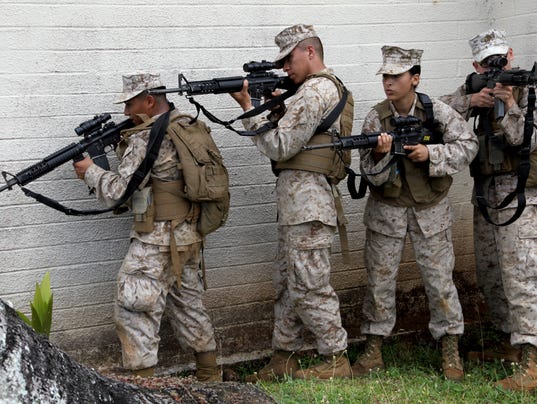
CLD trains for urban warfare

Marines from Okinawa plan to conduct urban environment training in Guam next month, which could create noise in some villages. The Marine Corps officer in charge of the operation, Col. Daniel H. Wilson, on Tuesday issued the following open letter to Guam in connection with the training:

By now you may have heard that a small force of Marines and sailors are scheduled to conduct a training exercise in Guam next month. As the Officer in Charge of this exercise, I would like to explain to you what we have in mind and why your community is so important to us.

The 31st Marine Expeditionary Unit (MEU) is the fighting force for the Okinawa-based Bonhomme Richard Expeditionary Strike Group, set to deploy in the Asia-Pacific region. Typically, a MEU’s mission is to serve as a sea-based quick-reaction force, ready to respond to any crisis that occurs in its area of operations.

Many of the Marines you may see in the coming few weeks have served all over the world but we also have new Marines preparing to make their first deployment. Their lives and the success of our future missions depend on the training we accomplish during our work-ups in your community.

Months prior to deploying, an MEU begins training intensively for a multitude of separate and distinct missions which it must be ready to execute at any time. We conduct much of that training at our home bases in Okinawa and aboard Navy ships at sea; however, we cannot adequately prepare to operate in an unfamiliar environment without moving out of our comfort zone and into areas like yours with which we are not familiar.

Marines are trained to fight in every clime and place. For desert training, we go to Twentynine Palms, California. For cold-weather and mountain-warfare training, we head to Bridgeport, California, or Norway. For jungle-warfare training, we’ve sent Marines to Panama, the Philippines, Thailand, and Okinawa.

Training in an urban environment, though, is the most challenging situation we are likely to face. Maneuvering in a heavily congested area, identifying threats lurking in windows and around street corners, trying to tell whether a car speeding toward a vehicle checkpoint is a real threat or a simple mistake, are just a few examples of the challenges Marines face in an urban setting.

Our aim in Guam is to expose our Marines to realistic scenarios and stresses posed by operating in an actual urban environment, thereby increasing their proficiency in built up areas. Operating in Guam provides us with conditions we are not able to replicate aboard our home base.

The exercise runs from January 6 to 16. While most of the activity will take place aboard Navy installations, residents of the island could see Marines periodically throughout the exercise and are likely to notice increased military activities on the 13th and 15th of January.

We have coordinated our plans through the appropriate territorial agencies and village officials including the Guam Police Department, Guam Fire Department, the Office of Homeland Security, and Village Mayors to ensure the safety of residents and to minimize any impact on the community.

We understand that our presence may briefly raise the noise level in some villages and we greatly appreciate your patience and understanding. We hope you will bear with us as we complete this critical training exercise. Finally, we hope that what you observe will make you as proud as we are to serve on your behalf.

Monday, October 24, 2011

‘Webb Letter Gives False Hope on Military Realignment’

Monday, 24 October 2011 00:42 by Therese Hart | Variety News Staff

GUAM Delegate Madeleine Z. Bordallo last week said a recent letter sent by U.S. Senator Jim Webb to Secretary of Defense Leon Panetta regarding the realignment of U.S. forces in Okinawa “gives false hope that the issue of realigning U.S. forces in Japan can be revisited.”

In addition, Bordallo said the letter is “unhelpful to Japan Prime Minister Yoshihiko Noda’s efforts in trying to obtain consensus on these issues in Japan.”

In his letter, Webb urged Panetta to “re-examine carefully” alternatives to resolve the 15-year dispute surrounding U.S. military bases in Okinawa, stating the dispute is “the most serious defense and foreign policy issue facing our foremost ally in the Pacific.”

Last Friday, Panetta left for the Asia-Pacific region to attend meetings in Tokyo with Japanese government officials.

Webb wrote that the U.S. alliance with Japan “has long served as an absolutely crucial element in guaranteeing the stability of East Asia ... but despite well-intentioned efforts on both sides, there are credible concerns that the provisions of the 2006 agreement between our two national governments are not capable of a timely, cost-effective, politically agreeable and strategically viable implementation.”

Webb further wrote that the U.S.’ failure to resolve “the issue of American bases on Okinawa has resulted in a volatile political debate in Japan, the implications of which should not be underestimated by American leaders. It is in our national interest that this matter be resolved both quickly and smartly, for the well-being of our alliance and the stability of the region.”

Recommendations


Webb mentioned in his letter that five months ago, he, along with Senators Carl Levin and John McCain, sent recommendations to then-Secretary of Defense Robert Gates.

“With regard to basing in Okinawa, we recommended that the Department examine the feasibility of moving U.S. Marine Corps aviation assets assigned at Futenma into Kadena Air Base, while dispersing a percentage of Air Force assets now at Kadena to other locations in the Pacific region, including Andersen Air Force Base in Guam,” wrote Webb.

Webb said his recommendations were based on many years “of careful consideration dating to my time in the Pacific as a military planner during the 1970s,” in addition to two visits to Okinawa and Guam during the past 20 months.

“I have also made three visits to Tokyo during that period, and have hosted numerous meetings with Japanese officials here in Washington. I believe this alternative for Futenma is the most workable, cost-effective and least intrusive approach to resolving the most serious defense and foreign policy issue facing our foremost ally in the Pacific region.”

Webb stated he was aware that resolving the Okinawa basing issue would require stiff political debate with different interest groups in the U.S. and in Japan. Webb wrote he was also aware that any change in the American basing structure threatens institutional "turf" areas within the U.S. military.

Webb added, “At the same time, Senator Levin and I were told repeatedly by officials at the highest level of DOD and the uniformed military that there are deep concerns regarding the affordability and workability of the 2006 Roadmap Agreement for basing on Okinawa and Guam, even though our two national governments seem unable to admit this publicly. Thus, my sole purpose in raising this matter with you is to encourage the formulation of a reasonable and timely solution that will guarantee a credible U.S. presence in this vital part of the world, well into the future. I would suggest that you seriously re-examine carefully the proposals that Senators Levin, McCain and I put forward last May.

I would also suggest that you look at the possibility of our military contingency plans including the option of sharing non-American aviation facilities on Okinawa, which were specifically called for in the 2006 Roadmap Agreement.”

Webb further wrote, “As you know, the Senate has expressed strong interest in these matters, as reflected in legislative provisions in both the Senate versions of the Fiscal Year 2012 National Defense Authorization Act and the Fiscal Year 2012 Military Construction and Veterans Affairs Appropriations Act. I hope you will keep this in mind during your discussions with government officials in Japan.”

Wednesday, October 12, 2011

Activists to Protest Fighter Training

WEDNESDAY, 12 OCTOBER 2011 05:00 BY THERESE HART | VARIETY NEWS STAFF

A LOCAL activist group, Taotaomona Native Rights, is hosting two peaceful protests today and one tomorrow to oppose the U.S. military’s transfer of fighter jet training exercises from Okinawa to Guam.

The exercises were transferred in order to spare residents of Okinawa from the loud noise and harmful effects of the noise pollution created by the jets.

But Trini Torres, Pilong Maga' Haga, said the protests are necessary to call attention to the harm these fighter jets will create and the negative impact to Guam residents living in these areas over which the fighter jets will be flying.

“They are doing things to us without asking our permission, and we can’t just keep quiet,” Torres said.

The military recently announced that approximately 400 military personnel, including those from Marine Aircraft Group 12, will participate in air-to-air and air-to-ground jet fighter training maneuvers on Guam. These training procedures used to be held in Okinawa Prefecture, but Okinawa residents have voiced their protests over the loud noise of the maneuvers.

The activist group is inviting island residents to join them during the protests. The first is scheduled today from 2 to 3:30 p.m. in front of the Legislature.

The second will be held also today at 4 to 6 p.m. across and in front of Guam Delegate Madeleine Z. Bordallo’s office in Hagåtña.

Tomorrow, the group will hold a similar protest from 3:30 to 6 p.m. across the Andersen Air Force Base front gate.

“Senators and Congresswoman Bordallo need to stand up for the safety and protection of the people of Guam. At the same time, the U.S. military needs to stop using Guam as its dumping ground and they need to treat the people of Guam with respetu (respect),” said Torres.

Monday, October 10, 2011

Living Along the Fenceline in Jeju

October 6, 2011 by from DMZhawaii.org

The Stars and Stripes reports that “Naval base puts S. Korea’s ‘island of world peace’ in hot spot”:

JEJU ISLAND, South Korea — This country’s southernmost major island is a study in contrasts.

A popular tourist destination, Jeju boasts some of the world’s most beautiful scenery and is one of 28 finalists in an international competition for selection as one of the “New 7 Wonders of Nature.” Yet it’s also home to a number of cheesy tourist stops, including Jeju Love Land, a sexual theme park.

In 2005, the South Korean government officially recognized Jeju as the “island of world peace,” and then-President Roh Moo-hyun said he would do his best to make it a “center of peace in Northeast Asia.” But South Korea is now building a naval base on the island for the expressed purpose of enhancing its ability to police its vital shipping lanes and respond faster to any North Korean threats.

Critics suggest that once the base opens in 2014, the U.S. will use it extensively, with the goal of keeping an eye on China. That, they say, could make the “island of world peace” a target the next time hostilities erupt in the region.

[...]

The base could also prompt China to hasten the buildup of its naval firepower, further heightening tensions on the Korean peninsula, [Yang Mu-jin, a professor of politics and unification studies at the University of North Korean Studies in Seoul] said.

The South Korean government has tried to downplay the social and political implications of the base and have even drawn comparisons to the U.S. military in Hawai’i as an example of good military-civilian relations:

“The project is not aimed at building a military-only base for war,” the ministry’s August report said. “It is targeted at preventing war by strengthening maritime sovereignty, realizing peace and supporting other naval warships of South Korea.”

Pointing to other “successful civilian-military harbor complexes” like those in San Diego and Hawaii, the defense ministry said the naval base and the island of world peace “both can coexist in (a) mutually complimentary manner.”

But in Hawaiʻi, we know that this is rubbish. The military has taken a terrible toll on local communities and the environment. It was the force that drove the regime change and occupation of the sovereign and independent Kingdom of Hawaiʻi. The South Korean Defense Ministry erroneously referred to “successful civilian-military harbor complexes” in Hawaiʻi. Pearl Harbor is not accessible for civilian use. Warning signs along the shoreline of Ke Awalau o Pu’uloa make it clear that despite Hawai’i's otherwise strong shoreline public access laws, the water is off limits.

Meanwhile, the documentary film “Living Along the Fenceline”, which was screened at the 12th annual Women’s Film Festival in Jeju, exposes the social and environmental costs of military bases around the world, including Hawaiʻi. Director Lina Hoshino and Co-producers Gwyn Kirk and Deborah Lee attended the film festival. The Jeju Weekly reports:

One expat asked the most provocative question of the evening. He asked Ms. Kirk if she thought Jeju Island and its forthcoming naval base represented an inevitable pattern around the world for the creation of more military bases. Ms. Kirk answered she believed the US will inevitably want to build more bases if US imperialism continues to grow. She conveyed that if we can imagine a different kind of future that actively addresses climate change, use of resources, etc… then it is not inevitable. We need a change in leadership and attitude in the US and US allies, including South Korea, who should refuse to have a US military base in the country.

Answering another question, Ms. Kirk said today the United States government spends half of its tax dollars on the world military system, not including the cost of the wars in Iraq and Afghanistan. A grassroots campaign advocates spreading the money from the defense budget to other social programs including education, health care, care for children, the elderly, and people with disabilities, and domestic violence shelters. Unfortunately, these programs are being cut because of the economic crisis. But, the military budget remains intact.

Secondly, Ms. Kirk said there is another campaign to educate people about the military worldwide. People are unaware about the US’s worldwide military presence and are often shocked by the actual number of bases. This film is part of this education campaign.

Ms. Kirk hopes the film inspires people to think about what a military base means in their communities. She said it is important for people to be clear what happens when a military base is installed in a new location. She said, “It is tempting to think military bases will bring jobs. The reality is military spending generates the fewest amount of jobs of any government spending.” The military is a capital intensive industry, not a human capital intensive industry. The same amount of money spent on a military base spent on education or health care would generate far more jobs.

Friday, October 07, 2011

Of Bases and Budgets

Published on Friday, October 7, 2011 by Foreign Policy in Focus

by Christine Ahn and Hyun Lee

At 4 am on September 24, an intoxicated U.S. soldier based at Camp Casey in South Korea broke into the dorm of a high school student, threatened her with a weapon and repeatedly sexually assaulted her. Due to the extraterritoriality of the Status of Forces Agreement (SOFA) between the South Korean and U.S. governments, Seoul must issue an arrest warrant to the U.S. Forces in Korea (USFK) to transfer the soldier to face Korea’s criminal system.

This tragic incident presents a critical opportunity to question why, after 66 years, 28,500 U.S. troops still remain on 87 bases and installations on the Korean peninsula and whose security they are safeguarding. The same questions are being raised in Okinawa and Guam, islands in the Asia Pacific with large U.S. bases.

Although the economic crisis facing America has called into question the bloated military budget, it is the first time in U.S. history that Congress is discussing the prohibitive costs of U.S. bases. Given growing popular opposition throughout the Asia Pacific to the ongoing presence of U.S. bases, the time is now to seize this rare political window to close down U.S. bases worldwide.

High Cost of U.S. Bases to People of Asia Pacific

As in the past, the USFK will attempt to call the rape another case of a bad apple, when in fact U.S. troops in Korea have a long history of committing heinous crimes against Korea’s civilian population.

In 1994, South Korean civil society began to mobilize after U.S. soldier Kenneth Markle brutally murdered 27-year old Yoon Keum E. whose bloody body covered with white laundry detergent was found dead with an umbrella shoved up her anus and two beer bottles in her womb. This unspeakable violence forced the Korean people to question the so-called protection provided by the U.S. military and the unequal SOFA arrangements, which enables soldiers to act in impunity.

According to the National Campaign for the Eradication of Crimes by U.S. Troops in Korea, U.S. soldiers have committed tens of thousands of crimes against South Korean civilians since the beginning of its military occupation in 1945. According to South Korean National Assembly member Kim Tae-won, 377 U.S. soldiers were arrested for committing crimes in 2011 alone. Since 2008, the number of rapes doubled, and thefts and assaults tripled. According to the National Campaign for the Eradication of Crimes by U.S. Troops in Korea, U.S. soldiers have committed tens of thousands of crimes against South Korean civilians since the beginning of its military occupation in 1945.

But it’s not just interpersonal violence Koreans endure. U.S. bases have also borne significant social and environmental costs. In 2006, after nearly a 1,000-day long struggle, the South Korean government demolished the homes and fertile farmland of elderly rice farmers in Pyeongtaek for the expansion of Camp Humphreys. This past May, three U.S. veterans confessed to dumping barrels full of Agent Orange in an area the size of a football field at Camp Carroll. Today, Gangjeong farmers and fishermen on Jeju Island are fighting to save their village from becoming a naval base that will stage Aegis destroyers linked to the U.S. missile defense system.

Unfortunately, sexual violence and crimes committed by U.S. troops against civilians haven’t been restricted to South Korea. Okinawa, a prefecture of Japan, has also borne similar costs due to the ongoing presence of U.S. military bases. Although Okinawa accounts for only 0.6 percent of the entire land area in Japan, it is home to 74 percent of U.S. military facilities in Japan. Women for Genuine Security estimates that 37 U.S. bases and installations in Okinawa house 23,842 troops and 21,512 family members.

According to Suzuyo Takazato of Okinawa Women Act Against Military Violence, from 1972 to 2005, U.S. soldiers committed over 5,500 crimes against civilians, although many Okinawans say the number is actually much higher because women and girls rarely report crimes such as sexual violence. Only some 700 U.S. soldiers have been arrested. Since U.S. troops first landed on the island, Okinawans have been demanding their removal. In 1995, the resistance gained steam after three U.S. servicemen abducted and raped a 12-year-old girl.

In 1996, Tokyo and Washington agreed that the United States would return the land used by the Futenma Air Force base and build a replacement facility in Nago City’s Henoko Bay. But Okinawans have opposed this plan through every democratic means—elections, referenda, rallies, and public opinion polls. In 1997, Nago citizens voted in a referendum opposing the construction of the new U.S. base. In a May 2010 poll, 84 percent of respondents opposed this move, which would destroy Henoko’s ecological preserve. And recently, Nago’s 60,000 people elected a mayor who strongly opposes the base.

Given the fierce opposition to the base relocation, the Japanese government signed a deal in 2006 with Washington to transfer 8,000 U.S. marines and their families from Okinawa to Guam, or Guahan in its native language Chamoru, at a price of $27 billion. According to Lisa Natividad of the Guahan Coalition for Peace and Justice, the infusion of these additional marines, their families, and support workers to Guam’s population of 170,000 would grow the island population by 30 percent. “It will double the existing military presence on the island and will eclipse the Chamoru population,” says Natividad.

Since the announcement of the military build-up, Guahans actively led grassroots public education campaigns on the consequences to their culture and environment. Their organizing has begun to pay off. According to Natividad, the Pentagon received an unprecedented 10,000 comments of concern in 2009—6.5 percent of Guahan’s total population—about the planned Guam military build-up. Two civil society organizations—We Are Guahan and the Guam Preservation and Historic Trust—have filed a lawsuit to prevent the use of Pagat village as a live firing range.

Cost of U.S. Bases to America

For the first time in history, the call for closing bases and shifting priorities may actually have the ear of lawmakers on Capitol Hill as they cope with the nation’s intensifying budget crisis and take the unprecedented step of putting the Pentagon budget on the chopping block. Senator Tom Coburn (R-OK) proposes to save $69.5 billion by reducing military personnel overseas in Europe and Asia. This recommendation, originally made by the National Commission on Fiscal Responsibility and Reform, is aimed at reducing “the military personnel stationed at overseas bases in Europe and Asia by one-third.” Senator Coburn also recommends canceling the deployment of 8,600 U.S. Marines and their 9,000 dependents to Guam from Okinawa. To realign U.S. troops in Japan, Okinawa, and Guam would cost $27 billion.

The Sustainable Defense Task Force also proposes to cut military personnel and bases by one third in Europe and Asia and projects savings of up to $80 billion. “On the Korean peninsula, the gap between adversary and friendly conventional capabilities has grown much more favorable,” it states in Debt, Defense, and Deficits – A Way Forward, released June 2010. “Also, U.S. capacities for long-range strike and for effective rapid deployment of forces have grown greater, reducing the crisis response requirements for troops on the spot.” The Task Force does not view China as a military threat to the United States. Rather, it says, China’s integration into the regional economy means “Beijing does not seek to fracture its relationship with the United States.” It also sees Taiwan and the Mainland as “strongly interdependent economically.”The struggle of farmers and indigenous people against U.S. bases in Guam, Okinawa, South Korea, and elsewhere, and the struggle of working people for jobs, healthcare, and education here at home are opposite sides of the same coin.

In May, three ranking members of the Senate Armed Services Committee—Senators Carl Levin (D-MI), Jim Webb (D-VA), and John McCain (R-AZ)—called on the Pentagon to “re-examine plans to restructure U.S. military forces in East Asia” because they were “unrealistic” and “simply unaffordable in today’s increasingly constrained fiscal environment.” Their recommendations include putting on hold plans to expand Camp Humphreys in Pyongtaek, South Korea to support tour normalization, scrapping the relocation of Futenma in Okinawa, and scaling back plans for base expansion in Guam. “The proposals would save billions in taxpayer dollars,” stated the letter from the Senators. Last month, during Deputy Defense Secretary Ashton Carter’s confirmation hearing, Senator Levin asked whether the closure of some bases and bringing home U.S. troops was on the table. Carter responded that indeed, it was “on the table.”

Time to Link Arms

The struggle of farmers and indigenous people against U.S. bases in Guam, Okinawa, South Korea, and elsewhere, and the struggle of working people for jobs, healthcare, and education here at home are opposite sides of the same coin. The vibrant energy and creative talents of our nation’s youth are needed here to build hospitals and schools and revitalize local communities, not on unpopular bases abroad that displace indigenous populations.

It’s time to link up our demands – shut down bases abroad and create jobs here at home. Although oceans apart, we have more at stake in each other’s struggles than we may think. And Washington’s budget debate provides an opening for us to link arms and demand a change in the nation’s priorities.

Movements for peace and economic justice across the Asia Pacific are strengthening their ties by organizing two important convenings: “Peace in Asia and the Pacific: Alternatives to Militarization conference in Washington, DC on October 21-22; and Moana Nui: Pacific Peoples, Lands and Economies gathering from November 9-11 timed with the APEC Summit in Honolulu, Hawaii.

In the long term, the U.S. peace and social justice movement must press to change the fundamental mission of the U.S. military around the world. For now, we can start by impressing on the U.S. public and policymakers the urgency of people’s struggles against U.S. bases abroad as well as the high cost of maintaining them and what that means for the American people.

Wednesday, September 07, 2011

Connecting Aegis Dots Between Jeju, Okinawa, Guam, Hawai'i

September 5, 2011 by from DMZhawaii.org

Koohan Paik, co-author of the Superferry Chronicles and member of the Kaua’i Alliance for Peace and Social Justice wrote an excellent op ed in the Garden Island newspaper connecting the dots between the military expansion at the Pacific Missile Range Facility on Kaua’i, the struggle to stop a naval base in Jeju, South Korea, and protest movements in Okinawa and Guam.

True defenders

When I was a child in South Korea during the 1960s, we lived under the repressive dictatorship of Park Chung-hee. Anyone out after 10 p.m. curfew could be arrested. Anyone who tried to protest the government disappeared. A lot of people died fighting for democracy and human rights.

Today, the South Korean people carry in living memory the supreme struggles that forged the freedom they currently enjoy. And after all they’ve sacrificed, they are not going to give that freedom up.

So it is no surprise that the tenacious, democracy-loving Koreans have been protesting again — this time for over four years, non-stop, day and night. They are determined to prevent construction of a huge military base on S. Korea’s Jeju Island that will cement over a reef in an area so precious it contains three UNESCO World Heritage Sites.

This eco-rich reef has not only fed islanders for millennia, but it has also been the “habitat” for Jeju’s lady divers who are famous for staying beneath the surface for astonishing periods of time, before coming up with all manner of treasures. Even during South Korea’s times of unspeakable poverty, subtropical Jeju Island was always so abundant with natural resources and beauty that no one ever felt “impoverished” there.

There happens to be a very strong connection between Jeju’s current troubles and business-as-usual on the Garden Isle. You see, the primary purpose of Jeju’s unwanted base is to port Aegis destroyer warships. And it is right here, at Kaua‘i’s Pacific Missile Range Facility, that all product testing takes place for the Aegis missile manufacturers.

On Aug. 29, when Sen. Dan Inouye was here to dedicate a new Aegis testing site, he said, “We are not testing to kill, but to defend.” It would have been more accurate if Inouye had said, “We are not testing to kill, but to increase profits for Lockheed Martin and Raytheon, no matter how many people are oppressed or how many reefs are destroyed.”

Four days later, on Sept. 2, I got a panicked call from a Korean friend that there had been a massive crackdown on the peace vigil in Gangjung village to protect Jeju’s reef from the Aegis destroyer project.

More than 1,000 South Korean police in head-to-toe riot gear descended upon men and women of all ages blockading construction crews from access to the site. At least 50 protestors were arrested, including villagers, Catholic priests, college students, visiting artists and citizen journalists. Several were wounded and hospitalized. My friend told me, “We fought so hard for democracy. And now this. It’s just like dictatorship times.”

Another reason the Koreans are so angry is that their government has been telling them that the Aegis technology will protect them from North Korea. But Aegis missiles launching from Jeju are useless against North Korea, because North Korean missiles fly too low. In a 1999 report to the U.S. Congress, the Pentagon verified that the Aegis system “could not defend the northern two-thirds of South Korea against the low flying short range Taepodong ballistic missiles.”

So if Aegis is no good against North Korea, why build the base? Again, this is not about defense, this is about selling missiles (and increasing profits for Samsung and other major contractors on the base construction job).

There is a strong similarity between resistance on Jeju (where a recent poll showed 95 percent of islanders are opposed to the base) and concurrent uprisings on Guam and Okinawa, as well. All three islands are slated for irreversible destruction to make way for Aegis destroyer berthing.

And who wouldn’t protest? Like us, these are island peoples who care passionately for their reefs, ocean ecosystems and fisheries. I have heard certain Jeju Islanders say they will fight to the death to protect their resources.

Today, the mayor of Gangjung himself, along with many others, languish in prison because of their uncompromising stance against the Aegis base. Fortunately, people across the Korean peninsula and beyond, are heading to Jeju to support the resistance movement.

Without peaceful warriors like them, there would be no more reefs, no more coral, no more fish, no more nothing. They are our true defenders, not the missile manufacturers, as Inouye’s sham logic would have us believe.

As the Pentagon conspicuously ramps up militarization in the Asia-Pacific region, individuals of good conscious should pursue de-militarization. In the words of Aletha Kaohi, “Look to within and get rid of the ‘opala, or rubbish.”

Koohan Paik, Kilauea

Wednesday, January 05, 2011

Solidarity Actions to Protest US Military Expansion in Takae (Okinawa)

January 3, 2011 by kyle from DMZhawaii.org

U.S. military helicopters buzzed the peace encampment near the Yambaru forest in Takae, at the northern end of Okinawa. Construction of the jungle warfare training area has begun. This is another site of community resistance to U.S. military base expansion in Okinawa, but it has gotten far less media attention than Futenma and Henoko. Groups in Japan are mobilizing to protest the U.S. expansion of training in the rainforest of Yambaru. They requested international groups to send messages of solidarity:

Email your message/request to: no.base.okinawa@gmail.com

Please include in your email the following information:

*** Name (for an individual) or name of your organization
*** Your message/request (length is up to you)

Both Japanese and English messages will be accepted.

(日本語ではこちらをご覧ください。)
Please Join Us in Our Action for Preserving the Pristine Yanbaru Forest and People of Takae, Okinawa!

We invite you to join us in our protest at the U.S. Embassy in Tokyo over the restart of the U.S. helipads construction in Takae, Higashi Village of Okinawa, and the destruction of the sit-in tent by a U.S. helicopter, either by sending us your message/request to the US Embassy by email by January 8, or physically joining our action on January 10 in Tokyo (see instruction at the bottom).

The Yambaru Forest is a habitat for endangered species such as Yambaru Kuina (Okinawan Rail) and Noguchi Gera (Okinawan Woodpecker). It is known internationally as a region rich in biodiversity. Takae, situated in Yambaru, is a small village of about 160 residents, including many who moved here for its pristine nature.

However, the U.S. Marine Corps has been using the Yambaru Forest for combat training. In 1957, th US military started using the area as “Northern Training Area” (Jungle Warfare Training Center), and currently there are 15 U.S. helicopter takeoff and landing zones (helipads) in Higashi Village. Residents of Takae have constantly suffered from the noise and the risk of helicopter crashes. To make matters worse, the Japanese and US governments decided to build 6 new helipads, surrounding the residential neighborhood of Takae.

Construction of new helipads will not only further endanger the livelihood and lives themselves of Takae residents, but also further destroy the precious environment with its wealth of species, forest and rivers. New military facilities also pave the way to the possibility of a new war. Residents of Takae have protested against the helipads construction for the above reasons. In 2006, we passed a resolution against the new helipads, and demanded of the relevant authorities that they review the construction plan. Takae residents and their supporters from across Japan and from around the world have continued to sit-in, monitoring the site and trying to persuade the government against the construction.

The Japanese and US governments, however, have not listened to the voices of opposition by the residents, and have not provided sincere explanation or proper opportunities for public hearing. The Japanese government even decided, all of a sudden, to prosecute some of the local protesters for obstructing traffic.

Just before dawn on December 22, 2010, at 6:30 AM, some 100 members of the Okinawa Defense Bureau, ignoring the ongoing court proceedings, barged into the site without warning to restart the helipad construction. On the next night, December 23rd, a US helicopter hovered only 15 meters above the sit-in tent, causing the tent to blow down. Such military exercise over a public road threatens the safety of local residents. The Japanese and US governments are harming the people of Takae by forcing through the construction work without sufficient explanation or consent by local residents. Such an approach by the two governments is unacceptable.

Residents of the Henoko district in Nago City, where the Japanese and US governments plan to build a replacement base for MCAS Futenma, have also been sitting-in for over 2,400 days, in order to preserve their life and the beautiful ocean. We urge you also to say “NO” to the new base plan in Henoko.

Following our protest to the Ministry of Defense on December 22 and the December 26 demonstration in Shinjuku, “Save Takae/Okinawa – an urgent appeal and demonstration against construction of helipads,” we will go to the US Embassy in Tokyo and the Japanese Ministry of Defense on January 10 (Mon.), 2011, to protest. We would like to collect as many requests/demands as possible and deliver them to the US government. We accept both individual and organizational messages. Just one sentence message, such as “We do not need US helipads in the pristine forest” will suffice, or a longer message is welcome too. The Takae and Henoko issues are not just about war and military bases, but they are also about environmental preservation, biological diversity, and an alternative, “slow-life” lifestyle. Please express your message in your own words. Please follow the below instruction and send your message by January 8, 2011.

With our voices and with our actions, let us stop the helipad construction in Takae, and the base construction in Henoko. Let us bring a peaceful and fulfilling life to Takae and Henoko!

(The original document in Japanese is at: http://takae.ti-da.net/e3296164.html. Translated by Norimatsu Satoko and Gavan McCormack)

Tuesday, January 04, 2011

F-15s to train in Guam

WEDNESDAY, 05 JANUARY 2011 01:45 BY THERESE HART | VARIETY NEWS STAFF

* Okinawa training function moved to Guam

Photo shows an Air Force F-15 flying a patrol mission. Japanese media has reported that some training functions of F-15 fighters stationed at Kadena Air Base in Okinawa will be moved to Guam. (U.S. Air Force photo)

A recent agreement between Japan and the United States would move some training functions of F-15 fighters stationed at Kadena Air Base in Okinawa to Guam, according to a report from the Yomiuri Shimbun.

The airbase is home to two F-15 squadrons of the U.S. Air Force’s 18th Wing. The move is expected to happen this year, according to Japanese government sources cited by the report.

If final approval is granted, it will be the first time exercises of U.S. forces stationed in Okinawa Prefecture have been moved out of that country.

U.S. Defense Secretary Robert Gates and Defense Minister Toshimi Kitazawa are expected to finalize the agreement on Jan. 13 during a two-day visit by Gates to Japan.

The agreement is seen as a type of offering to Okinawa as a reduction of the “burden borne by the prefecture in hosting U.S. bases, and hopes to use it as a beachhead to get the prefecture's cooperation on the stalled plan to relocate the U.S. Marine Corps' Futenma Air Station within the prefecture,” the sources said.

The U.S. has kept two fighter squadrons -- each currently comprised of 24 F-15s -- permanently stationed at the Kadena base, which is one of the United States' largest strategic military locations outside the U.S. mainland.

Local residents in Okinawa have often complained of the noise pollution produced by the base's aircraft.

The Japanese government has been trying to have the United States move the training functions of as much as one full F-15 squadron to Guam.

The sources said fuel and other costs associated with the transfer of exercises will be financed by the exercise-relocation portion of the so-called “sympathy budget,” which are funds paid by Japan to cover the costs of having U.S. forces stationed in this nation.

The special supplemental accord to the Japan-U.S. Status of Forces Agreement that is the legal basis for the sympathy budget will expire at the end of March, so the relocation costs will be incorporated in a new agreement that will come into effect from fiscal 2011, which starts on April 1, according to the Yomiuri Shimbun.

U.S. Secretary of State Hillary Clinton and Foreign Minister Seiji Maehara are expected to confirm the basic agreement on the transfer during a five-day visit to the United States by Maehara, scheduled to begin Thursday, according to the sources.

Maehara plans to sign a draft accord with U.S. Ambassador to Japan John Roos shortly.

The government hopes the accord will gain Diet approval by the end of March, during the ordinary Diet session that begins this month.