Showing posts with label Military. Show all posts

Thursday, January 14, 2016

More than 1,800 Arriving in Guam for Military Drill

Published by Pacific Daily News on January 13, 2016

Written by Gaynor Dumat-ol Daleno

_


Guam will host more than 1,800 military personnel from the United States, Australia, Japan, New Zealand, the Philippines and South Korea for the annual massive military exercise Cope North.

Andersen Air Force Base is hosting Cope North on Feb. 10 through 26, the U.S. Air Force announced.

In a separate announcement, the Air Force’s Pacific Command confirmed that 12 F-16 Fighting Falcon jets and about 200 airmen are arriving for a temporary deployment in Guam this month as part of a rotational movement of U.S. forces.

The 200 airmen who are being deployed to Guam are from the 112th Fighter Squadron from Toledo Air National Guard Base in Ohio.

The Ohio airmen and their Expeditionary Fighter Squadron will move to Guam temporarily to assume a mission that the 125th Expeditionary Fighter Squadron, whose base is Tulsa, Oklahoma, is currently serving out of Kadena Air Base, Japan.

The airmen from Oklahoma are scheduled to return to the Tulsa Air National Guard Base in Oklahoma, but 12 of their F-16 Fighting Falcons will move to Andersen for the airmen from Ohio to operate.

Open House

Andersen Air Force Base will open its doors to the general public to attend an open house featuring static displays and flyovers during Cope North, according to the Air Force Pacific Command.

The open house will be held from 9 a.m. to 3 p.m. on Feb. 20.

Aircraft static displays, such as the U.S. Air Force B-52 Stratofortress and F-16 Fighting Falcon, Japanese Air Self-Defense Force F-2 Viper Zero and Royal Australian Air Force F/A-18F Super Hornet will be featured.

The open house also will feature entertainment, vendors and concessions, according to the Air Force.
Updates will be posted on the event's Facebook page. the Air Force said.

Multinational exercise

More than 100 aircraft from the U.S. military and its allies also are expected to arrive for the exercise, which Andersen is hosting for the 16th year.

This year’s Cope North will include humanitarian assistance and disaster relief training and air-to-ground practice airstrikes.

The 206-acre island of Farallon de Medinilla, in the Northern Marianas, which the U.S. military has leased for a bombing range, will be the target for the airstrikes.

The annual exercise comes in the wake of North Korea’s most recent and fourth underground nuclear bomb tests, and amid unresolved multi-country territorial disputes following China’s expansions in the South China Sea.

On Saturday, a U.S. B-52 bomber aircraft from Andersen was joined by South Korean F-15 and U.S. F-16 fighter jets in a low flyover over South Korea, near the North Korean border.

Adm. Harry B. Harris Jr., commander of the U.S. military’s Pacific Command, said in a press release the flyover “was a demonstration of the ironclad U.S. commitment to our allies in South Korea, in Japan, and to the defense of the American homeland.”

Cope North began in 1978 as a quarterly bilateral exercise held at Misawa Air Base, Japan. Cope North was moved to Andersen in 1999, according to the Air Force.

“Today, the annual exercise serves as a keystone event to promote stability and security throughout the Indo-Asia-Pacific region by enabling regional forces to hone vital readiness skills critical to maintaining regional stability,” according to the Air Force.

More than 930 U.S. airmen and sailors will train alongside approximately 490 Japanese, 375 Australian, five Filipino, 20 South Korean and 35 New Zealand service members, according to the Air Force.

Monday, January 04, 2016

If Top General Gets His Way, America's "Longest War" Will Become Even Longer

General John Campbell Says He Wants to Keep U.S. Troops in Afghanistan for as long as possible—and is considering asking for even more

Published on Wednesday, December 30, 2015 by Common Dreams

Written by Sarah Lazare

General John F. Campbell pictured in Kabul, Afghanistan, Saturday, May 23, 2015. (Photo: Allauddin Khan/AP)

If the highest ranking U.S. and NATO military commander in Afghanistan gets his way, America's longest official war could become even more protracted.

Army General John Campbell said in a USA Today article published on Tuesday that he wants to keep the 9,800 American troops currently in Afghanistan there for as long as possible—and is considering asking for even more boots on the ground.

"My intent would be to keep as much as I could for as long as I could," Campbell told the paper from Kabul.

The general's comments follow President Barack Obama's October announcement that he plans to reverse his prior pledge to remove all but 1,000 U.S. troops from the country by the conclusion of 2016. Instead, Obama proclaimed that the 9,800 troops will be maintained through most of 2016 and then cut to 5,500 by the beginning of 2017.

Even then, Obama's statement came despite the official declaration a year ago that the war was "over."

But now Campbell plans to ask the president to put off troop withdrawals even further by delaying the reduction to 5,500 troops.

"If I don't believe that we can accomplish the train, advise and assist... the (counter-terrorism) missions, then I owe it to the senior leadership to come back and say, 'Here's what I need,'" Campbell said. "If that's more people, it's more people."

The general expressed confidence that he will get his way. "My job as commander on the ground is to continually make assessments," Campbell said. "Every time I've gone to the president and said, 'I need X,' I've been very, very fortunate that he’s provided that. So he’s been very flexible."

Campbell's comments come as the U.S.-led war in Afghanistan stretches well into its 15th year—and appears certain to extend into the next presidency. While many argue that the Afghanistan intervention is not, in reality, the longest war in U.S. history, it is widely recognized as the most protracted according to the official record.

What's more, the Bilateral Security Agreement signed in 2014 by the U.S. and Afghanistan locks in another decade of heavy American involvement in the country, including the training, funding, and arming of the Afghan military. The pact also secures immunity for U.S. service members under Afghan law—a highly controversial measure in a country that has suffered civilian massacres by U.S. troops.

The U.S. is planning a military role long into Afghanistan's future despite indications that its long-term intervention and occupation so far has worsened conflict and violence, with the Taliban now showing signs of increased strength.

Meanwhile, Afghan civilians continue to pay the greatest price. In the first half of 2015 alone, United Nations agencies documented 4,921 civilian casualties (1,592 deaths and 3,329 injured).

Saturday, December 26, 2015

Marines Plan Guam Exercise in January

Published by Pacific Daily News on December 23, 2015

CLD trains for urban warfare

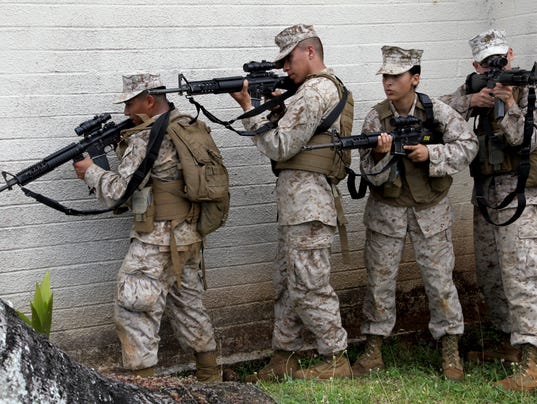
Marines from Okinawa plan to conduct urban environment training in Guam next month, which could create noise in some villages. The Marine Corps officer in charge of the operation, Col. Daniel H. Wilson, on Tuesday issued the following open letter to Guam in connection with the training:

By now you may have heard that a small force of Marines and sailors are scheduled to conduct a training exercise in Guam next month. As the Officer in Charge of this exercise, I would like to explain to you what we have in mind and why your community is so important to us.

The 31st Marine Expeditionary Unit (MEU) is the fighting force for the Okinawa-based Bonhomme Richard Expeditionary Strike Group, set to deploy in the Asia-Pacific region. Typically, a MEU’s mission is to serve as a sea-based quick-reaction force, ready to respond to any crisis that occurs in its area of operations.

Many of the Marines you may see in the coming few weeks have served all over the world but we also have new Marines preparing to make their first deployment. Their lives and the success of our future missions depend on the training we accomplish during our work-ups in your community.

Months prior to deploying, an MEU begins training intensively for a multitude of separate and distinct missions which it must be ready to execute at any time. We conduct much of that training at our home bases in Okinawa and aboard Navy ships at sea; however, we cannot adequately prepare to operate in an unfamiliar environment without moving out of our comfort zone and into areas like yours with which we are not familiar.

Marines are trained to fight in every clime and place. For desert training, we go to Twentynine Palms, California. For cold-weather and mountain-warfare training, we head to Bridgeport, California, or Norway. For jungle-warfare training, we’ve sent Marines to Panama, the Philippines, Thailand, and Okinawa.

Training in an urban environment, though, is the most challenging situation we are likely to face. Maneuvering in a heavily congested area, identifying threats lurking in windows and around street corners, trying to tell whether a car speeding toward a vehicle checkpoint is a real threat or a simple mistake, are just a few examples of the challenges Marines face in an urban setting.

Our aim in Guam is to expose our Marines to realistic scenarios and stresses posed by operating in an actual urban environment, thereby increasing their proficiency in built up areas. Operating in Guam provides us with conditions we are not able to replicate aboard our home base.

The exercise runs from January 6 to 16. While most of the activity will take place aboard Navy installations, residents of the island could see Marines periodically throughout the exercise and are likely to notice increased military activities on the 13th and 15th of January.

We have coordinated our plans through the appropriate territorial agencies and village officials including the Guam Police Department, Guam Fire Department, the Office of Homeland Security, and Village Mayors to ensure the safety of residents and to minimize any impact on the community.

We understand that our presence may briefly raise the noise level in some villages and we greatly appreciate your patience and understanding. We hope you will bear with us as we complete this critical training exercise. Finally, we hope that what you observe will make you as proud as we are to serve on your behalf.

Wednesday, February 10, 2010

Senator Pangelinan Says Military's Estimates of GovGuam's Revenues During Buildup are Flawed

Senator Pangelinan Says Military's Estimates of GovGuam's Revenues During Buildup are Flawed

Guam - Senator Ben Pangelinan has issued a release saying the military's estimates of GovGuam's revenues during the military buildup are flawed.


According to Pangelinan government economists and bureacrates use a simple financial ratio of general tax revenue to gross island product. The rule of thumb is GovGuam collects 10% of every new dollar invested into the economy after it multiplies through. According to the Draft Environmental Impact Statement Govguam will collect between 42% to 49% of the estimated Gross Island Product during the buildup. Because of this the senator has sent leters to several experts in the private sector, UOG, GovGuam, the Government Accountability Office and the Department of Defense asking them to provide an analysis of the revenue estimates in the DEIS.

Written by :
Clynt Ridgell

Saturday, January 30, 2010

Military's use of landfill could benefit residents

Military's use of landfill could benefit residents

By Steve Limtiaco • Pacific Daily News • January 25, 2010

The military wants to be a customer of the new landfill when it is built, according to the draft Environmental Impact Statement for the military buildup, and that decision could help keep trash fees down for Guam residents, saving them about $20 a month.

The bad news is the current $10 monthly fee, which has been in place during the ongoing registration period, is scheduled to increase to $30 per month by April 2011, and will not decrease, even if the military commits to using the civilian landfill.

The good news is the military's use of the landfill is expected to shield residents from steep price increases during the next decade, so the monthly fee would remain about $30.

Solid waste receiver Gershman, Brickner & Bratton last summer calculated the monthly fee for residential trash collection, with and without the military's participation. The government's solid waste operations are in receivership because the government of Guam failed to close the Ordot dump and build a new landfill, as required in a 2003 consent decree.

Without the military, the monthly fee for residential trash collection would increase to $43 by 2015, then to $52.81 by 2017, according to the receiver's calculations. The $52.81 fee would hold steady for at least five years, through 2022.

And commercial customers would save as much as $118.60 per ton on commercial tipping fees if the military uses the landfill -- $156 instead of $274.60, according to the calculations for the year 2017.

According to the draft EIS for the buildup, the amount of trash that would be generated by the military is significant -- about 40 percent of the trash entering the new landfill would be put there by military customers. The entire island, including the military, is projected to produce 135,849 tons of waste per year, not including recyclable material.

But the projected life expectancy of the new landfill is expected to remain the same -- more than 30 years -- according to the receiver, because public works officials overestimated how much trash was being generated by Guam civilians. That's because there was no accurate way of measuring the trash going into Ordot dump when estimates were made for the new landfill. Trash entering Ordot dump now is weighed on a truck scale.

"It will certainly fill up faster with (the military) but the estimated life will still be well above 30 years," said David Manning, special principal associate for the solid waste receiver. "With the scale system in place, it is now clear that the total waste stream, even when the military is included, are at about the levels originally projected without the military."

In its latest quarterly report to the federal court, the receiver also noted that the military's use of the landfill could benefit the environment by reducing the number of landfills and by providing greater opportunities to work with the military on ways to recycle and minimize the amount of waste being generated here.

According to Manning, the military likely will collect and haul its own trash, even if it becomes a customer of the new landfill. In that respect, it would be similar to a commercial trash hauler.

The receiver has been negotiating with the military on behalf of the local government, and the military in July 2009 signed a letter of intent to use the new landfill.

"The military has consistently indicated that it will continue to handle its own waste collection," Manning said.

Tuesday, January 26, 2010

On Guam, military’s roots run deep

On Guam, military’s roots run deep

Story and photos by Teri Weaver, Stars and Stripes
Pacific edition, Saturday, January 23, 2010

BARRIGADA, Guam — At a deployment ceremony at Guam’s National Guard headquarters last week, Maj. Gen. Donald Goldhorn gave out his personal cell phone number.

It’s the 27th time he’s done that for the families of the island’s Air and Army National Guard members. And it marked the 27th time a unit has deployed from the island since 2003.

About 1,500 members have deployed at least once to either Iraq, Afghanistan, the Horn of Africa, Djibouti or the Philippines, about the same number as total membership in the Guard.

"It has consumed us, quite frankly," said Goldhorn, the Guard’s adjutant general.

The military, in many ways, also consumes Guam.

Already the Air Force and Navy occupy about a third of the 212-square-mile island. The Pentagon wants to add at least 9,182 more troops — including at least 8,000 Marines from Okinawa — more than doubling the current military population of 6,800.

But the island’s relationship with the military runs much deeper. Of the 178,000 residents, more than 10,000 are currently in uniform, according to a report released last week by the island’s Chamber of Commerce.

Another 12,000 veterans live on the island, according to Carl Peterson, a veteran who chairs the chamber’s military affairs committee.

Some members of the Guam guard’s Matua Platoon — officially the 4th Platoon, Company B, 1st Battalion of the 294th Infantry — said Jan. 13 that they’ve been too busy to attend recent public hearings on the buildup.

Instead, they were preparing for a six-month deployment to the southern Philippines to work with Joint Special Operations Task Force-Philippines, which is training the local military and advising it in its fight against al-Qaida-linked terror groups. Two U.S. soldiers were killed there in September from a roadside bomb laid by a group linked to al-Qaida.

Army 2nd Lt. Olin Yaopoqa, the platoon’s leader, said the buildup could bring "a whole spider web of work here." He also noted it could come at a cost.

Guam is less than nine miles wide and a little more than 30 miles long, and "there will be tension, frictions," he said. "There is only so much room to go around."

On Jan. 12, Guam Legislature Speaker Judi WonPat helped hand out USO care packages to the platoon.

Later that night, WonPat spoke at a public hearing in support of "We Are Guahan," a local coalition fighting against the military’s expansion plans. "This military buildup is another example [of Guam] being taken for granted," she said at the hearing.

At the Jan. 12 deployment ceremony, Pete Alvarez sat beside his son, Spc. Peter Alvarez. The senior Alvarez has a daughter serving in Afghanistan.

Alvarez says he’s followed news of the military’s proposed buildup on Guam, but he hasn’t attended the public meetings.

"It’s good for the economy," he said, but he worries about fights among the incoming troops and young men on the island.

For now, "I’m more worried about my kids," the Vietnam veteran said. "Right now, they are more of my priority."

About 200 Guam guard members are deployed around the world, including a squadron with the Guam Air National Guard currently in Baghdad, according to Army Capt. Kenneth Ola, spokesman for the guard.

Staff Sgt. Carl Santos estimates he’s been gone nearly four of the seven years he’s been in the Guard. He said he likes being able to serve and to come home to his home in Dededo.

Santos said he’s followed the complaints about the buildup.

"They are entitled to their opinions," he said.

Yet Santos sees it more from a military vantage point.

"We’re such a strategic location," he said.

For some in Guam, the military’s ability to move in without asking for permission lies at the heart of their opposition to the move.

"We hate being possessions to the federal government," said Carmen Artero Kasperbauer, 74, whose family once owned land now part of Andersen Air Force Base. "That’s why people are angry."

Her anger, she said, is mostly toward leaders in Washington. Guam was originally won by the United States after the Spanish-American war. It remains a territory with a non-voting member of Congress. Registered voters on the island cannot vote for president.

"I’m not talking about the uniformed military. We love the uniformed military," she said, and began listing a family tree that includes her son, an Air Force pilot, her grandson and granddaughter, who are deployed, her brother, a retired submariner, and another brother who was wounded in Vietnam.

"Our son … helped liberate the Kuwaitis," she said. "But he can’t help liberate me."

Sunday, January 10, 2010

Military negotiates with 3 landowners

Military negotiates with 3 landowners

By Brett Kelman • Pacific Daily News • January 11, 2010

The military is already negotiating with the three landowners whose property will most likely be absorbed into the new firing range on Guam's northeast coast.

On Thursday night, retired Maj. Gen. David Bice, executive director of the Joint Guam Program Office, said he was certain the landowners and the Department of Defense will reach an agreement that benefits everyone.

"We've talked to those landowners, and I am very confident that we can reach an agreement," Bice said. "I'm a landowner, I'm a farmer. I know about land rights and property rights ... I am not going to be involved with any process that takes other people's land."

Bice was so certain an agreement would be reached that he declined to discuss what would happen if parties didn't see eye to eye. He would not discuss "speculation."

Sen. Judith Guthertz, who is chairwoman of the Legislature's buildup committee, is not so confident the landowners will part with their property.

"I think he's wrong," Guthertz said. "I know some of the families he is speaking of."

Although Bice said only three landowners are likely to be affected by the construction of the firing range, land acquisition has quickly become one of the most combative issues brought on by the coming military buildup.

Pagat Cave

The buildup will require the Department of Defense to expand its borders and place access restrictions for civilians to some land it owns. At the center of this issue is a large tract of land near Pagat Cave where a firing range will be built.

On Dec. 29, 2009, more than 50 people attended a public hearing on a legislative resolution against the condemnation of local property. More than 30 of them spoke in favor of the resolution, while only one spoke against it.

Some of them are concerned residents who have land in the valley area near Marbo Cave, Bice said. They are "inappropriately worried" their land will be acquired, but it's unlikely, he added.

The ridgeline is the primary site for the firing range and the valley is the backup. And the ridgeline is preferred by a wide margin, Bice said.

According to the draft Environmental Impact Statement, nearly all of the land on the ridgeline belongs to GovGuam, not individuals.

Community concern


On Friday, Guthertz said it didn't matter if the military wanted the land of one family or a thousand. They had an island full of support, she said.

Many of Guam's residents are still angry the military took land from local people after World War II and didn't fairly compensate them, she said. The island felt indebted and the military took advantage of them, she said.

This frustration runs deep, she said.

"They just really hate the idea because they feel there was a lot of injustice done," Guthertz said.

Although some protesters may not own any land that will be acquired for the coming military buildup, they are still concerned their fellow islanders will be taken advantage of again, Guthertz said.

"(Bice) shouldn't assume because it's only one to three families they will voluntarily agree to sell or lease their land, even if he has a hammer over their head ..." Guthertz said.

If the military makes an offer that the private landowners actually want, no one should object to the transfer of land, Guthertz said.

Public lands

The military must also acquire some public land from GovGuam that isn't owned by any single resident but is shared by the community.

The Defense Department is already discussing the acquisition of this land with local leaders, like the governor and senators, to broker a deal, Bice said.

"Everyone is looking for the highest and best use in terms of any potential compensation for that," Bice said. "Having had discussions with everyone -- with all stakeholders -- I am convinced that we are going to reach an agreement."

For John Sarmiento, a discussion with local leaders isn't good enough.

Sarmiento, 17, is a member of We Are Guahan, a group protesting the buildup and draft EIS.

During a public hearing on Thursday night, Sarmiento said the buildup hadn't been planned on the terms of average citizens.

The buildup became inevitable before it was ever discussed with the public, he said.

"It was an order handed down, and then we were informed. We were never part of the dialogue like they say we were," Sarmiento said. "Even if the Legislature or the governor do represent the people, I think they failed on their part to really connect with us."