Showing posts with label Marines. Show all posts

Saturday, December 26, 2015

Marines Plan Guam Exercise in January

Published by Pacific Daily News on December 23, 2015
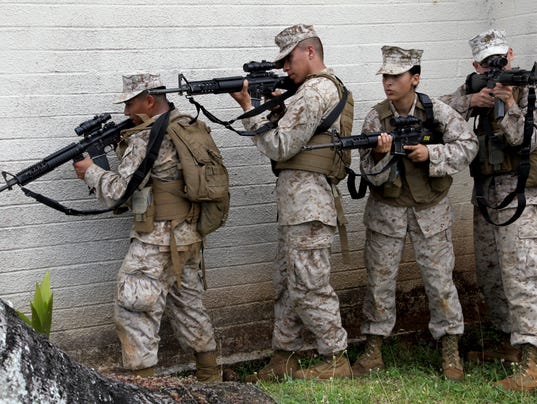
CLD trains for urban warfare

Marines from Okinawa plan to conduct urban environment training in Guam next month, which could create noise in some villages. The Marine Corps officer in charge of the operation, Col. Daniel H. Wilson, on Tuesday issued the following open letter to Guam in connection with the training:

By now you may have heard that a small force of Marines and sailors are scheduled to conduct a training exercise in Guam next month. As the Officer in Charge of this exercise, I would like to explain to you what we have in mind and why your community is so important to us.

The 31st Marine Expeditionary Unit (MEU) is the fighting force for the Okinawa-based Bonhomme Richard Expeditionary Strike Group, set to deploy in the Asia-Pacific region. Typically, a MEU’s mission is to serve as a sea-based quick-reaction force, ready to respond to any crisis that occurs in its area of operations.

Many of the Marines you may see in the coming few weeks have served all over the world but we also have new Marines preparing to make their first deployment. Their lives and the success of our future missions depend on the training we accomplish during our work-ups in your community.

Months prior to deploying, an MEU begins training intensively for a multitude of separate and distinct missions which it must be ready to execute at any time. We conduct much of that training at our home bases in Okinawa and aboard Navy ships at sea; however, we cannot adequately prepare to operate in an unfamiliar environment without moving out of our comfort zone and into areas like yours with which we are not familiar.

Marines are trained to fight in every clime and place. For desert training, we go to Twentynine Palms, California. For cold-weather and mountain-warfare training, we head to Bridgeport, California, or Norway. For jungle-warfare training, we’ve sent Marines to Panama, the Philippines, Thailand, and Okinawa.

Training in an urban environment, though, is the most challenging situation we are likely to face. Maneuvering in a heavily congested area, identifying threats lurking in windows and around street corners, trying to tell whether a car speeding toward a vehicle checkpoint is a real threat or a simple mistake, are just a few examples of the challenges Marines face in an urban setting.

Our aim in Guam is to expose our Marines to realistic scenarios and stresses posed by operating in an actual urban environment, thereby increasing their proficiency in built up areas. Operating in Guam provides us with conditions we are not able to replicate aboard our home base.

The exercise runs from January 6 to 16. While most of the activity will take place aboard Navy installations, residents of the island could see Marines periodically throughout the exercise and are likely to notice increased military activities on the 13th and 15th of January.

We have coordinated our plans through the appropriate territorial agencies and village officials including the Guam Police Department, Guam Fire Department, the Office of Homeland Security, and Village Mayors to ensure the safety of residents and to minimize any impact on the community.

We understand that our presence may briefly raise the noise level in some villages and we greatly appreciate your patience and understanding. We hope you will bear with us as we complete this critical training exercise. Finally, we hope that what you observe will make you as proud as we are to serve on your behalf.

Tuesday, October 18, 2011

There Is No Honor In This!

10.17.11 - 12:16 PM from Commondreams.org

Shamar Thomas talks to schoolkids

Powerful video as an enraged veteran, Marine Sergeant Shamar Thomas, rants against the NYPD for their harsh tactics against protesters in Times Square. Watch the horde of blue and white shirts silently back off from him: What could they possibly say?

"This is not war! This is America! How do you sleep at night? There is no honor in this! There is no honor in this! None!


Tuesday, April 05, 2011

One dead, 3 hospitalized after military helicopter crash

KANEOHE (HawaiiNewsNow) - One Marine is dead after a CH-53D Sea Stallion helicopter carrying four crew members crashed in Kaneohe Bay. The aircraft issued a mayday call shortly after it left Marine Corps Base Hawaii.

One crew member was removed from the helicopter, pronounced dead by the state medical examiner and later taken to Tripler Army Medical Center. The name of the deceased will be released 24 hours after next of kin notification.

The other three crew members were transported from Marine Corps Air Station Kaneohe Bay to Queens Medical Center. At last check, two were listed in critical condition and one in stable condition.

The aircraft made an emergency landing in shallow water on the Kaneohe Bay sandbar around 7:30 p.m. on Tuesday, approximately two miles from the air station. The downed helicopter remains on its side in Kaneohe Bay and the salvage operation is being planned.

The emergency startled residents who live near the bay.

"One big boom like thunder, and then about 10, 15 minutes after that I noticed military helicopters was unusually circling around," said Kaneohe resident Glenn Pang.

"We're working with the Kaneohe Marine Base waterfront ops, working with US Coast Guard. Fed fire is on the base, and HFD, Coast Guard and waterfront ops are in the ocean with the patients," said Capt. Terry Seelig of the Honolulu Fire Department.

Containment booms have been placed around the wreckage as a precaution. The Coast Guard is enforcing a temporary safety zone extending 500 yards around the aircraft.

Rescue responders included the Marine Corps Base Hawaii Waterfront Operations, aircraft from the U.S. Coast Guard and Army and the Honolulu Fire Department as well as another CH53D from HMH363.

This incident is under investigation by the Marine Corps.

Copyright Hawaii News Now 2011. All rights reserved.

Friday, October 29, 2010

Clinton makes brief visit to Guam

BY BRETT KELMAN • PACIFIC DAILY NEWS • OCTOBER 30, 2010

Secretary of State Hillary Clinton stood in front of a star-spangled backdrop yesterday and told hundreds of military troops that their crucial role in the Pacific is growing.

Clinton, who embarked on a two-week tour through Asia, stopped on Guam briefly yesterday afternoon and gave an address at Andersen Air Force Base. About 400 service members from the various military branches packed into the Global Hawk hangar to hear her speak.

To begin, Clinton called on each branch to make some noise.

"I can barely hear you all," she taunted, with her hand cupped at her ear. "Who's here from the Navy?"

In response, a mass of sailors in blue and brown camouflage stood up and roared. Next to them, at least 200 airmen sat silent, waiting for their turn to roar back.

"All right. And what about the Marines?" Clinton asked.

One woman in the middle of the crowd stood up with a "oorah," then peered around and realized she was alone.

"Well, I don't think you'll be lonely for too long," Clinton said, smiling and laughing.

So there it was, even when the Secretary of State was rallying troops and joking around, the footsteps of fast-approaching military buildup were inescapable.

The buildup will transfer about 8,000 Marines from Okinawa to Guam, and that shift is expected to trigger a total growth of about 41,000 people to Guam by 2016, and about 14,000 by next year, so the population boom alone has the power to reshape the island. So do the billions of dollars of buildup funds headed to Guam.

Before she spoke yesterday, Clinton met with Gov. Felix Camacho, Lt. Gov. Mike Cruz, Speaker Judith Won Pat and Vice Speaker Benjamin Cruz, each of whom brought concerns about the buildup to the table. Won Pat presented a legislative resolution that details senators' concerns with the buildup process.

During the speech yesterday, Clinton didn't talk much about the buildup directly, but she spoke about the general increase in federal government activity and energy on this half of the globe. This is her sixth trip to the Asia-Pacific region as secretary of State, she said, since this region is "the center of much of the change and challenges of the 21st century."

"We are engaging ever more actively in this region," Clinton said. "With our allies, our partners, with emerging powers, with institutions that are being built in order to keep the peace, advance prosperity and stability."

Clinton added later in her speech that one of the goals of the President Obama's administration was to "re-assert" the American presence in Asia.

"You can see we are paying a lot of attention to what's going on in the Asia-Pacific region because the United States is both an Atlantic and a Pacific power ... Everywhere I travel on your behalf, I hear from leaders and citizens alike that they are glad America is back."

From Guam, Clinton will head to Vietnam, where she said the United States is building relationships that were "unthinkable" only a decade ago.

Buildup Talks

Journalists were not permitted to interview Clinton during her time on Guam, but Camacho made himself available for interview when her speech was done.

Camacho said he spoke with Clinton for about 15 minutes and most of the discussion was spent on buildup concerns and Japan politics. The Japanese government is helping to pay for the relocation of Marines from Okinawa to ease the presence of military troops in Japan.

A gubernatorial election in Okinawa could potentially alter the current path of the buildup, Camacho said.

The governor said Clinton told him she believed Okinawa would stay "on the right track."

Guam and Okinawa share many of the same buildup concerns -- such as the construction of a new military base -- Camacho said, and what happens in Okinawa has a direct impact on what happens here.

"She said, you know, that they were in discussions with the leadership -- the prime minister of Japan -- with regards to this, and there is a commitment to move forward," Camacho said. "But there is a bit of a conflict, in that, on the one hand, they recognize the concerns of the Okinawan people and the nation of Japan with regards to the building of additional military bases. On the other hand, they recognize the value and the need for America to remain as a resident power in this part of the world, as a deterrent to aggressive neighbors. It's conflicting, and they are caught somewhere in the middle."

China

Clinton spoke about one of those neighbors, China, during a speech in Hawaii on Thursday, before she flew to Guam.

In Hawaii, she said the military would remain "forward deployed" in this region, and urged China to work with the United States instead of against it.

"It is not in anyone's best interest for the United States and China to see each other as adversaries," she said.

Yesterday, Camacho said he also spoke to Clinton about a visa waiver program for Guam, which could allow tourists from China to infuse more tourism dollars into the local economy.

If a visa waiver wasn't possible, at least a "Marianas-only waiver" should be considered.

"Japan is a declining market ... and we see China as a growth market," Camacho said.

The governor said Clinton said the idea of a "Marianas-only waiver" was interesting, but she made no promises.

Thursday, October 07, 2010

Cruz requests President Obama visit Guam

by Nick Delgado from KUAM.com

Guam - Vice-Speaker B.J. Cruz is urging President Barack Obama today to include Guam in his November trip. Cruz sent a letter to the nation's commander in chief requesting that he make time to meet with members of the military and the civilian communities as part of his plans to visit India and Indonesia next month.

The vice-speaker expressed his disappointment that Obama's planned visit earlier this year was canceled and states that a November visit would be timely. He adds that the relocation of Marines from Okinawa to Guam plays a huge importance as to why the President should speak with the people regarding the impacts the buildup will have on the island.

Saturday, February 20, 2010

Comments on the Draft Environmental Impact Statement/Overseas Environmental Impact Statement EIS/OE

Comments on the Draft Environmental Impact Statement/Overseas Environmental Impact Statement EIS/OE

Joint Guam Program Office (JGPO)
C/O NAVFAC Pacific
258 Makalapa Drive, Suite 100
Pearl Harbor, Hawaii 96860-3134
Attention: GPMO

Reference: Comments on the Draft Environmental Impact Statement/Overseas Environmental Impact Statement (EIS/OEIS), Guam and CNMI Military Relocation:

Relocating Marines from Okinawa, Visiting Aircraft Carrier Berthing, and Army Air and Missile Defense Task Force

Hafa Adai! Thank you for the opportunity to provide comments on the referenced Draft Environmental Impact Statement (DEIS). The military buildup proposed for the island of Guahan unprecedented in sheer size and magnitude that it will undoubtedly significantly impact and change the culture, environment, quality of life, and future of the island. Guahan's ability to effectively integrate the military expansion will determine the success of the island's growth and development for decades to come.

This cover letter summarizes our technical and policy concerns about the DEIS, and are detailed in the attached comment spreadsheets prepared by the staff and technical experts of the Government of Guahan instrumentalities. We are submitting these comments as the "affected official local government" in accordance with the requirements of the National Environmental Policy Act (NEP A). Please enter this letter and all the attachments submitted with it into the comment record.

Our purpose in submitting detailed comments is to ensure that the Department of Defense (DOD) has a full understanding of Guahan's concerns about the proposed military buildup and the DEIS. We believe that the DEIS is lacking in a number of areas.

Click here to view this posting in it's entirety. (pdf format - file size 44mb)
http://guamgovernor.net/GOV%20FINAL%20COMPILATION.pdf

Sunday, January 10, 2010

Public hearings on military buildup

Public hearings on military buildup

Monday, 11 January 2010 00:00

THE CNMI Military Integration Management Committee would like to encourage the public to participate in the upcoming Joint Guam Program Office public hearings that are scheduled for Tinian on Thursday, Jan. 14, and Saipan on Friday, Jan. 15, a media release stated.

The committee, or MIMC, coordinator Tom Linden will be on hand at both of these public hearings to answer any questions in regards to how the CNMI is dealing with the regional military buildup.

These meetings will be an introduction to the draft environmental impact statement, or EIS, that has been prepared for both Guam and the CNMI.

While the CNMI government understands the complexity of the document which is to be commented on, the MIMC office encourages active participation. In an effort to ensure that the community has an opportunity to fully digest the contents contained in the EIS, the MIMC in partnership with Office of Economic Adjustment, or OEA, and the Guam Advisory Consulting Team, or ACT, will be hosting a public forum on Jan. 27 at the multi-purpose center in Susupe.

Representatives of the OEA and ACT will breakdown the 11,000-page EIS and be willing to answer any questions in regards to the military buildup in our region.
The public hearings will be a great introduction to the EIS and then allow the public time to review and comment prior to the public forum which will be held on the 27th.

The MIMC public forum will also be broadcast to both Tinian and Rota through a VTC provided by Northern Marianas College and IT&E.

The MIMC and the Department of Commerce will have representatives on Tinian and Rota to help answer any questions.

Members of the public are urged to submit questions ahead of time to the MIMC coordinator by e-mailing them to cnmi.mimc@commerce.gov.mp This e-mail address is being protected from spambots. You need JavaScript enabled to view it
The MIMC was created through a charter in June 2009.

It serves as the planning and policy making entity for all activities that relate to the expansion of military training and other defense transformation initiatives in the CNMI and Guam.

The CNMI-MIMC is the official entity through which the commonwealth will interface with the Department of the Navy, the Marine Corps, JGPO, the Department of Defense, and all other military representatives in regards to the military buildup in the region.

The policy making committee is chaired by Gov. Benigno Fitial and consists of the governor, lt. governor, Senate president, speaker of the House, and the mayors of Rota, Tinian, Saipan and the Northern Islands.

Due to the overwhelming scope of this military relocation, the MIMC realizes that the path to success will require a partnership with Guam and both Fitial and Guam Gov. Felix Camacho have pledged their support of one another to ensure that the entire region benefits.

Residents air buidup concerns: Health care, land issues raised at UOG field house

Residents air buidup concerns: Health care, land issues raised at UOG field house

By Laura Matthews • Pacific Sunday News • January 10, 2010

The University of Guam's field house teemed with varying emotions yesterday when more than 500 people gathered to publicly comment on the draft Environmental Impact Statement.

Die-hard activists, determined landowners, concerned citizens and officials paced the floor of the field house, reading all the information on display. They talked with military officials about the buildup, in order to learn all they could before the public comment session.

Signs that read: "Only independent nations control immigration" and "Yankee go home!" showed military officials where they stood with some residents.

Then, the conch shells were blown, the Guam national anthem was sung and the proceedings for the second public hearing on the draft Environmental Impact Statement got underway.

The first speaker on the day was Vice Speaker Benjamin Cruz, who expressed public health concerns as Guam prepares to get about 20 years of growth over the next five years because of the military buildup.

Approximately 8,000 Marines and their 9,000 dependents will be brought to the island. In total, the buildup is projected to bring about 80,000 people to Guam by 2014, which will increase Guam's population by almost half its current size.

"My main concern is that the hospital is the choke point," Cruz said. "We just don't have enough beds to take care of the people coming."

The vice speaker told Department of Defense officials that he would like for the final Environmental Impact Statement to be "very specific" about how it is going to address the need for more hospital beds on island.

"The hospital is unable to take care of us at this time. We are short of doctors," he said.

The draft Environmental Impact Statement notes that the island's health-care system will need a personnel increase of 26 percent in order to deal with the growth. It also states that at the peak of the construction phase in 2014, an additional 15 doctors and 91 nurses will be needed.

Land concerns

Some residents expressed worry they might lose their land.

Juan Martinez Unpingco, an 85-year-old Sasayan Valley landowner, said he worked two jobs throughout his lifetime in order to feed his eight children and save enough money to buy property. That piece of property, he said, sustaines his livelihood.

"This has obviously paid off since it has been helping me to pay all my medical bills," Unpingco said. "Thus, the property I own in Marbo Cave has indeed sustained my livelihood and I plan to deed it to my children upon my death. I anticipate that my children would do likewise and deed the property onto the next generation."

He said he fears the military will take his land through condemnation and asked them not to.

"I am in support of the military buildup, provided there is no land condemnation," he said. "It was my bread and butter. I worked very hard for it. I will sell it or rent it."

Joint Guam Program Office Executive Director David Bice, a retired Marine major general whose office oversees the buildup, has said that residents whose lands are used for military projects will get a fair price. The Defense Department follows strict procedures to pay landowners the fair market value, he said, also noting that congressional defense committees would first have to approve any major land acquisitions by the military.

Juan Unpingco's son, Superior Court of Guam Judge Steven S. Unpingco, also a private landowner, said the draft Environmental Impact Statement fails to address "the contentious issue" of land condemnation. Moreover, the Sasayan Valley area is a proposed alternative for a live firing range -- an idea he said should be dismissed.

"Equally important to the public is the impact that explosive grenade and demolition ranges may have on the environment," he said. "Is there any specific study on any potential environmental degradation or possible lead contamination from these activities on soil?"

Speaking out

Melvin Won Pat-Borja, a 28-year-old teacher and member of the We Are Guahan group, said his generation should know that it is important to let their voices be heard. They don't need to be "a scientist or an expert to comment on the EIS," he said.

The group is a combination of residents who seek to disseminate the information from the lengthy draft Environmental Impact Statement to ordinary citizens in a way that is easily understood.

"This problem will not affect the people who are making the decisions. It will ultimately be our youth," he said. "I have students who will be graduating this year and will possibly be graduating college in four years. And when they want to come back home and raise their families here and make a living here, things will not be the same as they were when they left. This island will not be the same as it was when they left."

Residents have until Feb. 17 to submit their comments on the draft Environmental Impact Statement, which will reshape nearly all aspects of life on Guam.

The public meetings are a way the military officials garner the concerns of the citizens, which will be evaluated and taken into consideration to make better decisions as the military moves forward with the final EIS, Bice said.

Thursday, January 07, 2010

Tinian, Saipan hearings on military buildup's draft EIS

Tinian, Saipan hearings on military buildup's draft EIS

Friday, January 08, 2010
By Haidee V. Eugenio

By now, concerned CNMI citizens should have been reading some 11,000 pages of documents on the draft environmental impact statement related to the $15 billion to $20 billion military buildup in Guam, which also involves the use of Tinian for military training.

A copy of the draft EIS/Overseas Environmental Impact Statement can be accessed online at www.guambuildupeis.us.

Because Guam cannot accommodate all training for the relocating Marines, the military looks at Tinian to provide opportunities for training groups of 200 Marines or larger due to greater land availability.

Tinian is only about 100 miles or 160 km away from Guam.

The northern two-thirds of Tinian are leased to the U.S. Department of Defense. Company and battalion level non-live fire training areas already exist and are used on these lease parcels.

“The land, however, could be developed to accommodate live fire ranges,” the draft EIS/OES stated.

The proposed actions on Tinian include firing ranges for rifle known distance, automated combat pistol, platoon battle course, and field firing; and airspace use.

Comments on the draft EIS/OES can be submitted online, or during the public hearings set by the U.S. Navy in Guam and the CNMI.

All comments must be submitted by Feb. 17, 2010, in order to be considered in the final EIS/OES.

Two of the six public hearings set by the Joint Guam Program Office will be held on Saipan and Tinian, while the other four are being held in Guam.

The public hearing on Tinian will be held on Jan. 14, Thursday, at the Tinian Elementary School. An open house will be from 5pm to 7pm, while the public hearing will be from 7pm to 9pm.

The Saipan public hearing will be held on Jan. 15, Friday, at the Pedro P. Tenorio Multi-Purpose Center in Susupe. A 5pm to 7pm open house will be followed by the public hearing at 7pm to 9pm.

The JGPO said public comments “are an important part of the environmental planning process.”

During the open house, the public can both submit written comments and ask questions of programs leaders and subject matter experts. During the two-hour formal hearing, the public can submit oral comments on the draft EIS/OES.

JGPO facilitates the realignment of U.S. Marines from Okinawa, Japan to Guam. The agency works within the Department of Defense and with the Government of Japan, Government of Guam, U.S. Congress and federal agencies to lead and manage the delivery of required capabilities to the Marines.

The military buildup involves the relocation of 8,000 Marines and their 9,000 dependents to Guam, and the development and construction of facilities to support the training and operations in Guam and Tinian for the relocated Marines.

It also involves the construction of a new deep-draft wharf in Apra Harbor, Guam to support a transient nuclear powered aircraft carrier.

The buildup also involves the development of facilities and infrastructure in Guam to support the relocation of some 600 military personnel and their 900 dependents to establish and operate an Army Air and Missile Defense Task Force.

The CNMI government plans to provide operational support and services to Guam instead of viewing the neighbor island as a "competition" to maximize benefits from the multi-year U.S. military buildup in Guam.

US-Japan row won’t affect Guam pact

US-Japan row won’t affect Guam pact

Friday, 08 January 2010 00:38
by Zita Y. Taitano | Variety News Staff

JOINT Guam Program Office executive director General David Bice doesn’t believe the souring relationship between the U.S. and Japan will affect the Marines move to the island.

“I deal with my counterparts in Japan, bureaucrats as they are. I watch what Japan does and they’ve already deposited over $330 million in the U.S. bank account for the move,” Bice said.

He noted nearly $500 million detailed in Tokyo’s next fiscal year budget allocated to carry out task associated with lessening the burden on Okinawa by relocating the Futenma Air Base to a less populated area of the island and moving service personnel to Guam.

“I’m confident that we’ll be able to continue this program and work out any issues that relates to the Futenma replacement facility,” Bice said, expressing confidence that the new Japanese government’s decision would not cause any delay to the military’s timeline to complete the troop transfer by 2014.

“I don’t see it. I think the United States government and Japan officials are working (together) and I’m confident based on what I see, and my counterparts, that we’re going to be continuing to move forward,” he said.

Wednesday, January 06, 2010

Policy chief pitches alternative Futenma plan

Policy chief pitches alternative Futenma plan

By Chiyomi Sumida, Stars and Stripes
Pacific edition, Thursday, January 7, 2010

NAHA, Okinawa — Transferring 23 F-15 fighter jets from Kadena Air Base, Okinawa, to Misawa Air Base in mainland Japan would free up room for operations at Marine Corps Air Station Futenma to be moved to Kadena, according to a proposal pitched Tuesday by the policy chief of one of the two junior partners of Japan’s coalition government.

Mikio Shimoji, a New People’s Party representative and a senior member of a subcommittee set up to find a settlement on the relocation issue, said his party’s plan included moving training normally conducted at Kadena to mainland Japan.

Sending the visiting aircraft to train at Kansai Airport in Osaka, as well as using Ie-Shima island and the Higashi Fuji training ground for Marine helicopter exercises, will greatly reduce the noise that is a frequent complaint of Okinawans, Shimoji told reporters at his campaign office.

On Camp Schwab, meanwhile, helipads would be built instead of runways, Shimoji said.

“Additionally,” he said, “if the United States wishes, Futenma air station can remain under U.S. military control for contingency purposes,” which would allow the Okinawan landowners to continue to receive rent from the U.S. military.

The subcommittee, set up by Prime Minister Yukio Hatoyama last month after he set a deadline of May to reach a formal agreement with the U.S. on Futenma, will forward its plan to Hatoyama “by the end of January,” Shimoji said.

The subcommittee still has some work to do. Mizuho Fukushima, leader of the other junior coalition partner, insists on moving the operations outside Okinawa, possibly to Guam.

Hatoyama said last month after the delay announcement that he would seek a solution that would be acceptable for both Okinawa residents and the United States. Meanwhile, the United States maintains its stance that the present plan to move Futenma operations to Camp Schwab as agreed in 2006 is the only viable option.

“If Kansai Airport and Higashi Fuji become available for the military to use as training sites, it would be an added value for the military,” Shimoji said.

Relocating the Futenma operations within Okinawa is the most realistic and feasible solution, he stressed.

“This is a now-or-never chance for Okinawa to remarkably reduce the presence of the military on the island,” he said.

Sunday, January 03, 2010

FOCUS: U.S. military eyes Guam as staging post to counter threats

FOCUS: U.S. military eyes Guam as staging post to counter threats

January 02 2010 19:12
Saturday, January 02, 2010 5:13 AM

HAGATNA, Jan. 2, 2010 (Kyodo News International) -- The United States plans to fortify Guam, upgrading its military base on the island into a strategic staging post that would allow rapid access to potential flashpoints in the Pacific region.

More troops, including 9,182 Marines, army soldiers and their dependents from Okinawa, Japan, will be relocated to this island, while more than 9,000 transient troops, mainly from the navy's carrier strike group, will also be based here.

The ''overarching purpose'' of beefing up Guam as a military fortress is ''to provide mutual defense, deter aggression, and dissuade coercion in the Western Pacific Region, according to a draft impact report recently released by the U.S. Defense Department.

The proposed buildup would allow U.S. military forces to respond to regional threats and contingencies in a ''flexible'' and ''timely manner'' as they work to ''defend U.S., Japan and allied interests,'' the study says.

''Moving these forces to Guam would place them on the furthest forward element of sovereign U.S. territory in the Pacific, thereby maximizing their freedom of action,'' it says.

According to the report, the United States envisions Guam as a ''local command and control structure'' manned, equipped, trained, and sustained by a modern logistics infrastructure.

The relocation and buildup cost, including expansion of infrastructure needed to maintain a permanent base for Marines and U.S. Army troops on Guam and Tinian, an island 160 kilometers to the northeast, is pegged at $12 billion. Japan has agreed to chip in $6.09 billion of the total.

The plan would entail ''increased operational activities,'' more frequent berthing by aircraft carriers and other warships, building aviation training ranges and upgrading of harbors, wharves and ports.

The existing Andersen Air Force Base on Guam would be expanded to include the air elements of the Marines. A new Marine base would be built ''right next door,'' the study says.

Various firing ranges would be built to meet the various training requirements of a larger military contingent.

The U.S. also plans to expand its live fire training ranges in Tinian where about 200 or more Marines could ''realistically train'' with their weapons and equipment ''without restrictions.''

Also on the drawing board is the building of a deep-draft wharf at Guam's Apra Harbor to support nuclear-powered aircraft carriers transiting through the area.

A U.S. Army ''Air and Missile Defense Task Force'' is also proposed for Guam to protect the island and U.S. forces there against the threat of harm from ballistic missile attacks.

Weapons emplacement sites would be constructed to accommodate the ''Terminal High Altitude Area Defense'' system, which is designed to intercept missiles during late mid-course or final stage flight.

Other emplacement sites would accommodate Patriot missiles, which are designed to strike threat aircraft, unmanned aerial vehicles, and cruise missiles just before impact.

The U.S military is beefing up its presence in Guam after U.S. allies in the Pacific -- the Philippines, Thailand, Australia, South Korea and Singapore -- turned down U.S. requests for permanent basing of U.S. troops on their soil.

Already concerns are being raised over plans to transform Guam into ''a multi-service military base.''

''Some of the areas that they're planning to convert into firing ranges include pristine limestone forested areas that will require some clearing of native forest trees,'' Jeffrey Quitugua, a biologist, told Kyodo News.

Judith Guthertz, a senator in the Guam Legislature who chairs the military buildup committee, is concerned over ''land condemnation or land takings.''

''That is a very emotional issue for the people of Guam because of what happened after World War II where the federal government condemned so much land on Guam. We don't want a repeat of that,'' she told Kyodo News in an interview.

Henry Simpson, general manager of Guam Racing Federation, said the U.S. military aims to take his race track without even consulting him. ''They want to run over our land,'' he said.

But Paul Shintaku, executive director of the Guam Buildup Office, in the Guam governor's office, said public consultations are ongoing, with a series of fora scheduled in January to enlighten the public on the plan.

Guam's government also scoffs at fears the plan will make the island prone to attacks by U.S. enemies.

''I don't see it as painting a bigger red target on us,'' Shintaku's deputy Nora Camacho said. ''Of course we have that red light, that red circle around us...but there's a deterrence.''

(Source: iStockAnalyst)

SEE ALSO:

SUPPLEMENTARY INFORMATION: The overarching purpose for the proposed actions is to locate U.S. military forces to meet international agreement and treaty obligations and fulfill U.S. government national security to provide mutual defense, deter aggression, and dissuade coercion in the Western Pacific Region. The need of the proposed actions is to meet various criteria based upon U.S. policy, international agreements, and treaties, including but not limited to positioning forces to defend the homeland and U.S. Pacific territories; respond within a timely response range; maintain regional stability; provide flexibility to respond to regional threats; defend U.S., Japan, and allied interests, and other defense related criteria. Guam's location as the westernmost part of the United States is critical to U.S. national security interests. In implementing U.S. national security policy, the Department of Defense would increase the role of Guam and the CNMI through the relocation of Marines to Guam, increased presence of a transient aircraft carrier, and enhanced capability to protect the U.S. homeland, Pacific territories, forces, and its allies from ballistic missile attacks.

As a result of reviews of the U.S. defense posture in the Pacific region and a parallel review of U.S. force posture supporting the U.S. alliance with Japan, a portion of U.S. Marine Corps forces currently located in Okinawa, Japan would be relocated to Guam. This relocation is proposed to occur concurrent with proposed wharf construction in Guam's Apra Harbor to support the Navy transiting nuclear aircraft carriers. An Army AMDTF is also proposed for Guam to protect the U.S homeland, Pacific territories, forces and its allies against the threat of harm from ballistic missile attacks.

Federal Register: November 20, 2009 (Volume 74, Number 223)
http://edocket.access.gpo.gov/2009/E9-27960.htm

Tuesday, December 15, 2009

PBS features documentary on buildup

PBS features documentary on buildup

By Dionesis Tamondong • Pacific Daily News • December 15, 2009

The military buildup and its impact to the island is the topic of a 25-minute documentary featured on the Public Broadcasting Service.

"The Marines Are Landing" premiered Friday and featured local community leaders, families and military officials talking about the expansion of military facilities and the influx of tens of thousands of people onto Guam.

The American nonprofit TV service is a prominent provider of public programming, with 356 member TV stations in the United States. The documentary can be viewed on the PBS Web site until Dec. 31.

The program starts with retired Marine Col. John Jackson, director of the Joint Guam Program Office, being interviewed about the need for the buildup, which includes the relocation of 8,000 Marines from Okinawa and their 9,000 dependents to Guam.

He talked about the island's strategic importance and how Guam can, if necessary, become a platform to go to war if diplomacy fails.

The video balances the military's need for the buildup with voices from some who oppose it, or at least the way it's being conducted.

Former senator and local activist Hope Cristobal spoke about how she is working to help prevent the buildup, while Speaker Judith Won Pat expressed her frustration over Guam's government having practically no part in decisions related to the buildup.

"We all know that whatever we do or say, it's not going to matter," Won Pat said on the program. "The decision is made in Washington, and we're not brought to the table. We were told that that is a county-to-country level of discussion. That means Japan and the United States -- not us."

The PBS correspondents attended the Barrigada fiesta to get residents' perspectives on the buildup.

One man said he was angry that he carries a U.S. passport, but can't vote for president. But another resident said he looked forward to how the buildup will infuse the local economy.

Other people featured in the video:

# Businessman Jeff Pleadwell, owner of Jeff's Pirates Cove in Talofofo, gave his take on what the buildup will mean for local businesses;

# Simon Sanchez, Consolidated Commission on Utilities chairman, talked about the need for millions of dollars to shore up the power, water and wastewater facilities for the population influx, and that the federal government needs to pay for that; and

# Dededo Mayor Melissa Savares said she looks forward to buildup-related jobs being available to residents but was worried about how Guam's indigenous culture may be overwhelmed by the buildup.

Sunday, December 13, 2009

Hikers worry about site access: Military plans would restrict public from lands

Hikers worry about site access: Military plans would restrict public from lands

By Brett Kelman • Pacific Daily News • December 13, 2009

A series of hikes in January will take anyone who wants to go to five natural sites before they become more difficult, impossible or illegal to visit when the military buildup arrives.

Guam Boonie Stompers President Dave Lotz hopes to take as many people as he can to places such as Pagat Cave before the Department of Defense utilizes these areas. He hopes enamored hikers will join his cause to preserve the access local residents have now.

Pagat Cave is a sinkhole and stone cavern in Yigo filled with cool, waist-deep water and candlelight. Locals and tourists swim in the cave and explore the coast almost every day. An ancient Chamorro village once drew fresh water from the cave, Lotz said. Artifacts pepper the ground.

The military will build a firing range next door.

When the Boonie Stompers hike to Pagat Cave on Jan. 2, some residents might go there for the first time.

Or for the last time.

"Go while you can," Lotz said on Dec. 4. "Obviously we want to garner support for our cause, but realistically we may not prevail. But we are optimistic we will."

The military buildup will bring about 8,000 Marines and their dependents from Okinawa to Guam in the next few years. Air Force and Navy operations will expand as well.

As the military's presence grows, so will its borders.

According to the Draft Environmental Impact Statement released on Nov. 20, the Department of Defense will acquire or transform large portions of land in northern, central and southern Guam for its increased needs.

There are a lot of hiking sites on that land, and the Guam Boonie Stompers want to ensure the public will not lose access to them completely after the Marines arrive, Lotz said.

Three of the hikes -- Pagat Cave, Ague Cove and the Lajuna area -- are on land the public will lose access to, according to the Draft EIS report. Access to Mount Lamlam and other southern mountains won't be restricted significantly, but Lotz isn't taking chances.

"In some of them (restriction) seems quite apparent, in others it's ambiguous," Lotz said. "As we have seen on this island -- and I've been here 40 years -- access is basically at the whims of the base commander."

Balance

The access craved by hikers such as Lotz must be balanced with military needs and public safety, according to an e-mail from Joint Guam Program Office spokesman Capt. Neil Ruggiero.

It is not the military's intent to unnecessarily restrict access, Ruggiero wrote.

Although the preferred plans listed in the Draft EIS state that public access to Pagat Cave, Ague Cove and the Lajuna area would end, Ruggiero wrote that it is premature to assume that all access to these areas will be prohibited. Comments from the public could change plans for the future.

"Comments on the DEIS, to include those on the subject of access, will be analyzed and considered in the development of the Final EIS. Thus, final decisions have not been made at this time, and specific policies regarding public access to military bases and facilities on Guam will be determined by the Joint Region and base commanders," Ruggiero wrote in his e-mail.

Exchange

According to a preliminary statement prepared by the Boonie Stompers, Lotz and his fellow hikers will request the military include specific plans and schedules for continued access to the noteworthy places that could be gobbled up by the buildup.

If a plan for public access isn't spelled out, Lotz worries access could wither over time until it barely exists -- like at Fena Caves.

The caves are the site of a brutal World War II massacre that sits on Navy property in Santa Rita. A small group of mourners are allowed to visit the caves once a year, but the site is otherwise closed to the public.

If access to Pagat Cave and the other sites are going to be restricted in a similar way, the public should get something in return, Lotz said.

The Boonie Stompers will request the military create access to areas including Haputo Beach, Double Reef Beach, Orote Point, Fena Caves and Tarague Beach as an exchange, according to the statement.

Ruggerio did not respond to a question about whether renewed access to these areas was a possibility.

Wednesday, December 02, 2009

Editorial :: Pride and prejudice

Editorial :: Pride and prejudice

Thursday, 03 December 2009 03:48
Editorial

WITH the impending military buildup on Guam, the merging of the military population and civilian community will be an inevitable occurrence. Considering the differences in orientation between the two communities, the issue of peace is therefore a natural concern. Preliminary results of Variety’s online poll indicates that sociocultural impact and public safety issues rank as the top two concerns among residents.

The draft environmental impact statement for Guam military buildup identifies some of the sociocultural problems that the island will have to deal with as a result of increased military presence. The draft impact report acknowledges the Marines’ not-so-pleasant reputation as troublemakers, but at the same time dismisses the attribution as unfounded and lacking in evidence.

International news agencies have in the past reported cases of rape and other forms of public disturbances involving young Marines. And the fact that 8,000 Marines are on their way to Guam naturally causes concern among many in the community.

On the other hand, the military itself is concerned about the perceived hostility or xenophobia on the part of the local community. The report hence cites the potential “for social friction” that “could well trigger a transitional period of adjustment in which local young men test themselves against Marines in fights.”

Making a sweeping generalization on both sides is unfair. Overcoming the pride and prejudices and changing the “us” versus “them” attitude are challenges for both communities.

While it is prudent for law enforcement agencies to prepare for increased demand for public safety responses, it would be equally prudent for local officials to work with the military on creative initiatives to help bridge the gap between civilians and Marines.

The local community expects the military establishment to give the Marines adequate information and proper orientation about the local culture before they arrive on island. In the same breath, local leaders must work with the community to foster a welcoming atmosphere and demonstrate the hospitality that we always say our island is famous for.

While there is a place for protest, political debate and expression of discomfort about the uncertainty of our future, it should not be at the expense of harmony and looking forward.

Sunday, November 22, 2009

DOD wants to acquire 2,200 acres

DOD wants to acquire 2,200 acres

By Dionesis Tamondong • Pacific Daily News • November 23, 2009

The Department of Defense is interested in acquiring at least 2,200 acres of non-federal land for the military buildup, according to the draft Environmental Impact Statement.

The report lists four main parcels the military is looking at, the largest of which is for a firing range along the island's northeast coast.

Between 1,100 acres and 1,800 acres along Route 15 in Mangilao and Yigo are needed for the proposed firing range. That would require the condemnation or leasing of those properties, which are owned by the local government, private owners and ancestral land claimants.

Sen. Judith Guthertz, chairwoman of the legislative committee overseeing buildup issues, said the military acquisition of land is going to be the most sensitive issue.

"They'd have to negotiate with the landowners, and it's really entirely up to the private landowners what they will want to do," Guthertz said. "With reference to the government land, we're talking about Chamorro Land Trust property and ancestral land. Those are very sensitive issues."

The EIS report lists three other main parcels of interest:

# Former Federal Aviation Administration housing in south Finegayan, Dededo, is owned by private landowners and GovGuam. The 680-acre parcel is currently vacant.

# In Harmon, there are 326 acres of land claimed by multiple ancestral land claimants, as well as private owners and GovGuam. This area is vacant but for a few abandoned buildings.

The Dededo and Harmon parcels are part of the planned Marine Corps base headquarters. About 8,600 Marines and their 9,000 dependents are being relocated from Okinawa to Guam.

# About 105 acres of GovGuam land in the Cabras area of Piti is being looked at as part of a wharf and related facilities. The site is generally vacant with a few abandoned buildings.

The Defense Department is also looking to acquire small pockets of non-federal land, and some road projects may also require land acquisitions.

"There may be some owners who are interested in selling or leasing land to the federal government and would perceive the federal acquisition or the lease of their property as a beneficial impact," the EIS report states. "Other owners who do not want to sell their property (or relocate) are likely to consider the forced sale or relocation as an adverse impact, even though they are properly compensated."

A bill sponsored by Guthertz in the last Legislature requires that any GovGuam land transactions for federal purposes require the approval of the Guam Legislature. The bill is now law.

"That means that no GovGuam land can be sold or leased on a long-term basis without the approval of the Legislature," she said. "Any such request will have to undergo the normal process of public input and testimony and due diligence from the senators."

Guthertz said military officials have assured her and other lawmakers they would not condemn any private land.

Monday, August 24, 2009

Buildup Hits Another Snag

Buildup hits another snag
Monday, 24 August 2009 01:08 by Gerardo Partido | Variety News Staff .

Conflict over military housing may delay Marines’ relocationTHE planned transfer of U.S. Marines from Okinawa to Guam has apparently hit another snag as Japanese media reported over the weekend that there are serious “differences” between the U.S. and Japan over a housing project for the relocating Marines.

The Kyodo news agency, citing sources close to Japan-U.S. relations, reported that these differences revolve around conflicting interpretations over the quality standards for the housing project.

Earlier, Japanese opposition officials already expressed concerns over the “expensive” cost of housing units on Guam given by U.S. authorities.

Bloomberg News had quoted opposition Democratic Party of Japan legislator Keiichiro Asao as saying that the projected $700,000 per housing unit for the Marines quoted by the U.S. is too much given that the land is already free.


Japan election

The Japanese election is just a week away and the opposition, which had been pushing for a review of the Guam buildup costs, is widely predicted to take over power from the ruling Liberal Democratic Party.

According to Kyodo, the housing project for the Marines is already more than six months behind schedule because of the conflict between the U.S. and Japanese sides.

Moreover, the impasse may delay bids by potential contractors since it normally takes about a year and half before the winning bidder is selected and three to four years before a project of that size can be completed.

This threatens to delay the Marines’ transfer, which was scheduled to be completed by the end of 2014 by both governments.


Friction

According to Kyodo, another cause of friction is the U.S. proposal to use part of the Japanese funding to help improve military facilities on Guam that are not directly linked to the transfer of the Okinawa-based Marines.

Public opinion in Japan is already very much against the financing plan for the relocation of the Marines, which many Japanese consider too high and unfair.

The decision to take on $6 billion of the total cost marks the first time a Japanese government has agreed to share the costs of building and improving facilities at a U.S. base overseas and this has enraged Japanese nationalists.

Kyodo said the deadlock in the talks to relocate the Marines to Guam may also affect the plan to transfer the heliport functions of the U.S. Marine Corps' Futenma Air Station from Ginowan to Nago, both in Okinawa, as the two elements are closely tied by the bilateral agreement.

Another Kyodo source, which the news agency did not name, said a delay beyond 2014 appears to have become the "tacit understanding" of officials from both sides.

Under the May 2006 agreement, Japan is to shoulder up to $6.09 billion of the $10.27 billion relocation cost mainly to build houses and improve infrastructure.

Friday, May 08, 2009

Pentagon Reconsiders Pricey Guam Move

Pentagon reconsiders pricey Guam move
By Otto Kreisher
CongressDaily May 7, 2009

The Marine Corps commandant told House appropriators on Wednesday that the initial $4 billion estimated U.S. cost for relocating thousands of Marines from Japan to Guam is "way short" of what the service will likely spend.

"It will be far more than that," Gen. James Conway told the House Military Construction Appropriations Subcommittee.

Conway said the decision to move more than 8,000 Marines from Okinawa and some bases in mainland Japan would be reconsidered as part of the global basing study during the upcoming Quadrennial Defense Review. The Defense Department will have to come up with a prioritized list of projects and determine Guam's ability to support the additional forces, the commandant said.

Rep. Norman Dicks, D-Wash., opened the issue, saying he was concerned that Guam does not have the infrastructure to support all the Marines and additional sailors that are planned to be based there.

Conway agreed and noted that plans call for $3 billion a year in construction over a considerable period, and the territory of Guam could support only half of that. He also expressed concern about the ability to provide training facilities for those Marines.

Japan has committed to financing most of the cost of moving the Marines out of the bases on Okinawa, which are impacted by the growing population. But the Japanese government is struggling to provide the funds for that effort and the relocation on the island of a Marine air base.

Military Construction Appropriations Subcommittee Chairman Chet Edwards, D-Texas, asked if additional funds were provided in the fiscal 2010 budget to reflect the higher cost for the Guam move. Conway noted that he could not provide details until the budget is released on Thursday, but said "X amount of dollars" were in the budget.

Most of the big expenses, he added, were in future years, subject to decisions made in the QDR.

Rep. Ander Crenshaw, R-Fla., noted that the Navy's plan to relocate a nuclear-powered aircraft carrier from Norfolk, Va., to Mayport, Fla., also would be reviewed in the QDR. But Crenshaw asked Adm. Gary Roughead, the chief of naval operations who also attended the hearing, if he still supported that move.

Roughead said he did, because he considered the concentration of all five of the Atlantic Fleet's carriers in Norfolk a security risk. He noted that the six Pacific Fleet carriers are in three locations.

The Virginia delegation has protested the move, arguing that the Navy could not afford what could be as much as $1 billion to prepare Mayport to host a nuclear carrier. The base had been home to the conventionally powered carrier John F. Kennedy, which has been retired.

Tuesday, May 05, 2009

Guam to Save the Day Again with Military Buildup

Military Build-Up: Guam to Save the Day Again
By Mia Concepcion Triton’s Call, Volume 31, Issue 02

Driving around the island, one can see some big changes happening. New restaurants, businesses, and housing complexes are carving their way through Guam’s natural landscapes.

Multiple roads are currently going through extensive reconstruction to prepare for the military buildup, the transfer of 8000 U.S. Marines and their 9000 dependents from Okinawa to Guam.

According to Governor Felix Camacho in his address to the U.S. Senate Committee and Energy Resources, the Marines will start departing their old base in Okinawa in 2012 and the relocation will be complete by 2014. With such a close deadline for the Marines’ arrival, Guam is working overtime to be prepared.

Both the Japanese and the United States government are spending billions of dollars, 15 billion to be exact, to help Guam prepare for this nearly 25 percent increase in population.

Japan is agreeing to foot some of the bill to ensure a speedy relocation due to social problems between Okinawans and the Marines.

Great amount of publicity given to rapes done by U.S. Marines. According to the Japan Press Weekly, the number of sex offenses in the military forces is 22 times the amount occurring in Japan. Okinawan political activists were strong in voice and were adamant about the ridding of the Marines, one even travelling to Guam to speak of the military presence and the ills that come along with it.

Some newspapers, on the other hand, have criticized some of Okinawa’s media, saying that things were blown out of proportion in order to serve a special need. According to Stars and Stripes, the number of offences committed by the Marines is merely a fraction of the number of offences committed by locals.

Either way, there has been an obvious apprehension on both sides and the relocation seemed the best choice to get rid of it. This is where Guam comes in, to save the day in the same way the buildup will save Guam’s day, financially.

With the recession of multiple economies, these are not the brightest days of our island. The Japanese economy hasn’t been in its best shape either, which has a direct and serious effect on the island.

Guam, an island heavily relying on the money pulled in from Japanese tourists, is also feeling the tightening of the belt. The number of flights from Japan is steadily going downhill, thus the number of tourists and there is nothing else for our economy to rely on.

With such desperation regarding money on island, many people are really looking to this Marine buildup as an economic savior who couldn’t have come at a better time. The government of Guam seems to be stuck in a financial whirlpool, never quite getting out and the more people involved only results in a bigger debt, a bigger hunger.

Students of the University of Guam are in a unique position and have an invaluable perspective on this change on island. We can benefit enormously from this buildup and increase in population and military presence. We are embarking on our careers and it could not be a better time for us to do so.

With so many businesses and agencies coming to support the buildup, we have endless professional choices.

Older generations seem to be in consensus that this buildup will be a good thing. They have been on Guam long enough to see her during the good times: when politicians were trustworthy, when the government wasn’t in debt and when schools were actually safe havens for children.

Needless to say, things aren’t the same. Being able to gauge how good things were with money, it is easier for them to welcome this military expansion with open arms.

Maybe it’s a feasible way for them to return Guam to her good old days. Maybe they don’t want to see the social problems that might arise with the increased Marine presence on the island. Maybe it’s not going to be that big of a deal.

But denying that there will be social changes is a huge mistake. Any area that experiences a large population increase will, without a doubt, face a little tension, especially when there are differences in culture if transition is not done properly.

As young adults living on a small island with an already prominent military community, we see first-hand what these tensions can lead to. We see animosity rooted in cultural misunderstandings and what comes out of it: harsh words being exchanged, violence and worst, the passing of this animosity onto future generations.

We see numerous fights involving two different ethnicities, always on opposite sides and rarely mixing. We also hear the hatred and anger from certain elders about those “guys”.

I remember specifically waiting outside the Globe for a friend to come out. As I sat outside, I noticed that there was a military guy laid out on the ground. He was unconscious and wasn’t receiving help from anyone except for his lone friend, holding up his head. I thought he had blacked out from drinking but upon speculation, I learned that two local guys had attacked him. I insisted that some guys help him out, but they only replied with a cold “That’s what they deserve”.

It wasn’t a “That’s what he deserves” but a general statement about a large amount of people. I’m not saying that this misunderstanding is only on one side but it’s a multi-faceted thing. Tons of military guys, probably missing home and still getting used to Guam, tend to speak badly of the island. We have heard multiple times that they can’t wait to get off this rock.

With Chamorros being a proud people, it’s easy to understand how upset one can get when hearing such talk. Young men tend to be protective of their homeland, no matter where it may be, and will get violent in order to get their point across. We’ve heard countless stories, from both sides, about how things aren’t as pleasant as one would hope in regards to the relations between the locals and the military. We have heard about how the Chamorro people can be extremely hospitable or can be mean-spirited. We have also heard that members of the military are the most interesting people or the most obnoxious.

Either way, we need to open our eyes and our minds. As of right now, the buildup seems like a mere blueprint. Sure, we see new roads being constructed and new buildings going up left and right but are we ready for this? We can have numerous shopping malls and restaurants but what we need to prepare ourselves for are the cultural and social changes we are going to see in our community.

We, as a whole, could look forward to sharing our majestic island with others. We can teach others the joys of our culture instead of chastising those who don’t understand it.

That being said, we can also learn from other cultures to become better citizens of the world. We live in a wonderful place and we’re blessed to call Guam our home. It’s only right that we represent her the proper way; with respect and understanding, no matter who you are.

We could look at this buildup with fear, excitement or utter confusion but the number one thing to do is to keep open our minds and our hearts. We, as students of the University of Guam, are the island’s future leaders and we need to be the ones to show the way.

Wednesday, December 03, 2008

From Japan: Obama May Delay Guam Build

Written by Stefan Sebastian

Guam-- More reports are coming out of Japan that the pending military buildup on Guam could be delayed as the plan is reviewed by President-Elect Barack Obama's administration when he takes office next year.

The President of Japan's Democratic Party, Seiji Maehara, says Obama's diplomatic staff has already agreed with Japanese officials that the plan to relocate about 8,000 Marines and their families to Guam from Okinawa is “in-feasible” and should be re-examined. Maehara met with Obama's staff in a June trip to the United States. Officials with Gov. Felix Camacho's office are declining to comment on the reports for now until they can verify them with Japanese and American officials. Any delay in the buildup plan could affect the local economy and set back GovGuam's efforts to address the impact it will have on the island. However, officials say the plan for now remains on track.

The buildup plan comes under the Alliance Transformation And Realignment Agreement and calls for the relocation of the Marines and their families to Guam by 2014.