Showing posts with label Guam. Show all posts

Monday, July 04, 2016

Some in Guam push for independence from U.S. as Marines prepare for buildup

Published on June 17, 2016 by The Washington Post


HAGATNA, Guam — This tiny Pacific island has several nicknames. There is “the tip of the spear” because it is the closest U.S. territory to potential hot spots in Asia, such as North Korea and the South China Sea.

There is “America’s unsinkable aircraft carrier,” because the island is home to a huge air force base. And then there is “Fortress Pacific,” because of the huge military buildup that is planned to take place over the next decade.

But Guam’s population calls it by another name: Ours. And a sizable portion wants a real say in how it is run.

“This American territory is not enjoying democracy, where citizens can determine who their leader will be and what laws will be put upon them,” said Gov. Eddie Baza Calvo, who has called a vote for November on Guam’s political status. “It’s up to our people to decide which way to go: whether to be fully in union with the United States or to chart a separate course.”

A “decolonization commission” is set to report to Calvo (R) next month on whether to proceed with the plebiscite, which would give Guamanians three alternatives to their current status as a U.S. territory. That status — shared by Puerto Rico and the U.S. Virgin Islands — confers U.S. citizenship on people born here but does not give them the right to vote in presidential elections or a voting representative in Congress.

“Guamanian soldiers have gone to fight in countries so they can have democracy and vote, yet we have never voted for the person who sends us to war,” the governor said.

The three alternatives under consideration are:

● Statehood, which would give Guam all the rights (and burdens) of being a state, albeit a very small one, with a population less than one-third that of Wyoming.
●Free association with administrative power, like Palau and the Marshall Islands.
● Independence, which would make Guam a (minuscule) sovereign state.

The vote would not be binding — only Congress can change Guam’s political status — but would be symbolic of the territory’s sentiment.

The issue has been simmering for years but returned to the political front burner with the Pentagon’s preparations to relocate thousands of troops stationed on the southern Japanese island of Okinawa to here.

The U.S. military presence on Okinawa has long been a source of contention in a prefecture that complains of being treated as a second-class citizen by Tokyo. But there are similar complaints on Guam, a 30-mile-long tropical island of only 160,000 people, which is already home to large air force and naval bases.

Pockets of fierce opposition to the initial plan formulated a decade ago to move 10,000 Marines from Okinawa to Guam led the Defense Department to halve the number coming here.

“The prospect of the military buildup caused a crack in the facade of American-ness on this island,” said Michael Lujan Bevacqua, who teaches the indigenous Chamorro language at the University of Guam.

Bevacqua is a strong advocate of breaking free from the United States. “Being independent and having the ability to determine our own policies is much better for us,” he said.

Lisa Linda Natividad, another proponent of change, says the decision to move the Marines onto this island is the latest sign of Washington’s highhanded ways. “The whole Guam buildup was set in motion because we’re a U.S. colony, and they think they can do whatever they want with our land,” said Natividad, who sits on the decolonization commission. “Just drive around for 10 minutes and it’s obvious."

The issue of Guam’s political status is complicated. Some resent the U.S. military presence but do not want to give up their American passports. Some want greater independence but want their taxes to stay here on the island, as they do now, rather than going into the federal coffers. Some fear the lack of opportunity if they could no longer travel freely to the mainland.

It is also controversial. People who have lived here for half a century take issue with the way the vote is being structured, saying it unfairly favors the Chamorro people. Only people who can trace their roots on the island back to 1950, when the island became an unincorporated territory, will be allowed to vote.

Efforts to populate a voter registry have been slow-going — only 10,500 have registered so far, Calvo said — and the education campaign is barely existent.

“I believe that before we have a vote, we need to have a strong education effort where people can really see what each status would mean,” said Shannon Murphy, a local journalist who runs the Guampedia website. “I haven’t seen it laid out in a way where people can compare each option.”
Even advocates of political change, including Bevacqua, say the governor is rushing the plebiscite because he has his mind on his legacy. A vote can only be held in an election year, and term limits mean Calvo will be on his way out of office at the 2018 poll. Calvo, who prefers the statehood option, said he called the vote because the time was right.

For the vote to go ahead, the governor, the decolonization commission and the Election Commission all have to agree. The decolonization commission is due to decide whether to press ahead at its meeting next month.

Local business representatives think that moving to lessen or get rid of the military presence on Guam would be economic suicide.

“As a business person, I wonder if they have thought through the economic aspects of the decisions they want to make,” said Joe Arnett, an accountant who has lived on Guam for 32 years and runs the armed forces committee for the local chamber of commerce.

“The U.S. federal government puts $600 million a year into Guam through Social Security and taxes paid by military personnel stationed here. That’s not including food stamps and school lunches and things like that,” he said.

Almost $9 billion has been earmarked for the base expansion and support facilities, one-third of which will be moved from Japan. In the north of Guam, preparations are underway. The Pentagon has unlocked $309 million for the first phase of construction of the new Marine base, which will be built on existing military land lined with palm trees. Next door at the Andersen Air Force Base, where B-52 bombers were lined up on the runway this week, construction workers were building a new hangar that will be part of the expanded footprint.

But the buildup will be long and slow. The first wave of 2,500 Marines is expected here by 2022, with the remainder due by 2027.

The Marines are making sure to stay out of the local debate. “Guam needs to figure out what’s best for Guam,” said Col. Philip Zimmerman, the officer in charge of the 20-strong Marine contingent on Guam.

But, he said, from a military perspective, Guam is a crucial forward base, noting tensions with North Korea and with China around the Spratly Islands and the South China Sea in recent months. It is 2,500 miles to Beijing from here, but more than double that to Los Angeles.

The base itself would be good for the island’s economy, Zimmerman said. “We will be creating jobs during the buildup, then we’ll be creating civilian jobs to run the ranges and to run the base itself,” he said.

A military socioeconomic impact assessment study found that the new base would create more than 3,000 full-time civilian jobs in 2021, and tax revenues to the Guam government would increase by about $40 million a year from 2028.


For his part, the governor said he would “gladly” pay federal taxes so that Guam could be a full-fledged state. “But anything is better than being an unincorporated territory,” Calvo said. “That’s just another word for colony.”

Sunday, April 03, 2016

Calvo Pushes Political Status Vote in Annual Address

Published on April 1, 2006 by Pacific Daily News

By Shawn Raymundo

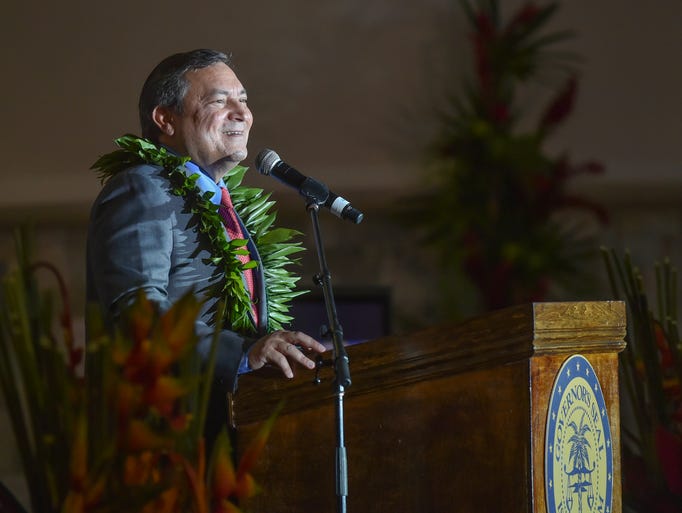
Standing at the entrance of the nearly completed Guam Museum in Hagåtña on Thursday evening, Gov. Eddie Calvo delivered his annual State of the Island address.

The location of this year’s address symbolized the theme of Calvo’s speech. With the past behind him — a building that will soon be filled with artifacts from another time — Calvo spoke of the island’s future.

The Republican governor, now midway through his second term, made several announcements in his speech, including a strong, immediate push for a political status vote, the release of $40 million in tax refunds this month and a proposal to help the financially strapped Guam Memorial Hospital.

Toward the end of his more than 6,000-word speech, Calvo announced Guam’s native inhabitants might “finally” be able to vote in a plebiscite to determine the island’s political status.

The governor said on Friday morning, he will “submit a draft measure to petition for the referendum of the political status plebiscite.”

Calvo said he’s already organized a campaign to secure the required number of signatures to get the referendum on the November ballot.

“We will aggressively seek the required number of signatures, making this a grassroots decolonization effort,” he said.

If, by mid-July, depending on how an education campaign to inform the native inhabitants of their political status options is going, Calvo said he would file the petitions.

On the topic of tax refunds, Calvo announced that residents could look forward to roughly $40 million in tax refunds being released this month, covering 13,000 checks.

The state of the island is confident partly because the state of your government is strong,” Calvo said. “It is a government that manages its resources and finances responsibly, values its employees, and delivers services better as a result.”

The governor’s tax refund announcement was met with criticism from the Democratic Party of Guam, which issued several press releases to the media Thursday night, responding to Calvo’s speech. The party pointed out that the Calvo administration’s pace to pay out tax refunds has slowed substantially in the past couple of years.

Referring to the government’s bank account used to set aside income tax revenue for tax refunds, the party stated that the government hasn’t kept up with the mandatory amount of deposits that should have been collected by now.

“The truth is that the tax refunds are $26 million behind; he is fighting our taxpayers in the U.S. Supreme Court, and we owe millions of dollars to our people just as we did before he started,” the Democratic Party wrote.

Touching on the financial burdens facing the government-run hospital, Calvo noted the Guam Memorial Hospital Authority is “bleeding cash and needs a transfusion right away.”

Earlier this year, amid bickering between the Guam Legislature and the governor’s office, Adelup submitted a measure to lawmakers that would use $1.3 million in legislative lapsed budgetary funds to assist the hospital.

Legislative officials, however, said that money already had been adopted into the senator’s operating budgets.

During his address, Calvo said he’s now withdrawing the bill and urging the lawmakers to back a partnership between Sen. Dennis Rodriguez Jr. and Adelup in financing $120 million capital improvements. The endeavor, he explained, would yield $30 million.

“This is on top of revenue-generating programs we are implementing. We can secure a low interest rate if we do this now, and we identified the repayment source,” he said. “If we do this, along with Sen. Rodriguez’s bill that authorizes public-private partnerships, we will stabilize GMH for the foreseeable future.”

Rodriguez said he’s happy to work with the governor to find solutions that would address the hospital’s outstanding vendor payables, which are around $26 million.

“I’m glad that was part of his speech. And I’m going to work together to really develop a long term sustainably plan,” Rodriguez said. “He talked about financing for the immediate needs and I want to see the details on that and based on that we need to move forward, even if we look at the long term plan for the hospital we have these needs now.”

As for other plans, Calvo said, over the next few days he will introduce a bill to assess fees from major real estate transactions, which in turn will be used to infuse the Guam Housing Corporation so it can issue more mortgages to families who have been denied by the banks.

The governor also plans to improve the health and wellness of the island by pushing more resources toward programs and facilities that encourage fitness. Along those same lines, Calvo said he would work with Guam lawmakers to construct more athletic facilities and get more streets paved throughout the villages.

Gov. Eddie Calvo delivers his annual State of the Island

Editor's Note: Sen. Dennis Rodriguez Jr. did not issue a media release following Gov. Calvo's State of the Island address Thursday night. The quotes in the story came from an interview Rodriguez had with Pacific Daily News following the address. The senator was also misquoted as saying he was happy the governor mentioned him in the address. The senator actually said he was happy the governor spoke about the financial troubles of GMH. This article has been corrected and updated.

Saturday, December 26, 2015

Marines Plan Guam Exercise in January

Published by Pacific Daily News on December 23, 2015

CLD trains for urban warfare

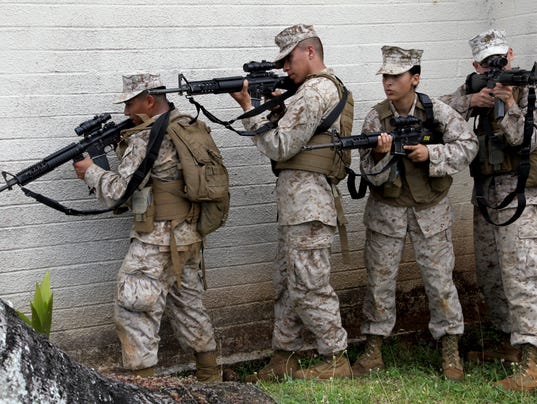
Marines from Okinawa plan to conduct urban environment training in Guam next month, which could create noise in some villages. The Marine Corps officer in charge of the operation, Col. Daniel H. Wilson, on Tuesday issued the following open letter to Guam in connection with the training:

By now you may have heard that a small force of Marines and sailors are scheduled to conduct a training exercise in Guam next month. As the Officer in Charge of this exercise, I would like to explain to you what we have in mind and why your community is so important to us.

The 31st Marine Expeditionary Unit (MEU) is the fighting force for the Okinawa-based Bonhomme Richard Expeditionary Strike Group, set to deploy in the Asia-Pacific region. Typically, a MEU’s mission is to serve as a sea-based quick-reaction force, ready to respond to any crisis that occurs in its area of operations.

Many of the Marines you may see in the coming few weeks have served all over the world but we also have new Marines preparing to make their first deployment. Their lives and the success of our future missions depend on the training we accomplish during our work-ups in your community.

Months prior to deploying, an MEU begins training intensively for a multitude of separate and distinct missions which it must be ready to execute at any time. We conduct much of that training at our home bases in Okinawa and aboard Navy ships at sea; however, we cannot adequately prepare to operate in an unfamiliar environment without moving out of our comfort zone and into areas like yours with which we are not familiar.

Marines are trained to fight in every clime and place. For desert training, we go to Twentynine Palms, California. For cold-weather and mountain-warfare training, we head to Bridgeport, California, or Norway. For jungle-warfare training, we’ve sent Marines to Panama, the Philippines, Thailand, and Okinawa.

Training in an urban environment, though, is the most challenging situation we are likely to face. Maneuvering in a heavily congested area, identifying threats lurking in windows and around street corners, trying to tell whether a car speeding toward a vehicle checkpoint is a real threat or a simple mistake, are just a few examples of the challenges Marines face in an urban setting.

Our aim in Guam is to expose our Marines to realistic scenarios and stresses posed by operating in an actual urban environment, thereby increasing their proficiency in built up areas. Operating in Guam provides us with conditions we are not able to replicate aboard our home base.

The exercise runs from January 6 to 16. While most of the activity will take place aboard Navy installations, residents of the island could see Marines periodically throughout the exercise and are likely to notice increased military activities on the 13th and 15th of January.

We have coordinated our plans through the appropriate territorial agencies and village officials including the Guam Police Department, Guam Fire Department, the Office of Homeland Security, and Village Mayors to ensure the safety of residents and to minimize any impact on the community.

We understand that our presence may briefly raise the noise level in some villages and we greatly appreciate your patience and understanding. We hope you will bear with us as we complete this critical training exercise. Finally, we hope that what you observe will make you as proud as we are to serve on your behalf.

Monday, October 24, 2011

‘Webb Letter Gives False Hope on Military Realignment’

Monday, 24 October 2011 00:42 by Therese Hart | Variety News Staff

GUAM Delegate Madeleine Z. Bordallo last week said a recent letter sent by U.S. Senator Jim Webb to Secretary of Defense Leon Panetta regarding the realignment of U.S. forces in Okinawa “gives false hope that the issue of realigning U.S. forces in Japan can be revisited.”

In addition, Bordallo said the letter is “unhelpful to Japan Prime Minister Yoshihiko Noda’s efforts in trying to obtain consensus on these issues in Japan.”

In his letter, Webb urged Panetta to “re-examine carefully” alternatives to resolve the 15-year dispute surrounding U.S. military bases in Okinawa, stating the dispute is “the most serious defense and foreign policy issue facing our foremost ally in the Pacific.”

Last Friday, Panetta left for the Asia-Pacific region to attend meetings in Tokyo with Japanese government officials.

Webb wrote that the U.S. alliance with Japan “has long served as an absolutely crucial element in guaranteeing the stability of East Asia ... but despite well-intentioned efforts on both sides, there are credible concerns that the provisions of the 2006 agreement between our two national governments are not capable of a timely, cost-effective, politically agreeable and strategically viable implementation.”

Webb further wrote that the U.S.’ failure to resolve “the issue of American bases on Okinawa has resulted in a volatile political debate in Japan, the implications of which should not be underestimated by American leaders. It is in our national interest that this matter be resolved both quickly and smartly, for the well-being of our alliance and the stability of the region.”

Recommendations


Webb mentioned in his letter that five months ago, he, along with Senators Carl Levin and John McCain, sent recommendations to then-Secretary of Defense Robert Gates.

“With regard to basing in Okinawa, we recommended that the Department examine the feasibility of moving U.S. Marine Corps aviation assets assigned at Futenma into Kadena Air Base, while dispersing a percentage of Air Force assets now at Kadena to other locations in the Pacific region, including Andersen Air Force Base in Guam,” wrote Webb.

Webb said his recommendations were based on many years “of careful consideration dating to my time in the Pacific as a military planner during the 1970s,” in addition to two visits to Okinawa and Guam during the past 20 months.

“I have also made three visits to Tokyo during that period, and have hosted numerous meetings with Japanese officials here in Washington. I believe this alternative for Futenma is the most workable, cost-effective and least intrusive approach to resolving the most serious defense and foreign policy issue facing our foremost ally in the Pacific region.”

Webb stated he was aware that resolving the Okinawa basing issue would require stiff political debate with different interest groups in the U.S. and in Japan. Webb wrote he was also aware that any change in the American basing structure threatens institutional "turf" areas within the U.S. military.

Webb added, “At the same time, Senator Levin and I were told repeatedly by officials at the highest level of DOD and the uniformed military that there are deep concerns regarding the affordability and workability of the 2006 Roadmap Agreement for basing on Okinawa and Guam, even though our two national governments seem unable to admit this publicly. Thus, my sole purpose in raising this matter with you is to encourage the formulation of a reasonable and timely solution that will guarantee a credible U.S. presence in this vital part of the world, well into the future. I would suggest that you seriously re-examine carefully the proposals that Senators Levin, McCain and I put forward last May.

I would also suggest that you look at the possibility of our military contingency plans including the option of sharing non-American aviation facilities on Okinawa, which were specifically called for in the 2006 Roadmap Agreement.”

Webb further wrote, “As you know, the Senate has expressed strong interest in these matters, as reflected in legislative provisions in both the Senate versions of the Fiscal Year 2012 National Defense Authorization Act and the Fiscal Year 2012 Military Construction and Veterans Affairs Appropriations Act. I hope you will keep this in mind during your discussions with government officials in Japan.”

Wednesday, October 12, 2011

Activists to Protest Fighter Training

WEDNESDAY, 12 OCTOBER 2011 05:00 BY THERESE HART | VARIETY NEWS STAFF

A LOCAL activist group, Taotaomona Native Rights, is hosting two peaceful protests today and one tomorrow to oppose the U.S. military’s transfer of fighter jet training exercises from Okinawa to Guam.

The exercises were transferred in order to spare residents of Okinawa from the loud noise and harmful effects of the noise pollution created by the jets.

But Trini Torres, Pilong Maga' Haga, said the protests are necessary to call attention to the harm these fighter jets will create and the negative impact to Guam residents living in these areas over which the fighter jets will be flying.

“They are doing things to us without asking our permission, and we can’t just keep quiet,” Torres said.

The military recently announced that approximately 400 military personnel, including those from Marine Aircraft Group 12, will participate in air-to-air and air-to-ground jet fighter training maneuvers on Guam. These training procedures used to be held in Okinawa Prefecture, but Okinawa residents have voiced their protests over the loud noise of the maneuvers.

The activist group is inviting island residents to join them during the protests. The first is scheduled today from 2 to 3:30 p.m. in front of the Legislature.

The second will be held also today at 4 to 6 p.m. across and in front of Guam Delegate Madeleine Z. Bordallo’s office in Hagåtña.

Tomorrow, the group will hold a similar protest from 3:30 to 6 p.m. across the Andersen Air Force Base front gate.

“Senators and Congresswoman Bordallo need to stand up for the safety and protection of the people of Guam. At the same time, the U.S. military needs to stop using Guam as its dumping ground and they need to treat the people of Guam with respetu (respect),” said Torres.

Friday, October 07, 2011

Of Bases and Budgets

Published on Friday, October 7, 2011 by Foreign Policy in Focus

by Christine Ahn and Hyun Lee

At 4 am on September 24, an intoxicated U.S. soldier based at Camp Casey in South Korea broke into the dorm of a high school student, threatened her with a weapon and repeatedly sexually assaulted her. Due to the extraterritoriality of the Status of Forces Agreement (SOFA) between the South Korean and U.S. governments, Seoul must issue an arrest warrant to the U.S. Forces in Korea (USFK) to transfer the soldier to face Korea’s criminal system.

This tragic incident presents a critical opportunity to question why, after 66 years, 28,500 U.S. troops still remain on 87 bases and installations on the Korean peninsula and whose security they are safeguarding. The same questions are being raised in Okinawa and Guam, islands in the Asia Pacific with large U.S. bases.

Although the economic crisis facing America has called into question the bloated military budget, it is the first time in U.S. history that Congress is discussing the prohibitive costs of U.S. bases. Given growing popular opposition throughout the Asia Pacific to the ongoing presence of U.S. bases, the time is now to seize this rare political window to close down U.S. bases worldwide.

High Cost of U.S. Bases to People of Asia Pacific

As in the past, the USFK will attempt to call the rape another case of a bad apple, when in fact U.S. troops in Korea have a long history of committing heinous crimes against Korea’s civilian population.

In 1994, South Korean civil society began to mobilize after U.S. soldier Kenneth Markle brutally murdered 27-year old Yoon Keum E. whose bloody body covered with white laundry detergent was found dead with an umbrella shoved up her anus and two beer bottles in her womb. This unspeakable violence forced the Korean people to question the so-called protection provided by the U.S. military and the unequal SOFA arrangements, which enables soldiers to act in impunity.

According to the National Campaign for the Eradication of Crimes by U.S. Troops in Korea, U.S. soldiers have committed tens of thousands of crimes against South Korean civilians since the beginning of its military occupation in 1945. According to South Korean National Assembly member Kim Tae-won, 377 U.S. soldiers were arrested for committing crimes in 2011 alone. Since 2008, the number of rapes doubled, and thefts and assaults tripled. According to the National Campaign for the Eradication of Crimes by U.S. Troops in Korea, U.S. soldiers have committed tens of thousands of crimes against South Korean civilians since the beginning of its military occupation in 1945.

But it’s not just interpersonal violence Koreans endure. U.S. bases have also borne significant social and environmental costs. In 2006, after nearly a 1,000-day long struggle, the South Korean government demolished the homes and fertile farmland of elderly rice farmers in Pyeongtaek for the expansion of Camp Humphreys. This past May, three U.S. veterans confessed to dumping barrels full of Agent Orange in an area the size of a football field at Camp Carroll. Today, Gangjeong farmers and fishermen on Jeju Island are fighting to save their village from becoming a naval base that will stage Aegis destroyers linked to the U.S. missile defense system.

Unfortunately, sexual violence and crimes committed by U.S. troops against civilians haven’t been restricted to South Korea. Okinawa, a prefecture of Japan, has also borne similar costs due to the ongoing presence of U.S. military bases. Although Okinawa accounts for only 0.6 percent of the entire land area in Japan, it is home to 74 percent of U.S. military facilities in Japan. Women for Genuine Security estimates that 37 U.S. bases and installations in Okinawa house 23,842 troops and 21,512 family members.

According to Suzuyo Takazato of Okinawa Women Act Against Military Violence, from 1972 to 2005, U.S. soldiers committed over 5,500 crimes against civilians, although many Okinawans say the number is actually much higher because women and girls rarely report crimes such as sexual violence. Only some 700 U.S. soldiers have been arrested. Since U.S. troops first landed on the island, Okinawans have been demanding their removal. In 1995, the resistance gained steam after three U.S. servicemen abducted and raped a 12-year-old girl.

In 1996, Tokyo and Washington agreed that the United States would return the land used by the Futenma Air Force base and build a replacement facility in Nago City’s Henoko Bay. But Okinawans have opposed this plan through every democratic means—elections, referenda, rallies, and public opinion polls. In 1997, Nago citizens voted in a referendum opposing the construction of the new U.S. base. In a May 2010 poll, 84 percent of respondents opposed this move, which would destroy Henoko’s ecological preserve. And recently, Nago’s 60,000 people elected a mayor who strongly opposes the base.

Given the fierce opposition to the base relocation, the Japanese government signed a deal in 2006 with Washington to transfer 8,000 U.S. marines and their families from Okinawa to Guam, or Guahan in its native language Chamoru, at a price of $27 billion. According to Lisa Natividad of the Guahan Coalition for Peace and Justice, the infusion of these additional marines, their families, and support workers to Guam’s population of 170,000 would grow the island population by 30 percent. “It will double the existing military presence on the island and will eclipse the Chamoru population,” says Natividad.

Since the announcement of the military build-up, Guahans actively led grassroots public education campaigns on the consequences to their culture and environment. Their organizing has begun to pay off. According to Natividad, the Pentagon received an unprecedented 10,000 comments of concern in 2009—6.5 percent of Guahan’s total population—about the planned Guam military build-up. Two civil society organizations—We Are Guahan and the Guam Preservation and Historic Trust—have filed a lawsuit to prevent the use of Pagat village as a live firing range.

Cost of U.S. Bases to America

For the first time in history, the call for closing bases and shifting priorities may actually have the ear of lawmakers on Capitol Hill as they cope with the nation’s intensifying budget crisis and take the unprecedented step of putting the Pentagon budget on the chopping block. Senator Tom Coburn (R-OK) proposes to save $69.5 billion by reducing military personnel overseas in Europe and Asia. This recommendation, originally made by the National Commission on Fiscal Responsibility and Reform, is aimed at reducing “the military personnel stationed at overseas bases in Europe and Asia by one-third.” Senator Coburn also recommends canceling the deployment of 8,600 U.S. Marines and their 9,000 dependents to Guam from Okinawa. To realign U.S. troops in Japan, Okinawa, and Guam would cost $27 billion.

The Sustainable Defense Task Force also proposes to cut military personnel and bases by one third in Europe and Asia and projects savings of up to $80 billion. “On the Korean peninsula, the gap between adversary and friendly conventional capabilities has grown much more favorable,” it states in Debt, Defense, and Deficits – A Way Forward, released June 2010. “Also, U.S. capacities for long-range strike and for effective rapid deployment of forces have grown greater, reducing the crisis response requirements for troops on the spot.” The Task Force does not view China as a military threat to the United States. Rather, it says, China’s integration into the regional economy means “Beijing does not seek to fracture its relationship with the United States.” It also sees Taiwan and the Mainland as “strongly interdependent economically.”The struggle of farmers and indigenous people against U.S. bases in Guam, Okinawa, South Korea, and elsewhere, and the struggle of working people for jobs, healthcare, and education here at home are opposite sides of the same coin.

In May, three ranking members of the Senate Armed Services Committee—Senators Carl Levin (D-MI), Jim Webb (D-VA), and John McCain (R-AZ)—called on the Pentagon to “re-examine plans to restructure U.S. military forces in East Asia” because they were “unrealistic” and “simply unaffordable in today’s increasingly constrained fiscal environment.” Their recommendations include putting on hold plans to expand Camp Humphreys in Pyongtaek, South Korea to support tour normalization, scrapping the relocation of Futenma in Okinawa, and scaling back plans for base expansion in Guam. “The proposals would save billions in taxpayer dollars,” stated the letter from the Senators. Last month, during Deputy Defense Secretary Ashton Carter’s confirmation hearing, Senator Levin asked whether the closure of some bases and bringing home U.S. troops was on the table. Carter responded that indeed, it was “on the table.”

Time to Link Arms

The struggle of farmers and indigenous people against U.S. bases in Guam, Okinawa, South Korea, and elsewhere, and the struggle of working people for jobs, healthcare, and education here at home are opposite sides of the same coin. The vibrant energy and creative talents of our nation’s youth are needed here to build hospitals and schools and revitalize local communities, not on unpopular bases abroad that displace indigenous populations.

It’s time to link up our demands – shut down bases abroad and create jobs here at home. Although oceans apart, we have more at stake in each other’s struggles than we may think. And Washington’s budget debate provides an opening for us to link arms and demand a change in the nation’s priorities.

Movements for peace and economic justice across the Asia Pacific are strengthening their ties by organizing two important convenings: “Peace in Asia and the Pacific: Alternatives to Militarization conference in Washington, DC on October 21-22; and Moana Nui: Pacific Peoples, Lands and Economies gathering from November 9-11 timed with the APEC Summit in Honolulu, Hawaii.

In the long term, the U.S. peace and social justice movement must press to change the fundamental mission of the U.S. military around the world. For now, we can start by impressing on the U.S. public and policymakers the urgency of people’s struggles against U.S. bases abroad as well as the high cost of maintaining them and what that means for the American people.

Saturday, October 01, 2011

Forum Tackles Militarization

FRIDAY, 30 SEPTEMBER 2011 04:25 BY GERALDINE CASTILLO | VARIETY NEWS STAFF

PRESENTATIONS and a public forum were held Wednesday evening at the University of Guam CLASS Lecture Hall, where experts discussed the impact of militarization as well as the current and intended acquisition of military land on Guam.

The forum, entitled “Islands of Shame: Base Displacement from Diego Garcia and Guåhan,” discussed the Pågat lawsuit and the impact military bases have on the island communities of Diego Garcia and Guam.

The speakers were Attorney Leevin Camacho, member of We Are Guåhan, and Dr. David Vine, assistant professor of Anthropology at American University in Washington D.C. Introducing the speakers and moderating the following forum was Dr. Michael Lujan Bevacqua.

“People tend to view the military bases through the more positive symbols of military service, of what the military does for the world, its mission,” said Bevacqua as he introduced the presentations. “But for every military base that you see, there's always some lesser ... aspects to it. There's always high levels of disease, there's always a sort of displacement, dispossession. And so throughout the world, the U.S military has worked on a thousand facilities and so almost all of those facilities – Guam, Diego Garcia, Okinawa, South Korea included – all of them have a shameful history, a history where people were dispossessed, displaced.”

Camacho's presentation detailed the Department of Defense's current footprint on the island; the expansion of DOD lands; and updates on the lawsuit to save Pågat village.

“There are 36,000 acres that DOD officially has control over – that's about 26 percent of Guam,” said Camacho, showcasing maps of Guam that manifest areas throughout the island belonging to DOD or are areas desired for acquisition.

According to Camacho, with DOD's current footprint, Andersen Air Force Base takes up 17,430 acres, while Naval Magazine takes up 8,600 acres; they are the third and seventh largest land areas, respectively.

Meanwhile, Vine spoke about research from his book, “Island of Shame: The Secret History of the U.S. Military Base on Diego Garcia,” drawing parallels between the history of Diego Garcia and that of Guam's. Diego Garcia is a small island in the middle of the Indian Ocean whose indigenous people were displaced during the development of a U.S. military base.

“Part of the reason I'm here is because I'm working on a new book about the whole network of U.S. military bases overseas,” said Vine. “It's taken me to Europe, Asia, Latin America, and now I'm lucky enough to visit Guam and continue that research.”

Vine's research for his new book explores the impacts – on cultural, health, environmental and sovereign representation – military bases have in areas outside of the U.S.

Vine noted similarities between Diego Garcia and Guam, with regard to the impacts of island militarization.

“One is the military use of strategic islands; second, displacement and dispossession; third, racism; [and] fourth, the struggle of people against the military.”

Friday, September 30, 2011

The 2011 International Guam Film Festival


This weekend the 1st Guam Film Festival will showcase local and international films to the masses on Island. Go support the event! Their website can be found here.

Wednesday, September 21, 2011

‘Guam must develop a self-sustaining economy’

THURSDAY, 22 SEPTEMBER 2011 00:32 BY GERALDINE CASTILLO | VARIETY NEWS STAFF

WITH the impending military buildup and the downturn in countries that have sustained Guam's economy, an economics expert

University of Guam Economics Professor Dr. Roseanne Jones was the guest speaker during the Association of Government Accountants Guam Chapter's monthly membership meeting at the Outrigger Guam Resort. Matt Weiss / Variety

points out this can be the chance for the island to develop its own self-sustaining economy.

University of Guam Economics Professor Dr. Roseanne Jones was the guest speaker during the Association of Government Accountants Guam Chapter's monthly membership meeting at the Outrigger Guam Resort, presenting her lecture on “Guam Economic Development: Trade and Demographic Indicators.”

Jones spoke about the physical manifestations of an improvement of trade and the importance of Guam, citing the developments being made at the A.B. Won Pat International Airport and the Port Authority of Guam.

“There's a new cement company that's coming to the Port area,” said Jones. “You can say, 'Well why is it that we get so excited about cement?' [But] these are the very key fundamental ingredients of economic development. The building going on, the capacity to build – that's what excites me ... regional trade.”

Jones also spoke about the downturn in Japan and the United States.

“Certainly [these are] difficult times for both of those nations, and it is a difficult time for Guam. It’s unprecedented that we have had both major nations that have been trading partners or countries that we've relied on for the two major sectors of our economy – tourism and federal investments in military – both not in the position to be spreading to the West like they used to,” Jones stated.

Opportunity

Despite that downturn, it presents an opportunity for Guam to look within itself to develop the economy instead of relying on the other countries to sustain us.

“For the first time, we may have this door opening where we can really begin to think about how we sustain ourselves,” said Jones.

“We've got the beginnings of domestic demand, we've got the beginnings of a solid infrastructure … but we have a momentum building and we have an opportunity to look to ourselves and say, 'Hey, what do we have and how can we make the most of what we have?’”

Jones pointed out the many things Guam already has in order to develop its self-sustaining economy, from the foundations of infrastructure and the growing educated population to the beginning of a hub of regional trade with island neighbors.

“We know that Japan and the United States will always be there,” said Jones. “But not with the same level and intensity that they once were.”