Showing posts with label Indigenous Rights. Show all posts

Monday, January 11, 2016

Leonardo DiCaprio Pays Tribute To Indigenous People In Golden Globe Speech

Posted: 01/11/2016 12:24 am by The Huffington Post Canada

Actor Leonardo DiCaprio got political in his Golden Globe acceptance speech on Sunday night.

DiCaprio, who won the Best Actor in a Motion Picture - Drama award for his role in "The Revenant," thanked indigenous peoples around the world and asked for them to receive more respect.

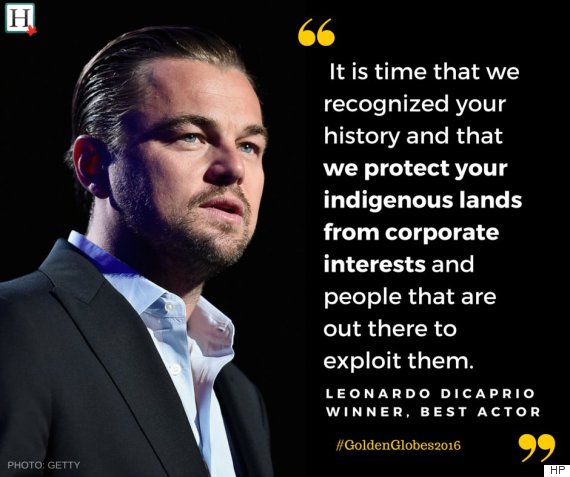
leo dicaprio quote

"I want to share this award with all the First Nations people represented in this film and all the 
indigenous communities around the world," the actor said at the award ceremony held in Los Angeles.

"It is time that we recognized your history and that we protect your indigenous lands from corporate interests and people that are out there to exploit them," added DiCaprio. "It is time that we heard your voice and protected them for future generations."

DiCaprio has been politically active around environmental causes. He made a heavily-publicized visit to Alberta's oilsands in 2014.

"The Revenant," which was shot in Alberta, cast hundreds of First Nations people from across that province as extras and in small roles.

Sunday, December 13, 2015

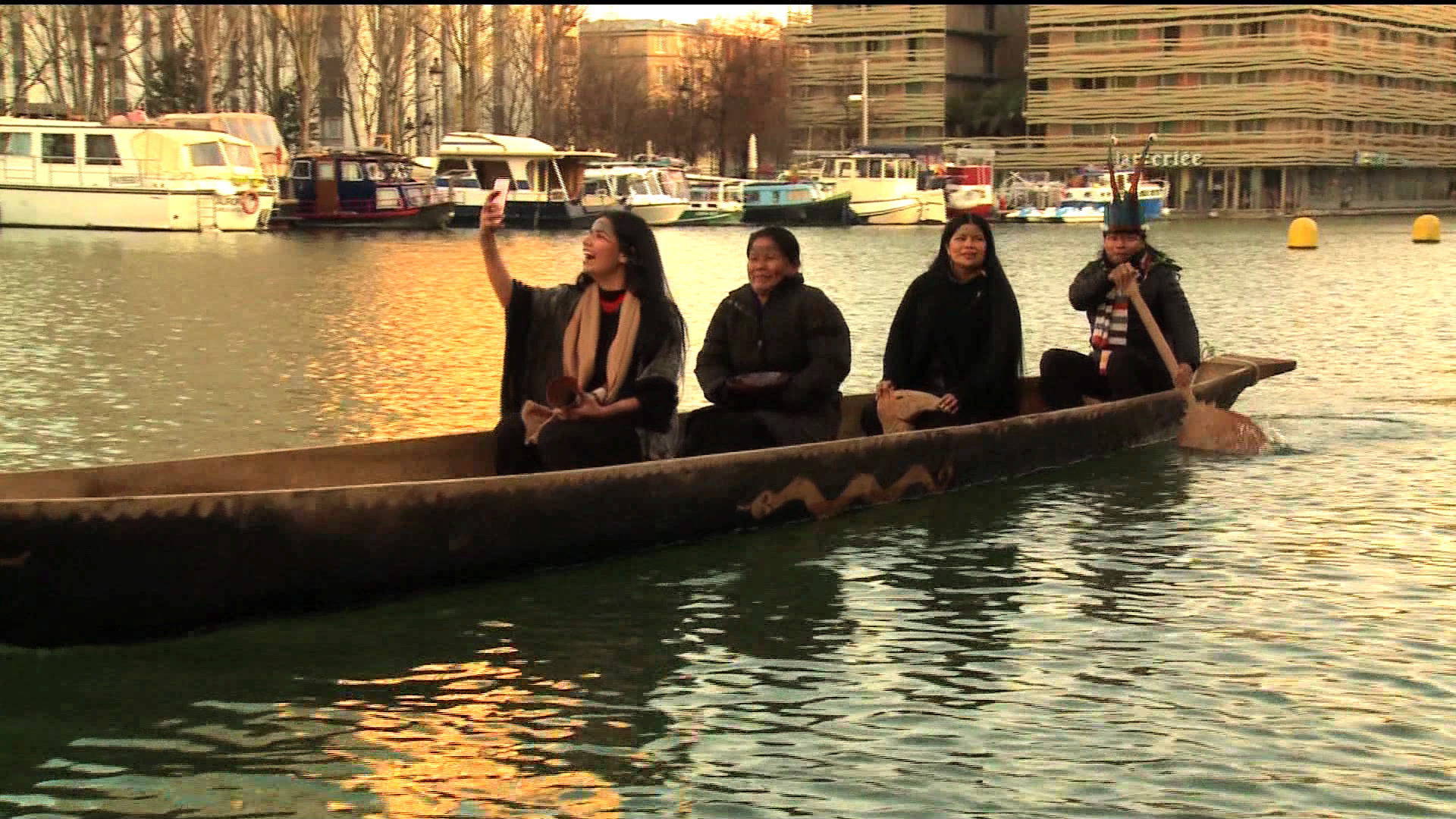
Indigenous Group Brings "Canoe of Life" 6,000 Miles from Amazon to Paris to Call for Climate Action

Published Dec. 11, 2015 by Democracynow.org


On Tuesday, as the sun rose in Paris, a delegation of indigenous people from Sarayaku, in the Ecuadorean Amazon, set out in a handmade, wooden canoe along the Villette Canal. The Kichwa people of Sarayaku have been fighting oil exploitation on their lands for many years; in 2012 they won a case at the Inter-American Court of Human Rights against the Ecuadorean government for permitting oil drilling on their land. Democracy Now!'s Juan Carlos Dávila and Amy Littlefield were there as the Sarayaku launched their canoe after its 6,000-mile journey from the Amazon. "Those who are actually negotiating right now, they might not have to live with the consequences of climate change, but I will," Nina Gualinga, a Kichwa activist from Sarayaku, says of the COP21 negotiations. "Who are they to decide over my future, over my sister's future, over my children’s future?"


TRANSCRIPT
This is a rush transcript. Copy may not be in its final form.

AMY GOODMAN: We wrap up our broadcast with an action earlier this week. On Tuesday, as the sun rose in Paris, a delegation of indigenous people from Sarayaku, in the Ecuadorean Amazon, set out in a handmade, wooden canoe along the Villette Canal. The Kichwa people of Sarayaku have been fighting oil exploitation on their lands for many years. In 2012, they won a case at the Inter-American Court of Human Rights against the Ecuadorean government for letting an Argentine oil company explore for oil on their land. This is the piece.

JOSÉ GUALINGA: [translated] For the first time in history, a canoe, that we call the "Canoe of Life," named after the hummingbird fish in our territory, a canoe from Sarayaku, from the Ecuadorean Amazon, has arrived here to Paris, France.

NINA GUALINGA: My name is Nina Gualinga, and I am here with a delegation from Sarayaku. And Sarayaku is situated in the Ecuadorean Amazon. And we have brought a canoe all the way to Paris, here to the COP, with a message of peace, of hope, and a proposal called Kawsak Sacha. That means "The Living Forest." And it is a proposal to make sure that nature’s rights are being respected, indigenous peoples’ rights are being respected, and also a way to combat climate change.

The whole community has been involved, pretty much. There’s one person who shapes the canoe, and then there are others also helping to burn it and things like that. And then you make like a big party. You gather all of your friends and family and community members to drag the canoe all the way from the mountain down to the river. We had to take it all the way to the nearest port, which is in Canelos, by canoe, so that took, I think, a day or so. And then, from Puyo, we had to take it to the capital of Ecuador, Quito, and then from Quito, on a plane—or from Guayaquil, maybe, to Paris. But first, it got stuck in Ecuador because of troubles with the flight, I think. And then it got stuck in customs here in Paris. So, it’s been quite hard to get it all the way here.

AMY LITTLEFIELD: Could you talk about the negotiations here at the COP? And do you feel your voice is being heard inside the summit?

NINA GUALINGA: I think that indigenous peoples’ voices are the voices that should be heard. Indigenous people should be inside the actual negotiations, but we are not. Those who are actually negotiating right now, they might not have to live with the consequences of climate change, but I will. I will have to live with it. My sister, my little brother and my children, they’re all going to have to live with the consequences of climate change. And who are they to decide over my future, over my sister’s future, over my children’s future?

AMY GOODMAN: Nina Gualinga of the Sarayaku of the Ecuadorean Amazon, speaking to Democracy Now!'s Amy [Littlefield]. Special thanks to Mike Burke and to Carla Wills, to Nermeen Shaikh and to Deena Guzder, to Denis Moynihan. I'm Amy Goodman. This is Democracy Now! I’ll be speaking tonight at 9:00 at The Place to B here in Paris.

Wednesday, January 13, 2010

Guam Senator Challenges DOD's Draft EIS Intentions

Guam Senator Challenges DOD's Draft EIS Intentions

Written by Guam News Factor Staff Writer
Tuesday, 12 January 2010 21:29

Blas Tells DOD To Deal With Guam's Unresolved Issues First

GUAM - Language in the Draft Environmental Impact Statement (DEIS) suggests the military is intentionally sabotaging efforts to resolve Guam's political status and uphold indigenous rights, Senator Frank Blas Jr. testified at a public meeting Tuesday night.

Blas made the accusation based on language in the draft, which states that "an expansion in non-Chamorro voting population could... affect outcomes of any future plebiscites about Guam's political status." The report also notes that budgets for cultural activities, the number of native Chamorros in government offices or leadership positions, and activities dedicated to cultural issues could also be affected by the population shift.

"Is it part of your military buildup plans to inundate our island with people who will have no appreciation or consideration of our culture and beliefs?" Blas asked in his testimony. "Do you firmly believe that we are going to sit back and let you take over our lives and force us to forget who we are?"

The senator also demanded that the Department of Defense and the federal government address war reparations and political status questions as part of the preparation process. The offensive and inflammatory language in the DEIS raises these issues despite the military's insistence that these concerns are not associated with the buildup, Blas added.

Another mention of Guam's efforts to hold a Chamorro plebiscite also suggested the military fully intends to ignore decades-old concerns about Guam's status, Blas noted.

According to the draft, "the political importance of some Chamorro issues would likely recede as the 'militarization' of Guam is stabilized at something close to present levels," the draft states. Blas called the characterization "both disturbing and highly offensive" and said the promise of economic activity in no way compensated for all that Guam has lost due to military activity.

Blas' message to the Department of Defense? "Deal with our issues first, then come back to me with your EIS!"

Hundreds of residents have testified at a series of meetings to inform the public about the military's upcoming buildup, and to collect comments on a draft impact statement that is federally required as part of the development process. In addition to the concerns raised by Blas, residents have formed numerous groups and organizations to protest environmental issues, proposed land acquisition, and other impacts that will result from increasing military activities in coming years.

Senator Frank Blas Jr.'s Testimony

My name is Frank Flores Blas, Jr., a Senator in the 30th Guam Legislature and this is my testimony:

In 2005 during the initial discussions concerning the anticipated military buildup, I had the opportunity to speak with Air Force Lieutenant General Daniel Leaf on the need to address quality of life issues for the people of Guam in order to gain its acceptance by the people. Two issues directly related to the quality of life for our people are war reparations and the amounts spent by the people of Guam to provide services relating to the Compacts of Free Association. We were informed then that those matters as well as any other unresolved issue that didn't relate to the construction of the needed military facilities would have to be brought up with other federal entities other than the Department of Defense.

In conversations I have had with Major General David Bice and Mr. John Jackson, they too further related that the Department of Defense was in no position to deal with Guam's unresolved issues and that DoD's plans relating to the military buildup will be presented and discussed in the DEIS. I was also informed that although the issues were important, it had no relevance to the tasks they were directed to perform.

I believe that before we can have any meaningful conversation concerning the impact that the proposed buildup will have on our island or the requirements that need to be fulfilled in order to accomplish this action, Guam's unresolved issues pertaining to war reparations, compact impact reimbursement, the return of excess lands, the unfretted access to private lands blocked by federal installations, political status, and true representation in Congress have to be addressed and determined.

In Chapter 3 of Volume 7 of the Draft EIS, more specifically on Page 3-55 under the sub-heading "Sociocultural Impacts," it states, "The political importance of some Chamorro issues would likely recede as the 'militarization' of Guam is stabilized at something close to present levels."

I find this statement both disturbing and highly offensive as to suggest that the promised economic activity as a result of the buildup will cause us to forget the sufferings and the killing of our people because of their loyalty to the United States during World War II. I don't appreciate the suggestion that we will forget the hundreds of millions of dollars that we have had to spend to fulfill the mandate imposed upon us as a result of the Compacts of Free Association. Your promise of economic activity does nothing for the many people who had their lands taken from them for military purposes only to see that those lands now sit dormant and selfishly held for no compelling reason. And like your fore-fathers who established the United States of America because they firmly believed that it was unconscionable to have no representation in a Parliament that was making decisions for them without their representation, I am offended that you would believe that the militarization of Guam will cause me to continue to accept my status as a third class citizen and let you continue to impose your will without a discussion with me.

Or maybe this is part of your plan.

In the same chapter of the same volume, but now on Page 3-64 under the sub-heading of "Chamorro Issues," it states, "Guam's indigenous Chamorro population has strong concerns about whether incoming military populations would recognize them as both American by nationality and also a unique ethnic culture worthy of respect and preservation." It goes on to say, "However, an expansion in non-Chamorro voting population could eventually affect the population of Chamorro office-holders and government workers; thereby affecting the current government budgets and activities dedicated to cultural issues and practices. It could also affect outcomes of any future plebiscites about Guam's political status."

What are you telling me?

Is it part of your military buildup plans to inundate our island with people who will have no appreciation or consideration of our culture and beliefs so as to derail us from our inherent and moral responsibility to protect our homes and our dignity? Do you firmly believe that we are going to sit back and let you take over our lives and force us to forget who we are and where we came from? That's never going to happen!

I have always said that before we have any discussion with what you further want to do on our island, we first deal with those issues that have been unresolved for too many years. Although it had been initially stated that those issues were not relevant nor connected to the buildup, the statements made on Pages 55 and 64 just made their relevance very significant. You opened the door on this, and now we're not going to let this go.

Where I have said, now I demand! Before you tell me of your plans to widen my roads, lease my property, strain my healthcare system, or overcrowd my schools, and how you intend to help me help you, deal with our issues first, then come back to me with your EIS!

Thank you.

Thursday, November 12, 2009

Chamorro rights advocates to protest

Chamorro rights advocates to protest

Posted: Nov 11, 2009 10:45 PM PST
by Heather Hauswirth

The Taotaomona Native Rights Group will be holding a protest on Friday evening. According to organizer Trini Torres, the group is protesting against the U.S. military buildup as well as rallying for self-determination. The group is also holding a candlelight vigil fro cancer victims and survivors.

The event will be held at the Chief Quipuha Park in Hagatna beginning at 4:30 in the afternoon.

Monday, September 28, 2009

Native group meeting

Native group meeting


Tuesday, 29 September 2009 02:12 Variety News Staff

(TNR)—The Taotaomona Native Rights group will meet on Oct. 3, from 2:30 p.m. to 5 p.m. at Plasan Maga' Lahi Hurao in Anigua near Adelup to discuss updates on the “Aboriginal Indigenous Native Fishing Rights” and the strategies for self-determination efforts.

For information, call Trini Torres at 477-0638, or email: trinit@ite.netThis e-mail address is being protected from spambots. You need JavaScript enabled to view it .

Thursday, June 04, 2009

Proud Taotaomo'na

Proud taotaomo’na
Thursday, 04 June 2009
Letter to the Editor
Marianas Variety

IT SEEMS amazing how many proud Chamorros there are in the Mariana Islands. But when the word “independence” or the phrase “Yankee Go Home” are mentioned, attitudes change. You see, I am used to hearing bragging rights on the word “proud” from people who come from independent nations except from America, for the white race are not from America. As a matter of fact, they all emigrated from Europe since the late 1400s. Instead of saying proud Italian, Scottish, Irish, German, etc., they used the word American. For example, proud Irish-American, African American, and just plain “proud American.” Who is the true American though? I was taught that the Indians (Apache, Sioux, Cheyenne, etc.) and Mexican, Columbian, Brazilians are the true Americans.

Now let’s return to these islands. These islands, called the Mariana Islands, are inhabited by the oldest society on earth and are known throughout our planet by the old civilization as the Mountain Range of the Crescent Moon, in which the old civilizations claim as their origins.

Today, these islands are owned by the United States of America through wars: the Spanish American War of 1898 and World War II. Not as an independent country, but a property.

Between “Chamorro” and “Chamoru,” which spelling is correct? Actually, the word Chamorro/ru is not indigenous to these islands. It is indigenous to Spain. If a person were to consult a Spanish/English dictionary, one will find out that the word “Chamorro” is defined as the hind leg of a cow. So my question is how we, the aboriginals, can call ourselves “Chamorro” when it is not indigenous to our own language.

The next question should be, “What is our true name?” The answer is taotanomo’na. Then again, a proud Chamorro/ru will say that taotaomo’na means spirit. In reality, the true word for spirit is Aniti. It was actually the Catholic Church that made us believe that taotaomo’na and Chamorro are our true names.

The reason why the indigenous succumbed to their lies in such a short time is due to the ordered punishment and abuse both mentally and physically.

To the foreigners, the Spanish, even God believed our ancestors to be savages, who needed to be civilized. So guess what happened? Since 1521, when Magellan arrived until 1696, record of the size of the native population has been estimated to be over 200,000 throughout the islands. But in 1695, when all natives were assembled on Guam, the population count was under 4,000.

I would love to say to all the indigenous of these islands: Let’s come together and reclaim being a “Proud Taotaomo’na,” and reclaim our lands back and become and independent nation.

Howard A. Hemsing
a.k.a. Maga’lahi Maga’ Aniti
Yigo

Monday, May 25, 2009

Youth Activists Take Center Stage

Youth Activists Take Center Stage
Monday, 25 May 2009
by Jude Lizama
Marianas Variety News Staff

EDUCATE, express, empower. This was the central theme of the Reclaim Guåhan Rally [Chule’ Tatte Guåhan] staged on Saturday by young activists at the Skinner’s Plaza in Hagåtña.

One of the event coordinators, Victoria-Lola Leon Guerrero, expressed her sentiments about the ongoing military buildup, which many in the community see as a “done deal.”

“I’d like to challenge our community to begin to envision that it isn’t a done deal. We currently remain an unincorporated territory of the United States. We belong to but are not a part of the United States,” she said.

“If we, as a community, support the Chamorro people’s right to self- determination to choose our relationship with our without the United States, then we can change these things. We can stop things like the military buildup from happening.”

Leon Guerrero said the only way to stop the military buildup is to acknowledge that the local population is entitled to choose they want for their future and to be able to decide as a community.

Accompanying Leon Guerrero onstage was Krista Flores, from Mt. Carmel Catholic School, who read the “Collective Bill of Rights for Guåhan,” which was one of the class’ pre-graduation assignments.

The bill of rights drafted by MCS student states that “the people of Guam should always be free. The people can overrule the Department of Interior. The military should give back our land. We must keep the island clean and green. The elected governor should have to deliver on every promise made. The Guam flag will be raised above all other flags.”


Creative thinking

Amid talks of self-determination and indigenous rights, the rally also served as an outlet for community networking, platform for free thinking, enjoyment of art and literature, and an appreciation for the island’s different cultures.

“I’m very excited. I’m glad to be a part of something very positive, something that’s by the people and for the people. Basically, if it’s a good thing, I’m down; I’m in,” said Jovan Tamayo, who spoke with the Variety while contributing to a collective poem that was on display at the plaza. “I’d definitely like to help in any way that I can. That’s why I’m here, and I’d like to think that’s why everyone else is here as well.”

“Some of the organizers are good friends of ours. A lot of them are poets too,” said Melvin Won Pat Borja, Sinangån-ta Outreach coordinator. “When they were organizing this event, we heard that they wanted some youth poets since it is a youth rally.”

“It was good timing for us because we just finished up our program so we had our core base of poets that could do something like this,” he added.

Won Pat Borja said the rally sought to encourage critical thinking about the things that are happening around Guam.

“It feels really amazing. I’m not indigenous to the island. I’m Filipino. I’ve come to call the island home. Being a part of this really means a lot to me,” said John Norman Sarmiento, a member of Sinangån-ta Outreach.

“I’ve always wanted to help change the island ever since I was a little boy and I think doing this is a vehicle of change for me because we can reach out to the youth in so many different ways,” he said. “We’re teaching the youth in ways that teachers thought they could only do in classrooms. Like Melvin said, we’re proving that wrong.”

Young poet and Yona resident J Rae Tedtaotao read a powerful piece titled “Territory” written last April. “It fit the whole theme so I read it today,” she said.

“I’m really glad that a lot of people have come out. I’m honored to be up on the stage and speaking,” said Tedtaotao. “I call on anyone else to put your minds together, your writing, and do anything to express yourself and see what you can do to help our island and keep our culture alive.”

Saturday, March 14, 2009

Indigenous group says federalization ‘violates’ NMI right to self-government

Friday, 13 March 2009 00:00 By Gemma Q. Casas - Variety News Staff


THE CNMI Descent for Self-Government and Indigenous Rights Inc. says the U.S. Congress exceeded its lawful powers under the Covenant when it enacted the federalization law, or U.S. P.L. 110-229.

The CNMI Descent filed its 48-page brief in the U.S. District Court for the District of Columbia as amicus curiae or friend of the court.

Federal Judge Paul Friedman allowed the CNMI Descent to file its brief but not to orally argue its position.

The group’s counsel, Saipan defense attorney Robert O’Connor, argued that federalization “is the infringement on, and deprivation of, the CNMI’s Covenant-guaranteed right of self-government,” and that this “is the immediate and primary injury, not any economic harm that may ultimately result from that deprivation.”

He added, “Regardless of how the law is classified or described, Congress exceeded its lawful powers under the Covenant by enacting it, and this court must therefore uphold the Covenant by enjoining its application to the CNMI.”

The lawyer said they are not seeking economic damages but rather a declaratory relief.

According to O’Connor, U.S. P.L. 110-229 not only applies federal immigration law to the CNMI but also creates a new and unique immigration law for the commonwealth.

“It purports…to establish a separate and distinct regulatory regime of indefinite duration, under which the immigration laws of the CNMI are established by the secretary of Homeland Security, in [her] sole discretion,” he said.

Gov. Benigno R. Fitial believes that federalization will destroy what is left of the CNMI’s alien labor-based economy.

The federal government, for its part, argued that the Covenant allows Congress to extend U.S. immigration law to the islands.

NMI resident disputes local group’s federalization claim

Friday, 13 March 2009 00:00 By Gemma Q. Casas - Variety News Staff


A local resident who wants to participate in the ongoing CNMI lawsuit against the U.S. Departments of Homeland Security and Labor in a federal court in Washington, D.C. is challenging the legitimacy of the CNMI Descent for Self-Government and Indigenous Rights’ claim that it represents 4,100 persons of NMI-descent.

Human rights lawyer Bruce Jorgensen told the U.S. District Court for the District of Columbia Judge Paul L. Friedman that his client, Celina Tilipao Mettao Setefano, an NMI-descent person is questioning the validity of the CNMI Descent group’s contention.

Setefano asked Friedman to allow her to file a brief as an amicus curiae, Latin for “friend of the court,” a privilege granted to the CNMI Descent group.

Jorgensen said there are also indigenous people who believe that the federalization law would be good for the CNMI.

He said Setefano is among those indigenous people who welcome the changes to the islands’ immigration system.

“Ms. Setefano and similarly situated others maintain that a substantial if not overwhelming number of CNMI situated persons of NMI descent and of non-NMI descent, including both U.S. and non-U.S. citizens, resoundingly support, laud, and are collectively relieved by, the recently enacted federal statutory provisions by which the U.S. government has finally come to the aid of the CNMI general populace — including the CNMI’s disenfranchised masses…,” he said.

“Local immigration laws, policies, and procedures have been “ineptly and woefully controlled over the past two decades by a malfeasant CNMI bureaucracy,” he added.

Jorgensen asked permission to attend today’s scheduled hearing regarding the CNMI’s motion to declare that certain provisions of the federalization law are illegal and the Department of Justice’s motion to dismiss the lawsuit.

Lawyers from the Washington-based law firm Jenner & Block will orally argue for the CNMI’s motion for preliminary injunction.

A team of Justice Department of lawyers will represent Homeland Security and the U.S. Labor in the hearing.

Saturday, February 07, 2009

Indigenous group submits anti-federalization declaration to court

Friday, 06 February 2009 00:00 By Junhan B. Todeno - Variety News Staff

The CNMI Descent for Self-Government and Indigenous Rights has filed a motion in federal court, expressing its desire to join the governor’s federalization lawsuit.

The motion for leave to participate as amicus curiae, or “friend of court,” was signed by Washington, D.C. attorney John E. Drury and CNMI lawyer Robert J. O’Connor.

The indigenous group also filed a brief in support of the governor’s lawsuit.

According to the group, it recognizes that the federalization law “will have a profound result for the self-government of the indigenous people.”

The indigenous group said it believes that “many of the issues implicated have not been fully or adequately addressed by the parties already in the case.”

The group “accordingly seeks to participate in this case as amicus curiae, so that the court may have the benefit of its perspective on these important issues.”

The governor’s lawsuit was filed in the U.S. District Court for the District of Columbia.

The group’s spokesman and adviser, former Speaker Oscar C. Rasa, , said he is confident that the court will allow their group to participate in the case.

Last December, the U.S. Department of Justice asked the court to dismiss the lawsuit, saying that under the Covenant, the U.S. Congress can extend federal immigration law to the islands.

It added that the governor’s economic disaster scenario was hypothetical and speculative

Rasa said the federal government claims that federalization law will not harm CNMI self-government.

Their group disagrees, he said, because the federal government failed to look into the constitutional issues.

“Their definition of self-government is more on institutional in nature which is by mere election and establishment of the executive, legislative and judicial branches of the government, but ours is constitutional,” he said.

Rasa said the issue should include the U.N. Charter and the Trusteeship Agreement to provide a “more accurate understanding of the Covenant’s guarantee of local self-government.”

He said when the U.S. government passed the federalization law it violated the self-government provisions of the Covenant.

Thursday, January 15, 2009

Mangilao JGPO Meeting

JGPO updates residents on status of military buildup
Thursday, 15 January 2009
by Zita Y. Taitano
Marianas Variety News Staff

RESIDENTS who live in the central part of Guam got a chance to voice their concerns on the impending military buildup last night at the Mangilao Senior Citizens Center.

John Jackson, director of the Joint Guam Program Office, provided an update on the plans to move 8,000 Marines in addition to their families and other military personnel from Okinawa to Guam by 2014.

"This is program is not just a Marine Corps program but it's a program that involves all the services and all of the services are looking at adding additional people, service members and dependents, to the numbers that are already on the island," Jackson said.

He said there are areas that are already being assessed as possible sites for the transfer such as firing ranges in a section of NCTAMS.

He said the military wanted to look at those places with a clean slate and what they learned is that areas on Andersen Air Force Base are being used by the Air Force whereas down south, projects have already begun for the Navy. Other obstacles they came across included the wildlife refuge.

"This planning has been continuing more and more over the past year and is getting more and more detailed," he said. "And as we begin to get more and more details, that's where we start getting to points where decisions have to be made and some of those decisions will be made possible in the 60 days or so. Once decisions are made in the form of a draft environmental impact statement, for instance, then the public, by law, will have 110 days to come up with questions and we would answer those questions."

Jackson also said that the military is not planning within a vacuum, so to speak.

"We're planning with the government of Guam," he said, adding that they are conducting land surveys with the assistance and permission of the Chamorro Land trust Commission.

"The end result of all of this is that we anticipate the citizens of Guam being happy. We're not looking at condemning land. That was something that was done in the past. We're not looking at doing that. And if we should lease lands, then that's a steady income of money for the CLTC that will go into the pockets of the people of Guam."

Jackson also addressed the matter of the preliminary draft of the EIS, which is expected to be released to the public around April or May, which is also when the 110 days of questions will go into effect. The final draft of the EIS should be done by January of 2010.

Raceway
Meanwhile, Henry Simpson, president of the Guam Raceway Federation, went up to a map of the proposed area on the east side of Guam and pointed out to the site the raceway track is located.

Simpson asked Jackson that if the military were to lease the properties, how would it replace the opportunities available to the race track and the plans to build a municipal airport based on a study done in 1989?

Jackson informed him that they haven't made any decisions as of yet because they are still looking at properties.

But he did say that the military has already looked at the impact of a firing range if it is situated in Andy South, which is near the raceway park and the municipal airport project.

"We have to look at what is not only on the ground today but may also be planned on the ground in the future and we look at that. We also have to look at what we're planning on DOD property such as Andy South," Jackson said. "We looked at some of the federal rules and we discovered there's an FAA rule that we cannot have a firing range within three nautical miles of a municipal airport," he added.

Concerns about the military buildup on Guam were also brought forth to Jackson by Trini Torres, Maga Haga of the Taotaomona Native Rights Group.

Torres told Jackson there is no need for the Marines because there is already enough military, adding that she is not happy with the thought of leasing Chamorro land.

"This island is so small and we keep bringing in so many people. This place is for a Chamorro person. Every outsider that comes to our island displaces a Chamorro," she lamented.

Meanwhile, Eric Untalan of Barrigada held a different perspective from Torres, assuring Jackson that there are others like himself who share a different point of view. Untalan did want to know, however, the chronology of hurdles that JGPO has to clear.

Jackson said the first hurdle is the financing, the program being a $10 billion project that has 60 percent being covered by the Japanese Diet and the remaining amount coming from the U.S. government.

The second hurdle, he said, is that the two governments have two different fiscal years. Japan starts on April 1 while the U.S. is on Oct. 1. Jackson did point out that the Japanese Diet is currently debating the first installment payment of about $335 million.

"They are debating that as we speak. We have monthly discussions with the government of Japan and all indications are that the Japanese Diet will approve that $335 million," he said, with the money going to coffers for next year's construction.

The final hurdle is the EIS document when it's officially finalized.

"And when that's finalized, that also has to go through the different regulators such as Fish and Wildlife, NOAA, all the other environmental agencies here on Guam and the federal level. When those pieces and parts all come together, the draft will be finalized and signed," he said.

Then there's the master plan that will contain where utilities will go and where roads and buildings will be built.

"Those are the kind of hurdles we're looking at prior to 2010," he said.

The JGPO meetings will continue on Jan. 20 at the Yigo Gymnasium.

On the next day, Jan. 21, the meeting is at the Dededo Senior Citizen Center, and on Jan. 22 at the Agat Community Center. All the meetings start from 6:30 p.m. to 8:30 p.m.

Sunday, December 21, 2008

Senator Pass Indigenous Fishing Rights Bill

Senators pass Guthertz's fishing rights bill
By Brant McCreadie
KUAM
Published Dec 23, 2008

Senator Judi Guthertz's Bill 327 provides indigenous fishing rights, which went up for a public hearing Monday. "I am very committed to the intent of this bill and I believe it sets a program where finally indigenous fishing practices and traditions can be recognized," said the Democrat policymaker.

The vote for the bill's passage was unanimous. The new law mandates the Department of Agriculture and a fishing council made up of grassroots organizations to develop rules to allow indigenous fishermen to practice traditional forms of fishing within the preserves.

Related links
Bill 327

Saturday, October 25, 2008

From a Footnote...To the DNC

MINAGAHET ZINE
Tulu'Nga'Fulu'Gualo
"From a Footnote...To the DNC"
October 3, 2008

ARTICLES

May 15, 2008 - Bei Falak Denver - I'm Headed to the Democratic National Convention
Yanggen ilek-hu na "excited yu'" siempre ti nahong este na fino'-hu para u na'tungo' hamyo i tinahdong-hu i minagof-hu put este! Mampos excited yu'! Mamposssss.

May 19, 2008 - From a Footnote...To the Democratic National Convention
My new audience, and one which I am definitely happy to engage with is a liberal, Democratic, progressive one. There is so much terrain, so many issues and so many ideas upon which there is a strong affinity between what I believe and what these other bloggers believe, but I know that given my political status, there will be very fundamental divisions and distinctions, that cannot be simply explained away as "politics" or simple differences of opinion, but stem directly from the ambiguous and colonial status of Guam.

June 26, 2008 - Fache'
TRUE RUMORS ABOUT OBAMA: Barack Obama is spearheading a movement to rename “Marine Corps Drive” “Marine Drive Magazine Drive.”...Barack Obama is the white lady in Mai'ina...Barack Obama was really the one who grabbed the gavel from Judi Won Pat...Barack Obama closed down Gameworks...Barack Obama is the reason that it always rains on Liberation Day...Barack Obama is the one who keeps putting casino gambling on the election ballots and who also keeps organizing the Lina’la’ Sin Casino movements...Barack Obama is the one who wrote all the terrible Guam jokes for Bob Hope, Johnny Carson and Jon Stewart...When the Marines and their dependents get to Guam and the roads get worse, the infrastructure becomes even more strained and the cost of living shoots up even more, it will all be Barack Obama’s fault

July 9, 2008 - Racial Fantasies
From this perspective Obama does represent a huge shift. He is not just another rich white guy, who came from a perfect American home and had plenty of perfect American opportunities. He is not part of that fallacy of American normativity. Since he comes from modest means and a broken home, he does have a much more actual American story than most Presidents. But as a person of color, he also knows the pain of being an American who must constantly endure the racism of American race relations, where those with different names, skin colors, phenotypes or religions can always be treated like outsiders and always be told in both polite and impolite ways to "go home" or back to where they came from. Obama, as a Presidential candidate still isn't exempt from this. Despite being born in the United States and being a US citizen, there are still very strong rumors working their ways through "hard working" communities that argue that he isn't an US citizen and was in fact born in Kenya, and that he believes in one of those "non-American" or "anti-American" religions.

August 15, 2008 - Bloggers at the DNC
Whether this year results in significant gains for racialized groups is unlikely, but the Democratic National Convention will be a potent symbolic event, creating a huge emotional bubble amongst people in the United States, built from two very intimate, yet transcendent hopes. The first is the laudable hope that racism in this country can be surpassed and that dream of Martin Luther King Jr.'s is possible. The second is the selfish and self-protecting hope that should America at last elect a black person to its highest office, then white people who never owned slaves or killed Native Americans, will no longer have to feel guilty for the slaves owned and indigenous people that their ancestors killed or profited from

August 23, 2008 - Kao Sina Hu Interview Hao?
To tell you the truth, there is some hope on the horizon for this dream of decolonization for Guam, a faint trace fell into my inbox this evening. It is not much, and probably won't amount to anything, but it is still something.

August 24, 2008 - DNC Preview
Tomorrow is the first day of the convention and I'll have a lot more. I was able to meet up with the Guam delegation today. They all sported red Hawaiian shirts which made them very popular with the other delegations and they were often asked by complete strangers if they could take pictures of them. I'm not quite sure how I feel about this...

August 25, 2008 - DNC Day 1- The AAPI Matrix
I attended four Asian Pacific Islander Events today, and for the part of me that has lived out in the states for the past four years, and become accustomed to pan-ethnic rubrics such as “Asian Pacific Islander Americans” it was an exciting day. For the other part of me which is rooted in Guam, and had never even used the term “Pacific Islander” until I came out here, the day has been a bit disconcerting.

August 25, 2008 - DNC Day 1 - The Return of the Native
I think the crosswalk lights had been white for a while. Because he immediately darted off, in a different direction than which we had both been initially facing. In the last look that I got of his face, I saw a mixture of fear and confusion, as if the foundation for his identity in that moment had just completely collapsed and fallen away, leaving him to dangle without any certainty. I imagine that so many people who come to Guam serving in the military, or even tourists who visit Hawai’i get that look after they realize that a place that they imagined as theirs, whether it be a paradise or just another military base, in reality belongs to someone else, and has natives who claim it.

August 26, 2008 - DNC Day 2 - The Half Vote Dilemma
I've written before about the half-vote delegates that Guam, the Virgin Islands, American Samoa and the Americans Abroad receive in the Democratic Presidential primary process. For me this is just another sort of way in which the island is included and excluded, how it is never made a full part of the United States, but instead treated to small token gestures to make it feel more American then it really is. But this is my view on things, a member of the Guam delegation Taling Taitano...looks at it in a different way.

August 26, 2008 - DNC Day 2 - Okinawan Realities
I briefly met one elected official this afternoon, who had spent several years of her life in Okinawa. I introduced myself as the blogger from Guam. She mentioned having always wanted to visit Guam but never having the chance too. I took this opportunity to discuss the impending military buildup there...At first her face went ashen, and she said, oh no, how terrible.

August 27, 2008 - DNC Day 3 - Another Dispatch from the AA/PI Matrix
Guestblogged by Rashne Limki
The fundamental difference between the two groups (Asian Americans and Pacific Islanders) can be captured in one word – ‘colonization.’ The AAPI rubric is as absurd as AANA (i.e. Asian American Native American). But what makes the indifference, lack of awareness and absurdity starkly evident is that the majority of the speakers at the caucus stumble over the ‘PI’ part, hesitating about where exactly the letters P and/or I fit into the label. And of course, when not using the abbreviated version, the group is addressed simply as ‘Asian American.’

August 27, 2008 - DNC Day 3 - Looking for the Other Side of American Militarization
Coming from an island which has a far more intimate relationship to the military than any other military community (with the exception perhaps of the Marshall Islands), I'm struggling to find a place for the expression or even just mention of Guam's particular relationship with the United States military. Can any "real" "formal" American community, meaning those in states, know the feeling of being occupied in an American war, being displaced from your land to transform your island into a massive base, and also have your people then serve and die in that same military in record numbers? And this is all history which is not ancient, but has all taken place in the lives of my grandparents and thousands of other Chamorros.

August 27, 2008 - DNC Day 3 - War Reparations and Self-Determination are on the Table
Pilar Lujan also made an impact on the proceedings with her short, but to the point introduction to Guam, prior to providing the tally for the Guam delegation. She began by invoking that they were the delegation from Guam, "Where America's Day Begins" which was met by applause. She followed up this statement with a reminder that the Guam delegation seeks self-determination and war reparations from the United States. She again repeated a moment later, the reminder about self-determination for Guam.

August 28, 2008 - DNC Day 4 - The Lost Pacific
To say that this convention has been frustrating because of a lack of Pacific Islander presence would be a sen dongkalu na understatement. I've attended this week all of the events which were marked as "Asian-American Pacific Islander" or "Asian Pacific Islander American" and even "Asian Pacific American." I've had little to no luck. The delegates and representatives from these islands haven't been attending these meetings or even speaking at them.

August 28, 2008 - DNC Day - Operation New Life
She was considering how far things had come, how things had changed, how they hadn't, and how people came full circle. She is currently teaching journalism at Kent State University, and more than thirty years ago, over that war and its expansion into Cambodia had sparked even more protests, and at her current university several protesting students were killed to protect that idea of American exceptionalism, and that it above all has a right to wage whatever war it wishes.

August 28, 2008 - DNC Day 4 - Of Course...
I spent Barack Obama's speech crawling around on the floor of Invesco Field, trying to worm my way close enough to the candidate so I could get a decent picture of him with my cheap digital camera. Unfortunately, the closest I was able to get was right in the middle of the Texas delegation, so I have several dozen photos of a brown blur in a black suit that still has plenty of gravitas.

August 29, 2008 - DNC Day 5 - The War We Fight
Guestblogged by Victoria Leon Guerrero
Like Obama’s advisor, most political advisors know nothing about Guam . The DNC taught me that we will never have a presence until we make a statement. No one is going to listen until we shout loudly for our rights. There is no hope in fighting another country’s war. It’s time to fight for our own nation and her people.

August 29, 2008 - DNC Day 5 - Breaking News - Sarah Palin as Republican VP
I'm watching CNN right now and it seems that the Republicans have decided to make major history this election, by not just picking a woman for Vice President, but bringing together the first Father -Daughter Ticket in History!!!!

August 29, 2008 - DNC Day 5 - Some Quotes from the Week
Guam Congresswoman Madeleine Bordallo: "When I first sat in the Armed Services Committee, my first meeting. They said now, the question you ask, I was on the lower tier, the first row, now I'm on the second row. They said the question should be kind of generic and not too specific. So I had this question written out. Then I heard the rest of them, "my base" and "my state." I says, "Hey!" So when it came down to me, I said, "I want a carrier sent to Guam."

September 4, 2008 - Why Obama Has a Vision, While Palin Doesn't...Or Why I'm (sort of) a Community Organizer
When organizing communities, you are often working with an injustice and a vision. A community which is being mistreated, is not getting their fair share, has been ignored or forgotten, and you reference this historical or contemporary mistreatment in order to activate them, to propel them forward into a progressive, more inclusive, more prosperous, more equal or simply, just a better vision of the future. In Barack Obama's campaign you can see this, and contrast it with the McCain campaign's approach.

September 7, 2008 - Change You Can Handle - A White Compromise
But whereas Obama represents a change that "you can believe in" or a change which is derived from hope or dreams in a better future (something which, even if incrementally pushes you forward), McCain's campaign has changed this race back into the question of "change that you can handle." For all of those white voters out there who are uncomfortable or uneasy about voting for black man, who might be Muslim, and talks like he's smart and "uppity" McCain has offered them a chance to still change this country, but to still protect its perceived identity as a "white" nation. Protect the whiteness of America, but still be part of that bold pioneering American spirit!

September 13, 2008 - An Indigenous View on Palin's Alaska
There is far more to "Native America" than just casinos, and if you don't know about the fragile relationships that reservations or tribes have with their state governments in your state, its probably not because it doesn't exist, but its either because of the metaphorical erasure of Native Americans from American consciousness, or its because they were physically erased and displaced from your area or state.

Monday, October 20, 2008

The Other Hawai'i

This week Avi Lewis visits the people behind the native movement for self-determination in Hawaii. Well over 200 years old the movement has recently been gaining on strength.


Part 1


Part 2

Saturday, October 18, 2008

My Sovereignty is here to stay


My my, hey hey
my sovereignty is here to stay
Its better to burn out
than to fade away
My my, hey hey

Red, black, green and white
are the colors of our sovereign rights
Though we may have been down
we never quit the fight
for the red, black, green and white

Hey hey, my my
you tried your best
but we still survived
cause there's more to our culture
than first meets the eye
you tried your best but we still survived

My my, hey hey
my sovereignty is here to stay.
Its better to burn out
than to fade away
My my, hey hey