Mass rally in Okinawa demands bases pullout .
Tuesday, 27 April 2010
by Therese Hart
Marianas Variety News Staff
ABOUT 100,000 protesters attended a rally on Okinawa Sunday to demonstrate against a U.S. air base in a row that is dominating Japan's national politics and souring its ties with Washington, according to Kyodo News and AFP.
News wires reported that Sunday’s gathering was the largest demonstration on Okinawa since the island reverted to Japan in 1972 after 27 years of U.S. occupation.
The protesters joined local politicians in calling for the removal of U.S. Marine Corps Air Station Futenma and vent their anger against the central government for dragging the issue out, according to the foreign wire agencies.
Kyodo News reported that Okinawa governor Hirokazu Nakaima, the speaker of the Okinawa assembly and most of the mayors of the Okinawa prefecture's 41 towns joined the huge protest near Kadena Air Base, the Asia-Pacific region's largest US military facility.
Demonstrators held yellow banners with messages protesting against the US military presence, including: "No Base!" and "US bases leave Okinawa!"
Meanwhile, Japan’s Prime Minister Yukio Hatoyama on Saturday denied a Washington Post story that Japan is close to supporting portions of the 2006 alliance to move U.S. Marines from Okinawa’s Futenma air base to the more northeast coast of Okinawa.
In a nationally televised news conference, Hatoyama said going along with the plan to build a new air facility on Camp Schwab — on the Henoko Peninsula and reclaimed land in Oura Bay — was unacceptable, according to the Stars and Stripes European edition.
"The report is not true," Hatoyama said. "We cannot accept the existing plan."
He said putting the air base on land reclaimed from the ocean would harm the marine environment.
The Washington Post stated that Foreign Minister Katsuya Okada met with U.S. Ambassador John Roos and outlined an alternate plan for closing the air station that involved accepting most of the 2006 plan.
Several Japanese media outlets reported Sunday that Okada admitted he met with Roos but denied he proposed accepting most of the 2006 agreement.
Hatoyama promised to reach a decision on an alternative site by the end of May.
"I do indeed have a plan in mind," he said earlier last week. "But we are still trying to convince the United States. I cannot relate to the local people a plan that the U.S. will not accept."
Sunday’s event had the support of Okinawa’s political spectrum. Gov. Hirokazu Nakaima, an independent backed in the last election by the conservative Liberal Democratic Party, shared the stage with the members of more left-leaning parties, including Prime Minister Yukio Hatoyama’s Democratic Party of Japan.
It was the first time members of the LDP — the ruling party for more than 50 years before Hatoyama took office — attended an anti-base rally on Okinawa, according to the Stars and Stripes.
Just after Hatoyama took office in September, he initiated a review of a 2006 agreement with the U.S. to close Futenma and build a new airstrip for the Marine units on Camp Schwab and on reclaimed land in Oura Bay. The ministerial committee reviewing the plan scrapped the idea, and Hatoyama is studying alternatives.
He promised to come up with a plan acceptable to Okinawa, the U.S. and whatever community he selects to host the Marines by the end of May.

Showing posts with label Protests. Show all posts
Showing posts with label Protests. Show all posts
Monday, April 26, 2010


Wednesday, February 03, 2010
US envoy to discuss Japan bases
US envoy to discuss Japan bases
UPDATED ON:
Monday, February 01, 2010
08:47 Mecca time, 05:47 GMT
The US assistant secretary of state for East Asia is due to arrive in Tokyo on Monday for talks on the future of American military bases in Japan.
Kurt Campbell's visit comes after thousands of people from across Japan joined protests at the weekend against plans to relocate a US base on the southern island of Okinawa.
Some 47,000 US troops are stationed in Japan, with more than half on the island.
Local residents have long complained about noise, pollution and crime around the bases.
In 2006, the two countries signed a pact that called for the realignment of American troops in the country and for a marine base on the island to be moved to a less populated area.
But the newly elected Japanese government is re-examining the deal, caught between increasing public opposition to US troops and its crucial military alliance with Washington.
'Cornerstone' alliance
Last month Campbell called on Japan to stick to the 2006 deal and relocate the US Futenma air base in Okinawa.
In written testimony before a Senate Foreign Relations Committee subcommittee on January 21, Campbell said the alliance with Japan was a "cornerstone" of the US engagement in Asia.
Campbell also reiterated Washington's desire to see that the US Marine Corps Air Station at Futenma be transferred to another area on the island by 2014.
He said the US is assisting the Japanese government, led by prime minister Yukio Hatoyama, with its review of the Futenma relocation plan.
Decision postponed
However, Hatoyama has repeatedly postponed his decision on the pact, with members of his own government divided on how to proceed.
Last week, he pledged to resolve the issue by May, just before national elections.
But the issue is a difficult one for the prime minister to juggle, with members of his coalition government calling for all US troops to leave Japan.
At a rally against the base, Mizuho Fukushima, a minister in Hatoyama's cabinet, told a crowd protesters that she wants to see the Okinawa base closed and US troops moved out of Japan entirely.
Meanwhile, opposition to the US-Japan pact is growing louder, as thousands marched through central Tokyo on Saturday.
Labor unionists, pacifists, environmentalists and students called for an end to the US troop presence.
They gathered for a rally at a park, under a banner that read "Change! Japan-U.S. Relations".
Wednesday, January 13, 2010
Guam Senator Challenges DOD's Draft EIS Intentions
Guam Senator Challenges DOD's Draft EIS Intentions
Written by Guam News Factor Staff Writer
Tuesday, 12 January 2010 21:29
Blas Tells DOD To Deal With Guam's Unresolved Issues First
GUAM - Language in the Draft Environmental Impact Statement (DEIS) suggests the military is intentionally sabotaging efforts to resolve Guam's political status and uphold indigenous rights, Senator Frank Blas Jr. testified at a public meeting Tuesday night.
Blas made the accusation based on language in the draft, which states that "an expansion in non-Chamorro voting population could... affect outcomes of any future plebiscites about Guam's political status." The report also notes that budgets for cultural activities, the number of native Chamorros in government offices or leadership positions, and activities dedicated to cultural issues could also be affected by the population shift.
"Is it part of your military buildup plans to inundate our island with people who will have no appreciation or consideration of our culture and beliefs?" Blas asked in his testimony. "Do you firmly believe that we are going to sit back and let you take over our lives and force us to forget who we are?"
The senator also demanded that the Department of Defense and the federal government address war reparations and political status questions as part of the preparation process. The offensive and inflammatory language in the DEIS raises these issues despite the military's insistence that these concerns are not associated with the buildup, Blas added.
Another mention of Guam's efforts to hold a Chamorro plebiscite also suggested the military fully intends to ignore decades-old concerns about Guam's status, Blas noted.
According to the draft, "the political importance of some Chamorro issues would likely recede as the 'militarization' of Guam is stabilized at something close to present levels," the draft states. Blas called the characterization "both disturbing and highly offensive" and said the promise of economic activity in no way compensated for all that Guam has lost due to military activity.
Blas' message to the Department of Defense? "Deal with our issues first, then come back to me with your EIS!"
Hundreds of residents have testified at a series of meetings to inform the public about the military's upcoming buildup, and to collect comments on a draft impact statement that is federally required as part of the development process. In addition to the concerns raised by Blas, residents have formed numerous groups and organizations to protest environmental issues, proposed land acquisition, and other impacts that will result from increasing military activities in coming years.
Senator Frank Blas Jr.'s Testimony
My name is Frank Flores Blas, Jr., a Senator in the 30th Guam Legislature and this is my testimony:
In 2005 during the initial discussions concerning the anticipated military buildup, I had the opportunity to speak with Air Force Lieutenant General Daniel Leaf on the need to address quality of life issues for the people of Guam in order to gain its acceptance by the people. Two issues directly related to the quality of life for our people are war reparations and the amounts spent by the people of Guam to provide services relating to the Compacts of Free Association. We were informed then that those matters as well as any other unresolved issue that didn't relate to the construction of the needed military facilities would have to be brought up with other federal entities other than the Department of Defense.
In conversations I have had with Major General David Bice and Mr. John Jackson, they too further related that the Department of Defense was in no position to deal with Guam's unresolved issues and that DoD's plans relating to the military buildup will be presented and discussed in the DEIS. I was also informed that although the issues were important, it had no relevance to the tasks they were directed to perform.
I believe that before we can have any meaningful conversation concerning the impact that the proposed buildup will have on our island or the requirements that need to be fulfilled in order to accomplish this action, Guam's unresolved issues pertaining to war reparations, compact impact reimbursement, the return of excess lands, the unfretted access to private lands blocked by federal installations, political status, and true representation in Congress have to be addressed and determined.
In Chapter 3 of Volume 7 of the Draft EIS, more specifically on Page 3-55 under the sub-heading "Sociocultural Impacts," it states, "The political importance of some Chamorro issues would likely recede as the 'militarization' of Guam is stabilized at something close to present levels."
I find this statement both disturbing and highly offensive as to suggest that the promised economic activity as a result of the buildup will cause us to forget the sufferings and the killing of our people because of their loyalty to the United States during World War II. I don't appreciate the suggestion that we will forget the hundreds of millions of dollars that we have had to spend to fulfill the mandate imposed upon us as a result of the Compacts of Free Association. Your promise of economic activity does nothing for the many people who had their lands taken from them for military purposes only to see that those lands now sit dormant and selfishly held for no compelling reason. And like your fore-fathers who established the United States of America because they firmly believed that it was unconscionable to have no representation in a Parliament that was making decisions for them without their representation, I am offended that you would believe that the militarization of Guam will cause me to continue to accept my status as a third class citizen and let you continue to impose your will without a discussion with me.
Or maybe this is part of your plan.
In the same chapter of the same volume, but now on Page 3-64 under the sub-heading of "Chamorro Issues," it states, "Guam's indigenous Chamorro population has strong concerns about whether incoming military populations would recognize them as both American by nationality and also a unique ethnic culture worthy of respect and preservation." It goes on to say, "However, an expansion in non-Chamorro voting population could eventually affect the population of Chamorro office-holders and government workers; thereby affecting the current government budgets and activities dedicated to cultural issues and practices. It could also affect outcomes of any future plebiscites about Guam's political status."
What are you telling me?
Is it part of your military buildup plans to inundate our island with people who will have no appreciation or consideration of our culture and beliefs so as to derail us from our inherent and moral responsibility to protect our homes and our dignity? Do you firmly believe that we are going to sit back and let you take over our lives and force us to forget who we are and where we came from? That's never going to happen!
I have always said that before we have any discussion with what you further want to do on our island, we first deal with those issues that have been unresolved for too many years. Although it had been initially stated that those issues were not relevant nor connected to the buildup, the statements made on Pages 55 and 64 just made their relevance very significant. You opened the door on this, and now we're not going to let this go.
Where I have said, now I demand! Before you tell me of your plans to widen my roads, lease my property, strain my healthcare system, or overcrowd my schools, and how you intend to help me help you, deal with our issues first, then come back to me with your EIS!
Thank you.
Tuesday, January 12, 2010
Residents voice buildup concerns: Final Guam hearing tonight at Okkodo
Residents voice buildup concerns: Final Guam hearing tonight at Okkodo
By Brett Kelman • Pacific Daily News bmkelman@guampdn.com • January 12, 2010
The coming military buildup will bring more planes, more missions -- and more noise -- to northern Guam in the next few years.
Additional noise will fuel more frustration and create more uncomfortable nights for some concerned residents of Yigo and Dededo. Some of them attended a buildup hearing last night.
There are residents like Leodith Abinales, 21, who hated the noise at first but somehow learned to live with it. There are others like Gwendolyn Nelson Taimanglo, who lives just far enough from the runways that jet engines frighten her every time.
If that noise grows more frequent after the buildup, Taimainglo will be "stuck," she said.
The peaceful Wusstig home she has spent so much time and money on will be peaceful no longer, she said.
"An uncomfortable life," she said last night. "It would be like when we have a typhoon and the power is off and everyone's generator is on. You can withstand it for a certain period of time, but then after a while it physically and emotionally wears you out."
Last night's hearing also brought some of the most passionate objection to the buildup from protesters, landowners and a few local senators.
Although aircraft zip in and out of Andersen Air Force Base every day, Taimainglo lives too far away to hear the daily traffic overhead. The aircraft that do come close rattle her sliding glass doors and shake the furniture on the second floor.
"It freaks you out," she said.
According to the draft Environmental Impact Statement, this aircraft activity at Andersen is expected to skyrocket in the next few years. There were about 30,000 flights at Andersen in 2006 and will be more than 99,000 by 2014.
And at least some of these additional flights will happen at night, the draft EIS states.
These additional flights will also create noise in off-base areas where planes and helicopters aren't heard overhead today.
At almost 1,700 acres where aircraft make no noticeable noise today, aircraft from buildup will generate noise at least as loud as a car 100 feet away, the draft EIS states. And the area where aircraft make as much noise as a vacuum cleaner will increase by almost 730 acres.
The jets already sound like a vacuum at Abinales' house, which is barely a mile from the back gate of Andersen.
And the neighborhood dogs bark like crazy every time, she said.
The noise bothered her years ago, but she got used to it. Still, some jets are louder than others and the loudest ones can't be ignored.
"I love jets when they fly through the sky and stuff, but when you want to watch your favorite movie or read or study for school, it's just not nice," she said. "It definitely doesn't help you."
Protest
Although protesters have been present at every public hearing on the military buildup, last night they couldn't be missed. Moments before the public comments began, a group of protesters marched into the middle of the Yigo gym to sing and speak.
Danny Jackson led the group dressed only in a shell necklace and a loincloth. His grandson walked by his side, blowing a conch-shell horn called a ku'lu.
Speaker Judith Won Pat and Vice Speaker Benjamin Cruz were at the front of the group.
Jackson urged his fellow islanders to stand against the buildup in his native language.
"If we don't do it now, we will be destroyed by the federal government atrocities in our own homeland," Jackson said later, in English.
Sen. Ben Pangelinan said the federal government was purposely spreading lies about the buildup to deceive residents. The crowd erupted in applause as he spoke.
Pangelinan said the buildup is only in the best interest of mainlanders.
He said only off-island companies will benefit from the buildup's economic boost. He said expanded military installations will ruin the environment and destroy artifacts and cultural sites without the public ever knowing.
"I don't want (the military) desecrating those ancestral burial grounds. I don't want (the military) bombing and shooting the spirits of our ancestors that rest in Pagat," Pangelinan said.
Sunday, November 22, 2009
Activists protest DEIS
Activists protest DEIS
Monday, 23 November 2009 00:05
by Jude Lizama | Variety News Staff
LOCAL activists provided a potent reaction ahead of the release of the draft environmental impact statement taking to the streets of Guam to protest what they perceive as non-transparency in the ongoing military buildup planning as the island anticipates absorbing upwards of 45,000 people over the course of the next 5 years.
Residents dissatisfied with faulty dialogue and a lack of clear information demonstrated Friday afternoon at the International Trade Center intersection in Tamuning.
“We are American citizens and I believe that we deserve better,” former senator Hope Cristobal stated passionately. We have this little island of ours that we are depending on to be the kind of environment that will sustain us as a people,” she said.
Cristobal was adamant, “There is no other study more important than the draft environmental statement,” she said referring to the complex document comprised of more than 10,000 pages contained in 10 massive volumes. “We are poor people. We are on the receiving end. We don’t have the kind of resources that the Department of Defense has,” the former senator explained about the public’s inability to access the technical expertise required to decipher the draft impact statement.
The outspoken activist and critic of military bases further noted serious flaws with the plan’s development besides the short review period allowed the public and local government officials. Cristobal cited a personal contact in Washington D.C. who informed her “an environmental impact study on a small island community such as Guam, with the kind of impact this $15 billion project would have, requires not a one or two year environmental impact statement, but at least a 10 year impact statement that would include comprehensive and proper land use planning.”
Senator Matt Rector was present at the Friday protest as well. He emphasized the complexity of the situation. “I have a degree in chemistry with a concentration in environmental science and I don’t have the expertise to evaluate the environmental impact statement. It’s an insanely complicated document.”
Rector, who has previously stated his intent on seeing local workers prioritized in military buildup projects, said he reviewed the executive summary and believes current plans would give 75 percent of the permanent civil service jobs created as a result of the military realignment to workers other than local residents.
“What is that good for? We are increasing our population with foreigners coming in and taking jobs; how is that good for the people of Guam,” Rector asked. “I don’t believe the military buildup will improve the quality of life for our families in the least. That’s why I’m here.”
“It feels very suffocating,” University of Guam professor Dr. Lisa Natividad said. “Because everything about life as we know it is going to be determined in the next 90 days.”
She added that “the imbalance of power, between Guam as a colony and the United States as the administering power, just sets us up so that with this environmental impact statement process and the buildup we are at a significant disadvantage.”
Natividad committed to continuing to struggle with bringing clarity to the situation. “We take hope in greater ideas and possibilities, so we continue to press on in terms of educating our people and taking a stand. We’re just fighting for our survival.”
Sunday, November 08, 2009
Japanese protest against US base
Japanese protest against US base
BBC News
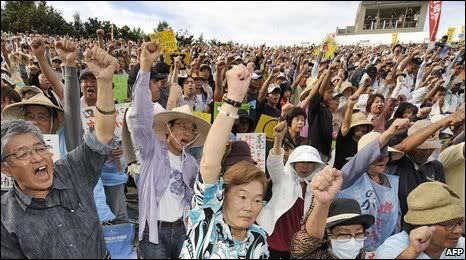
Protesters said they did not want the new government to let them down
Thousands of people have protested on the southern Japanese island of Okinawa demanding the removal of a US military base there.
The local mayor called on new Prime Minister Yukio Hatoyama "to put an end to Okinawa's burden and ordeal".
Japan and the US agreed in 2006 to relocate the Futenma base from an urban area to reclaimed land but the PM's election has rekindled opposition.
The protest comes ahead of this week's visit by US President Barack Obama.
The BBC's Roland Buerk in Tokyo says the row over the relocation of the base threatens to sour relations between Japan's new government and the country's key security ally.
Foreign Minister Katsuya Okada warned it was unlikely to be resolved before Mr Obama arrives in Japan on Friday.
Japan's new government has expressed a determination to have a less subservient relationship with the US.
Coral reefs
Organisers of the protest claimed 21,000 people took part.
Mayor of Ginowan, Yoichi Iha, told the rally: "I urge Prime Minister Hatoyama to tell President Obama that Okinawa needs no more US bases."
One protester, Yoshiko Yonamine, told AFP news agency: "Okinawans voted for the new administration, thinking it would remove the base from the island. I don't want it to betray us."
The base is in a busy city centre and amid local concern about noise, pollution and crime the two countries agreed in 2006 to move it to reclaimed land on Okinawa's coast.
But, our correspondent says, there is opposition to the new site too because of possible damage to coral reefs.
Okinawa is host to about half the 47,000-strong American force in Japan.
Mr Hatoyama, whose election in August ended more than half a century of conservative dominance, has suggested the base could be moved off the island, or perhaps out of Japan altogether.
The US insists Japan honour the 2006 agreement to move to the coastal Camp Schwab area.
The agreement would see Japan fund the replacement base and the transfer of 8,000 US marines to Guam by 2014.
BBC News

Protesters said they did not want the new government to let them down
Thousands of people have protested on the southern Japanese island of Okinawa demanding the removal of a US military base there.
The local mayor called on new Prime Minister Yukio Hatoyama "to put an end to Okinawa's burden and ordeal".
Japan and the US agreed in 2006 to relocate the Futenma base from an urban area to reclaimed land but the PM's election has rekindled opposition.
The protest comes ahead of this week's visit by US President Barack Obama.
The BBC's Roland Buerk in Tokyo says the row over the relocation of the base threatens to sour relations between Japan's new government and the country's key security ally.
Foreign Minister Katsuya Okada warned it was unlikely to be resolved before Mr Obama arrives in Japan on Friday.
Japan's new government has expressed a determination to have a less subservient relationship with the US.
Coral reefs
Organisers of the protest claimed 21,000 people took part.
Mayor of Ginowan, Yoichi Iha, told the rally: "I urge Prime Minister Hatoyama to tell President Obama that Okinawa needs no more US bases."
One protester, Yoshiko Yonamine, told AFP news agency: "Okinawans voted for the new administration, thinking it would remove the base from the island. I don't want it to betray us."
The base is in a busy city centre and amid local concern about noise, pollution and crime the two countries agreed in 2006 to move it to reclaimed land on Okinawa's coast.
But, our correspondent says, there is opposition to the new site too because of possible damage to coral reefs.
Okinawa is host to about half the 47,000-strong American force in Japan.
Mr Hatoyama, whose election in August ended more than half a century of conservative dominance, has suggested the base could be moved off the island, or perhaps out of Japan altogether.
The US insists Japan honour the 2006 agreement to move to the coastal Camp Schwab area.
The agreement would see Japan fund the replacement base and the transfer of 8,000 US marines to Guam by 2014.
Thursday, September 17, 2009
Masses in New Caledonia strike against French colonizers
By G. Dunkel
Published Sep 10, 2009 11:23 PM
Since the beginning of August, the struggle of oppressed workers and youth in New Caledonia has brought tensions to heights not seen since this South Pacific island had an armed rebellion against France in the late 1980s.
Marches and street sit-ins have brought protesters into direct conflict with the police. At least two cops have been shot, and RFI reported Aug. 6 that 30 had been wounded. The left-wing union leading the struggle is the USTKE, the Union of Kanak Workers and the Exploited (Union syndicale des travailleurs kanaks et des exploités).
Kanak is the official name of the Indigenous people of the island.
New Caledonia is in reality a colony of France, with some special privileges due to a sharp struggle in the 1980s. Its economy, based on the production of nickel, has done very well recently. Growth was 5 percent a year between 2004 and 2008, and Nouméa, its capital, has set a French record for the most luxury cars per person.
The economic stakes for France in New Caledonia are high. It is the world’s fifth largest producer of nickel, a vital ingredient for stainless steel, and has the world’s second largest reserves. Wages in the nickel industry are high. This is why 800 to 1,200 Europeans—mainly from France—move to the island each month.
The Kanaks, especially the youth, leave school early and live on what the French call “small jobs,” or temporary work at low wages, and on what they can grow in their gardens. They are shoved into ghettoes with tiny houses or buildings that need renovation, far from the better neighborhoods, and lack the education and skills needed for better-paying, full-time jobs.
USTKE has community organizers who travel around to these neighborhoods, especially to help families of those arrested in the protests. (Le Monde, Aug. 23) USTKE rejects charges that it has manipulated the youth into protest and points to “colonial police repression” as the cause of the violence New Caledonia has suffered during August.
The spark for the current conflict was the firing of an airline worker, a member of USTKE, for “incompetence.” The union vigorously defended him with marches, protests and runway blockades.
In the course of the struggle, Gérard Jodar, the leader of USTKE, and some of his comrades invaded Nouméa’s airport runway and took refuge in planes where they were attacked by the cops. His swift sentence of a year in prison took into account what the court called his “previous acts of vandalism and blockades.” (Le Figaro, Aug. 25)
Jodar’s sentence was recently confirmed, but he and a number of comrades have an appeal hearing scheduled on Sept. 15. The USTKE called a demonstration Aug. 22 to not only demand their leader’s freedom but also to protest the high cost of living and the “colonialism” the French state is exhibiting in Nouméa.
A demonstration was held in Paris on Aug. 24 where the French left expressed solidarity with USTKE. Corrine Perron, a representative of USTKE in France, told the protest, “We gather together to denounce the colonial justice in Nouméa and the unjustifiable condemnation of union militants in New Caledonia. It is necessary to alert the public that New Caledonia not only faces the threat of swine flu but also the threat of police and judicial repression.” (Libération, Aug. 24)
Tuesday, August 25, 2009
Saturday, August 16, 2008
Native Hawaiians Takeover Palace
Activists Arrested after Hawaiian Palace Takeover
From CNN
August 16, 2008.
HONOLULU, Hawaii (AP) -- A group of Native Hawaiians claiming to be the state's legitimate rulers occupied the grounds of a historic palace for two hours before being arrested by state officers in the second recent takeover of its kind.
A staff member of the Iolani Palace said she was assaulted and slightly injured during the takeover Friday night and then snubbed by city police who claimed that they didn't have jurisdiction. Gov. Linda Lingle said Saturday that there would be an investigation into the police response to the takeover.
A group of men, wearing red shirts with "security" stenciled in yellow on the back, took over the grounds by chaining the gates of the palace next to the State Capitol and posted signs saying, "Property of the Kingdom of Hawaiian Trust."
Kippen de Alba Chu, executive director of the Friends of Iolani Palace, said he and other staff members were locked down in the palace and a nearby administration building during the takeover.
"They've got a king, and the king wants to sit on the throne," de Alba Chu said.
State law officers climbed over the fence a couple of hours after the takeover began and made about 20 arrests. The palace, normally open to tours, will remain closed during the weekend to assess any damage and to ensure its security, police said.
Ah Yuen, an Iolani Palace employee, said she was assaulted by protesters and called for help from a Honolulu police officer, who told her the palace grounds were not under city police jurisdiction.
Witnesses said the confrontation started when Yuen went to the palace gate and talked with the protesters, who locked the gate with a chain and then forced their way into the palace itself before officers from the state Department of Land and Natural Resources came to arrest them.
Lingle said the people who invaded the palace "have to be shown it's not going to be acceptable."
"This is one of the most cherished sites in our state," Lingle said. "We always have to try to strike a balance between public access and security for the building and for the people there."
Laura H. Theilen, director of the Department of Land and Natural Resources, which oversees the palace, condemned the takeover.
"We intend to charge them to the fullest extent of the law," Thielen said.
The pro-sovereignty group identified its leader as King Akahi Nui, who was among those arrested. An "occupation public information bulletin" distributed by a member of the group began: "Majesty Akahi Nui, the King of Hawaii, has now reoccupied the throne of Hawaii. The Kingdom of Hawaii is now re-enacted."
Akahi Nui claims to have been crowned in 1998.
The takeover of the palace -- built in 1882, when the islands were ruled by a monarchy -- came on Admission Day, a state holiday marking Hawaii's admission to the United States on August 21, 1959.
Several Native Hawaiian organizations have rival claims to sovereignty over the islands. Another group calling itself the Hawaiian Kingdom Government occupied the palace grounds April 30 and has been getting permits to set up on the grounds each week since then. That group claims to be operating a functioning government from the palace grounds.
The ornate palace is operated as a museum of Hawaiian royalty. King Kalakaua built it, and it also served as the residence for his sister and successor, Queen Liliuokalani, the islands' last ruling monarch. Liliuokalani was imprisoned in the palace after the 1893 U.S.-supported overthrow of the monarchy.
After falling into disrepair, the palace was restored in the 1970s as a National Historic Landmark. It now includes a gift shop and is open for school groups and offers tours.
Hawaiian activists have long used the site for protests against the U.S. occupation of the islands.
Monday, August 04, 2008
AntiNuclear Groups Start Events in Japan
Antinuclear groups start events
Kyodo News
Two major antinuclear organizations have begun holding events to mark the 63rd anniversary of the U.S. atomic bombings of Hiroshima and Nagasaki.
The Japan Congress Against A- and H-Bombs, or Gensuikin, held an international forum Saturday in Yokosuka, Kanagawa Prefecture, and adopted a resolution against the planned deployment of a nuclear-powered aircraft carrier at the U.S. Navy base in Yokosuka.
About 100 people participated in the forum, with six panelists, including activists from China, South Korea and the United States, exchanging views on denuclearization in northeastern Asia and the deployment of the USS George Washington.
The Japan Council against Atomic and Hydrogen Bombs, or Gensuikyo, meanwhile, held an international forum Saturday in Hiroshima with 250 people taking part.
The forums were held amid news reports that water with trace amounts of radioactivity may have leaked for months from a U.S. nuclear-powered submarine when it traveled around the Pacific to ports in Guam, Japan and Hawaii.
The two groups will each hold rallies and other events in Hiroshima and Nagasaki through next Saturday.
The Japan Times: Monday, Aug. 4, 2008
(C) All rights reserved
Saturday, September 08, 2007
Japanese City Opposes New Runway
Japanese city opposes new runway
UPI
Sep 8 05:22 PM US/Eastern
NAGO, Japan, Sept. 8 (UPI) -- Residents of a Japanese city remain opposed to plans to build a U.S. military runway near their homes, businesses and schools.
"We want the runway to be built offshore to prevent (noise from) the base from affecting local residents' daily lives," Nago's mayor, Yoshikazu Shimabukuro, Saturday told Defense Minister Masahiko Komura.
The runway is to be built as part of the relocation of the U.S. Marine Corps' Futenma Air Station to Camp Schwab in Nago on Okinawa, reported Mainichi Daily News.
Nago's demand for an offshore runway runs counter to an agreement made last year between Japanese and U.S. defense officials to build it at the camp, the newspaper reported.
Wednesday, July 18, 2007
Protests Won't Hold Up US Military Construction in Guam
Radio New Zealand International
The Voice of New Zealand, Broadcasting to the Pacific
http://www.rnzi.com/pages/news.php?op=read&id=33365
Te Reo Irirangi O Aotearoa, O Te Moana-Nui-A-Kiwa
. . . . . . . . . . . . . . . .
Guam government says land protest won't hold up construction of US
military base
Posted at 08:23 on 02 July, 2007 UTC
---------------------------
The office of Guam's Governor, Felix Camacho, says it doesn’t expect
protest action by Urunao landowners to hamper planned construction by the
US military in their area.
About 400 Urunao landowners are concerned that they are being kept in the
dark about how their land is to feature in the construction plans for the
US military's pending build-up with the relocation of 8,000 Marines from
Okinawa to Guam.
The Marianas Variety newspaper reports that some of the landowners have
blocked off the access road leading to their property.
The Governor's spokesman, Shawn Gumataotao says the military are planning
construction on land the federal government legitimately owns.
But he concedes that access to and from that property is the issue:
"It's been an issue for, gosh, on six years now, and they (the military)
are working with the landowners individually to cmoe to some resolution.
It's not going to be an easy one, considering the amount of activity
that's going to be in that area on the footprint that belongs to the
federal government"
Wednesday, June 06, 2007
Peace marches expected to snarl Okinawa
By David Allen and Chiyomi Sumida,
Stars and Stripes
Pacific edition, Friday, May 11, 2007
CAMP FOSTER, Okinawa • If you're driving along major highways on Okinawa now through Sunday, expect delays due to a three-pronged peace march by thousands of people commemorating the 35th anniversary of Okinawa's reversion to Japan.
Local residents, peace activists and labor union members from Okinawa and mainland Japan are expected to take part in the marches that were slated to begin Thursday and end Sunday with a massive attempt to encircle Kadena Air Base.
The Okinawa Peace March is an annual event that began in 1978, six years after the U.S. ended its WWII occupation.
Organizers say 3,000 people will participate in the marches, beginning with a gathering in the northern village of Kunigami on Thursday that will proceed south to Nago for a 6 p.m. protest rally against plans to build a Marine air facility on Camp Schwab to replace Marine Corps Air
Station Futenma.
As of Wednesday, military officials on Okinawa had not issued any advisories concerning the protest activities.
On Friday, the marchers will take off on three routes.
The Eastern March will start Friday at the Henoko fishing port at 8:30 a.m. and will proceed south along Highway 329, stopping briefly for a rally in front of the main gate to Camp Hansen, organizers said.
On Saturday the eastern route will continue, starting at 8:30 a.m. in Uruma and heading south down Highway 329, diverting to Highway 330 and a rally in front of Kadena Air Bases' Gate 2.
The Western March starts from Onna village at 8:30 a.m. Friday and proceeds south along Highway 58 to Highway 6 in Yomitan and west to Torii Station, where another rally will take place. The western marchers then will pick up their walk at the Yomitan village office Saturday at 8:30 a.m., walking along Highway 6 and back to Highway 58, passing by Kadena Air Base's Gate 1, where they plan to have a brief rally.
The southern marchers step off Friday morning at Peace Prayer Park in Itoman. On Saturday they will start in Urasoe and walk north up Highway 330, pausing for brief rallies in front of the U.S. Consulate General's Office, MCAS Futenma's Gate 2 and Camp Foster's headquarters gate.
The three groups are scheduled to meet Saturday at the Chatan Town Ball Field for a rally at 6 p.m., organizers said.
Okinawa Peace March organizers say they expect about 20,000 people in an attempt to encircle Kadena Air Base in a protest expected to start at 3 p.m. Sunday and last one hour.
*"Although Okinawa is marking the 35th anniversary of its reversion to Japan, the U.S. and Japanese governments continue to pursue a military-first policy for the island,"* said Shiko Sakiyama, chairman of the Okinawa Peace Activity. He cited *plans to build the new air
facility on Camp Schwab and the recent move of Army PAC-3 missile batteries at Kadena Air Base as signs that Okinawa will continue "to bear the burden" of U.S. bases.*
*"Encircling Kadena Air Base is a way to express the voice of the Okinawa people against this military-first policy," he said. "It is also a way for us to send a message to the rest of the world that Okinawa aspires to world peace." *
Anti-base protesters last circled Kadena in July 2000, during the Group of Eight summit, drawing international attention to the Okinawa base issue. Then, 18,000 to 27,000 people, depending on who was doing the counting, *managed to join hands around the 10.8-mile perimeter of the air base*.
Sunday, May 20, 2007
Take Action For Henoko
Japan Begins U.S. Base "Pre-survey" against Local Opposition.
Today, the Japanese government set out their "pre-survey" for a new U.S. military off-shore base in Henoko, Okinawa.
At 6:20 this morning, Japan Coast Guard patrol vessels and ships chartered by Defense Facilities Administration's Naha Bureau showed up off-shore at Henoko. Local base opposition groups confronted them with seven boats, one rubber raft and 12 canoes. The Coast Guard proceeded to conduct spot inspections against five of the protest boats, (while their own chartered ships remained un-inspected), and this delayed the protesters' departure from Henoko port for about an hour.
On the sea, the protesters attached themselves to the survey ships in an attempt to stop them. The people called for stoppage of the survey, imploring "do not build a base for killings." In spite of the resistance, survey materials such as iron pipes were placed on the sea bed at several survey spots where the protesters could not allocate enough people.
According to an Asahi news report today, the Japanese Minister of Defense Fumio Kyuma acknowledged the involvement of Japanese Maritime Self Defense Forces divers in this activity. Some reports suggested the JMSDF did preparatory work in the middle of the night without being detected by protesters. Kyuma said, "the JMSDF's involvement is correct and the opposition's interruption of the private contractors' work is abnormal."
However, Hiroshi Nakachi, a professor at Ryuku University, warned in his interview with the Okinawa Times that "the fundamental role of the Self Defense Forces is to prevent aggression from overseas, not intervene in domestic confrontations. The people in Japan should be wary of this unchecked expansion of the SDF's activities."
Back on land, around 100 people kept their all-night vigil at the Henoko fish port, shouting encouragement to the protesters on the ocean.
The protesters are calling for more people to come immediately to Henoko to bolster opposition to the base "pre-survey."
Please take action for Henoko!
Hikaru Kasahara (Asian Peace Alliance[APA] Japan)
PPSG"
Wednesday, October 26, 2005
US Military Retreats Over Japanese Base After Protests
US military retreats over Japanese base after protests by islanders
By David McNeill in Tokyo
Published: 27 October 2005
The United States has been forced to back down over its plan to build a large offshore military base on the southern Japanese island of Okinawa after local protests stalled construction.
Washington and Tokyo had wanted to build a heliport and 1.5-mile runway over pristine coral reef more than a mile offshore, near Heneko village. But the plan enraged many locals on the small island, which already hosts around half of the 37,000 American troops stationed in Japan. Environmentalists joined the opposition to the planned base, saying it would destroy the reef, which is home to the dugong, an endangered species of sea mammal.
Richard Lawless of the US Defence Department said yesterday that a compromise, which will entail moving the new base to nearby Camp Schwab, had been agreed after considering "the importance of the Japan-US alliance".
Tokyo is an important ally in America's "war on terror" and Washington considers Okinawa, which is close to China and North Korea, a vital military lynchpin amid a major realignment of US forces worldwide. Japan contributes more than $1bn (£560m) a year and leases thousands of acres of land to US forces stationed in the country.
A congressional report released two months ago by the Overseas Bases Commission recommended maintaining current US troop levels on Okinawa. It said: "Diminishing our combat capability on the island would pose great risk to our national interests in the region."
Washington and Tokyo agreed in 1996 to build a new heliport to replace Futenma base, which sits in the heart of Okinawa's densely populated Ginowan City. The agreement had been forced on the two governments by the largest anti-US protests in Okinawa's modern history. The protests followed the kidnap and rape of a 12-year-old girl by two US Marines and a sailor.
But the Heneko plan, announced after years of tortuous negotiations, then proved deeply unpopular: a survey by the Okinawa Times-Asahi Shimbun newspaper last year found that 81 per cent of local people opposed it and dozens of mainly elderly protesters began blocking test drilling for the site 18 months ago.
The stalling of the plan angered Washington and is widely blamed for the cancellation of a scheduled visit to Japan this month by the Defence Secretary, Donald Rumsfeld. Tokyo was keen to resolve the dispute before President George Bush's visit next month; a relieved Japanese Secretary of Defence, Yoshinori Ono, said last night that the talks had been "long and difficult".
Despite the climb-down, however, protesters said last night that they were angry that the base was going to be built in Okinawa at all. Many said that the move to Camp Schwab would still mean construction would take place up to the shoreline.
"Tokyo and America just completely take us for granted. If they want a new base, why don't they build it on the mainland or outside Japan altogether?" asked one of the protest leaders, Osamu Taira. "The only reason that they foist it on us is because they know we are small and powerless. We will protest until this plan is scrapped and the military is gone from here."
Subscribe to:
Posts (Atom)