Tuesday, November 15, 2016

Trump, trade and the US pivot to Asia: what lies ahead?

President-elect likely to make some big changes to America’s foreign policy in region, analysts say
PUBLISHED : Thursday, 10 November, 2016, 7:04am
UPDATED : Thursday, 10 November, 2016, 10:18am
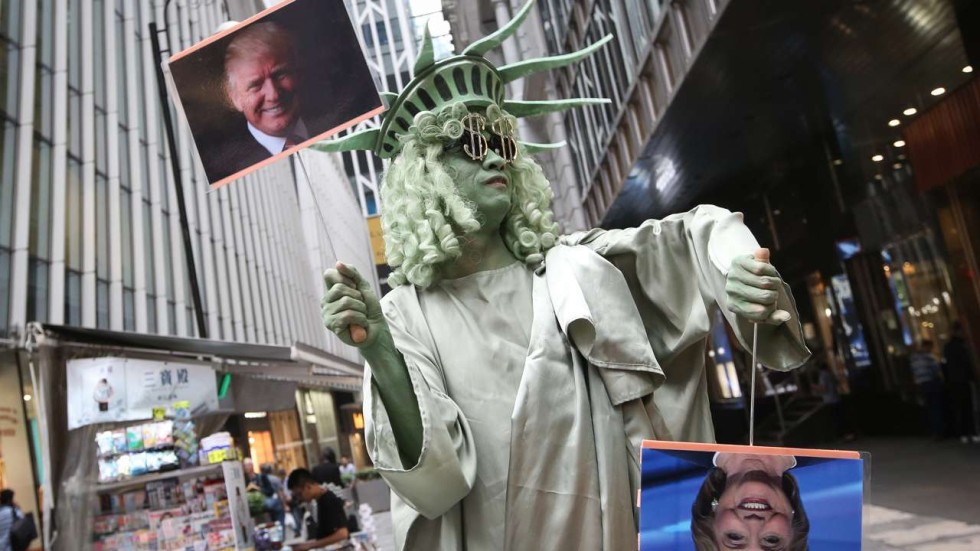
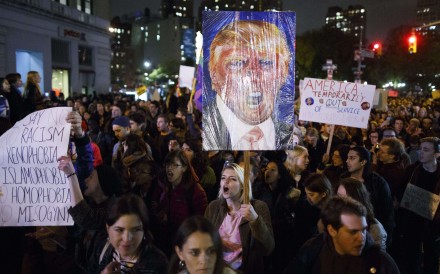
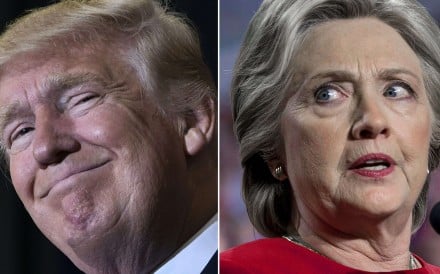
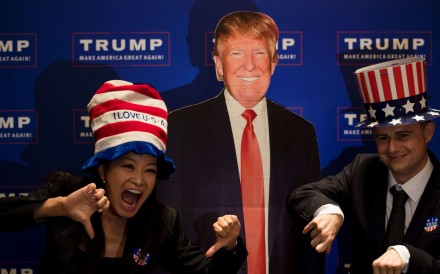
US presidential elections hardly ever hinge on foreign policy, but Donald Trump’s victory has raised serious concern in Asia about US policy in the region, given his rhetoric on the campaign trail on diplomatic isolation and trade protectionism.

How the US Military Spies on Okinawans and Me

Emails and reports obtained under the US Freedom of Information Act from the US Marine Corps include tallies of the number of protesters outside the base at the daily sit-ins and the names of some demonstrators. The one on top contains a profile and photo of journalist Jon Mitchell. (Photo: Jon Mitchell)
Outside the jurisdiction of its bases, the United States Marine Corps (USMC) on Okinawa is conducting extensive surveillance of Japanese residents, peace groups and the media -- including me (see above). The operations, revealed by documents obtained under the US Freedom of Information Act, have been denounced by Japanese lawyers, with one expert calling them a violation of national sovereignty. On October 23, Paris-based NGO Reporters Without Borders issued a press releasecondemning the surveillance operations.
The 268 pages of FOIA-released papers from between May and July consist of emails from the Provost Marshal office at Camp Schwab, Nago City, and reports titled "Protest Activity Intelligence Bulletins" compiled by the Criminal Investigation Division (CID) of Camp Butler, theUSMC's umbrella term for its bases on Okinawa. The documents are classified as "For Official Use Only" and "Law Enforcement Sensitive."
The emails include daily tallies and the names of some Okinawans engaged in sit-in protests outside Camp Schwab, the proposed site for the relocation of Futenma Air Station. The emails are distributed by the Provost Marshal's office to more than 30 parties, including the CID, Japanese security guards and marines with ranks as low as lance corporal.

Okinawa governor guardedly hopeful Trump will reduce U.S. base presence


The governor of Okinawa expressed guarded hope Wednesday that Donald Trump’s victory in the U.S. presidential election may lead to a reduced military presence in the prefecture, where most U.S. military facilities in Japan are located.
During the campaign, Trump complained that Japan shoulders too little of the cost of stationing U.S. forces there, and said he would consider withdrawing those military forces.
“While I am hopeful about the kind of measures (Trump) will take regarding the Okinawa base issue, I would like to keep a close eye on it,” Gov. Takeshi Onaga told reporters at the prefectural government office. For years, the prefecture has called on Tokyo and Washington to ease its burden from hosting U.S. military bases.

Election Animus Dims Hope for US Role in Asia Pacific

North Korea has ramped up nuclear and missile tests in the Korean Peninsula, tensions have mounted over China's territorial claims and aggressive actions in the South China Sea, and the new president of longtime ally the Philippines has vowed to 'break up with America' and turn to China as its main ally.
Both former President George W. Bush and President Barack Obama worked to open diplomatic, security and economic channels in a bid to cement America as a leader in the Asia-Pacific, where China is rapidly amassing power and influence. U.S. military assets in the region have been growing since Obama promised a 'pivot to Asia' early in his presidency.
Statements by Republican presidential nominee Donald Trump and Democratic presidential nominee Hillary Clinton, however, have left many in the region wondering whether that commitment will continue.

Settlement in Kaneohe military housing ground contamination lawsuit kept private

by: Rob Perez for   The Honolulu Star-Advertiser 
 published: November 08, 2016

 HONOLULU (Tribune News Service — A lawsuit alleging that military families were not informed of high levels of ground contamination before they moved into their Kaneohe Marine Corps Base housing has been settled.
But even though the litigation raised public-safety questions for residents of a roughly 2,500-unit housing development on federal land and was filed against a co-defendant partly owned by the Navy, the settlement is secret.
Taxpayers aren’t privy to the terms, including whether federal dollars will be part of any possible payout.
“If it involves taxpayer dollars, I think taxpayers should have the right to know how (those dollars) are being spent,” said Neil Gordon, an investigator for the Washington, D.C.-based Project on Government Oversight, which advocates for transparency in government operations.

Lawsuit: Army denies access to Hawaiian cultural sites

By JENNIFER SINCO KELLEHER | Associated Press | Published: November 7, 2016
HONOLULU — The U.S. Army is violating a court settlement by restricting access to cultural sites in a valley many Native Hawaiians consider sacred, a lawsuit filed Monday alleges.
Attorneys for environmental law organization Earthjustice filed the lawsuit in federal court in Honolulu on behalf of Malama Makua, a Native Hawaiian cultural group. It's the latest action in a long-running legal dispute over Makua Valley, the site of decades of military training.
A 2001 settlement allows Malama Makua to access sacred sites twice a month, but the Army suddenly imposed a "blanket ban" in 2014 when it claimed it first needed to obtain clearance from historic preservations to cut grass on trails leading to cultural sites so that any unexploded ordnance could be avoided, the lawsuit said. 

Can America Remain a Pacific Power?


This article was created in collaboration with the Wilson Center. Shihoko Goto is the senior associate for Northeast Asia at the Woodrow Wilson International Center for Scholars. Michael Kugelman is the senior associate for South and Southeast Asia at the Wilson Center. The views expressed here are the authors' own.


Through his tough talk and shrill rhetoric, the president of the Philippines is giving voice to deep concerns quietly harbored by other leaders in the Asia-Pacific.

US Military to Stay in Pacific Despite Public Opposition in Manila

The U.S. military's top official told troops Wednesday that the recent anti-American comments by the Philippine president will have no effect on the United States' growing presence in the Pacific region.
Defense Secretary Ashton Carter spoke to a room full of troops that includedU.S. Army, Marine and Air Force personnel at Fort Leonard Wood, Missouri.
One Marine staff sergeant asked Carter how the recent comments by Philippine president Rodrigo Duterte about "breaking ties with the U.S. and aligning itself with Russia and China" will affect the U.S. presence in the Pacific.

Guam's military importance noted by US, Republic of Korea

Posted: Nov 02, 2016 3:36 PMUpdated: Nov 09, 2016 3:36 PM
On Tuesday, senior military officials from the United States and the Republic of Korea stood their ground at Naval Base Guam, warning North Korea to end its nuclear program. 39th chairman of the Republic of Korea Joint Chiefs of Staff General Sun Lin Lee said if North Korea continues its provocations, the ROK-US alliance will have to review all military options.
He added that Guam is a key player because of its strategic location, telling KUAM News, "I realized that Guam is not only an important factor that maintains security in the Pacific Region, but it's also a hub that serves as a center for our response to North Korea's nuclear and WMD threat."
Commander of the United States Forces Korea, General Vincent Brooks, said Guam contains various offensive and defensive capabilities meant to defeat any possible threats, including the Terminal High Altitude Area Defense Battery, B-1 bombers, and nuclear ballistic submarines.

Comments
General Kim is in no place to say what he may think about Guam.

Someone from the U.S. military has not educated General Kim because if General Kim was educated about Guam, he would know that Guam is an American military colony and its residents have been historically disadvantaged and denied basic political rights to this day.

If General Kim was educated about Guam, he would understand that the military has instituted a policy of American governance for almost 5 decades that was arbitrary, and racist and he would know that the military build-up on Guam was never consented to by the Chamorro people of Guam.

If General Kim was educated about Guam, he would understand that the island has a rich and ancient culture, language and custom set that is not American produced, manufactured or related.

If General Kim was educated about Guam, he would have reserved his comments.

Thumbs down on General Kim's comments about Guam.
LikeReply1Nov 3, 2016 10:04am

US sends message with nuclear sub visit to Guam

(CNN) - The US military is sending a double-barreled message this week to potential adversaries in the Pacific.
A US Navy submarine carrying nuclear-tipped ballistic missiles is visiting Guam for the first time since the late 1980s and US and Japanese troops will practice amphibious landings on Pacific islands.
The submarine USS Pennsylvania (SSBN 735) is making what the Navy formally calls a "scheduled port visit" to the US territory in the Pacific, according to a Navy press statement.
But a US defense official says that both Japanese and South Korean delegations are in Guam at this time and will be offered rare tours of the submarine.

‘First in 28 years’: ‘USS Pennsylvania’ ballistic-missile sub comes to Guam, Pacific Ocean

[Here, have some military propaganda . . . sigh]
The ballistic-missile submarine ‘USS Pennsylvania’ has arrived in Apra Harbor, on the US Pacific territory of Guam, the US Navy has said in a press release.
“Ballistic missile submarines such as ‘USS Pennsylvania’ are on patrol continuously, providing a critical, stabilizing and highly effective element of the US nuclear deterrence force,” the release stated, emphasizing the visit is scheduled.
“This specific visit to Guam reflects the United States’ commitment to its allies in the Indo-Asia-Pacific and complements the many exercises, training, operations, and other military cooperation activities conducted between the US and its partner nations.”

OUR VIEW: Ahead of military buildup, save medicinal plants


Marine Corps Activity Guam recently invited Chamorro traditional healers to collect medicinal plants from Naval Computer and Telecommunications Station. The visit is a [superficial and essentially meaningless nai] example of cooperation between the U.S. military and local residents ahead of the military buildup on Guam.
Medicinal plant collectors are welcome to visit Guam's military installations throughout the year, access program coordinator Dave Snyder said in an email. “This program is conducted on land that is managed (or will be managed) by the Marines, Navy and Air Force. Plant collection could take place on Naval Base Guam, Andersen Air Force Base, and to a limited extent on the Naval Computer and Telecommunications Station (NCTS) and the Naval Magazine.”

Young Okinawans Visit & Study Military Bases


October 25, 2016 Ryukyu Shimpo
On October 24, young people of Okinawan heritage in their 20s and 30s from countries around the world visited places shaken by military base issues, namely the ocean at Henoko and the woods in Takae, prior to the opening of the 6th Worldwide Uchinanchu Festival on October 27. These participants shared thoughts such as, “resistance is essential after all,” “the existence of the bases is a problem which affects people’s lives,” and “I also wanted to hear the thoughts of people who accept [the bases].” Linked to the festival, the bus tour Yuntaku Bus 2016 via Takae and Henoko took about 20 participants including 13 from North and South America to view these areas.

U.S. sailor in Okinawa arrested over alleged assault


The Okinawa Prefectural police arrested a U.S. seaman Sunday on suspicion of assaulting a man on a street in the town of Chatan.
Navy Petty Officer 3rd Class Charles Wayne Lebaron, 22, is suspected of pushing the 21-year-old man to the ground and choking him at around 11:40 p.m. Saturday.
Lebaron, stationed at the U.S. military’s Camp Foster in Okinawa, has admitted to the charges, according to the police. He was believed to be under the influence of alcohol at the time.

Japan mulls deal to retrieve Russian-held isles by banning U.S. military from using them

KYODO
Tokyo might promise Moscow that returning the disputed islands off Hokkaido to Japan will not mean that U.S. military forces will be stationed there in line with Japan-U.S. security arrangements, diplomatic sources have said.
Tokyo believes such a promise will facilitate negotiations on the long-simmering dispute because Russia is particularly sensitive about U.S. military moves.
The idea has surfaced ahead of Russian President Vladimir Putin’s trip to Japan in December. Japan sees the visit as a chance to make progress on the decades-old territorial row, which has prevented the two countries from concluding a peace treaty to formally end World War II.

Why Okinawa Matters: Japan, the United States and the Colonial Past

Saturday, 29 October 2016 00:00By Richard Falk, The Asia-Pacific Journal | Op-Ed
  •  When President Barack Obama visited Hiroshima in May of 2016, there was an effort to persuade him to put Okinawa on his travel itinerary, but as has happened frequently throughout the long tortured history of Okinawa, the request was ignored. In an important sense, Okinawa is the most shameful legacy of Japan's defeat in World War II, exceeding even the sites of the atomic attacks by its daily reminders of a continued colonialist encroachment on Okinawan national dignity and well-being.
Okinawa is being victimized by overlapping exploitations with that of the United States reinforced and legitimized by mainland Japan since the reversion of Okinawa to Japanese rule in 1972. For the United States, Okinawa serves as a hub for its strategic military operations throughout the Pacific, with 32 military bases on the Ryukyu Islands, including more than 20 on the main island of Okinawa. The Okinawa bases occupy about 20% of the island, with Kadena Air Base having been used for B-29 bombing missions during the Korean War more than a half century ago, and the island serving as a major staging area throughout the Vietnam War. It was also a secret site for the deployment of as many as 1,000 nuclear warheads, as acknowledged by the US decades later, together with the claim that the nuclear warheads were removed prior to the reversion of Okinawa to Japanese rule in 1972. In recent years, Okinawa rarely receives global news coverage, except when a sex crime by American servicemen provokes local outrage and peaceful mass demonstrations, followed by the strained apologies of local American military commanders.

Opinion: Trump will need to cut a series of deals

The media elite called the presidential election wrong.  
Trump’s race to the bottom was predicated on hatred, racism, incomplete and inaccurate polling, late deciders and the awakening of the uneducated white Americans throughout the nation, especially those living in key political areas such as Wisconsin, Michigan, Pennsylvania and Florida.
In my opinion, the billionaire white guy was able to connect to the masses of low and middle income whites seeking to take back a country that they have felt was slipping away from progress made by non-white population segments. For better and for worse, it has worked.  
This election is historic in many ways because Trump is slated to become the first president in American history not to serve in previous government positions or in the military.  

Does Trump victory spell end of US as Pacific power?


  • 13 November 2016
  • Donald Trump's surprise election victory has caused widespread jitters throughout Asia, echoing global concern over the implications of a more isolationist and protectionist attitude by the US during his time in office.
    Mr Trump's approach to the world's most important bilateral relationship - China and the US - is still a relative unknown, fuelling speculation over whether the US will eventually recede from the Asia-Pacific region and allow China to fill the vacuum.
    Some conservatives in China have suggested that the US must finally face the reality of China overtaking the US as the leading regional power. The reality of Mr Trump's approach, however, may be "congagement": a mixture of enhanced containment and engagement, as opposed to the "smart power" doctrine of the Obama years.

Donald Trump’s Defense Plans and Their Implications for Asia

WORLD NEWS /13 NOV 2016 
https://intpolicydigest.org/2016/11/13/donald-trump-s-defense-plans-implications-asia/

Donald Trump’s Defense Plans and Their Implications for Asia

As President-elect Donald Trump prepares to be sworn in, international observers and his fellow countrymen are trying to understand the complex and unpredictable dynamics which are characteristic of American presidential elections. For security analysts the world over, political rhetoric matters little when compared to stated defense plans which are deliberated by a diverse array of policymakers, practitioners and strategists. To say that Donald Trump does not have a defense policy plan might sound plausible.

Opinion: How Much Will Duterte Wreck the US-Philippines Military Alliance?

As I’ve repeatedly pointed out, for all the headlines that Philippine President Rodrigo Duterte generates – including on his “separation” from the United States – more often than not his rhetoric does not translate well into reality (See: “The Limits of Duterte’s US-China Rebalance”).
Indeed, even his advisers have privately, and sometimes even publicly, urged those trying to understand Philippine foreign policy to look more at what the administration actually does, rather than what Duterte says.
That applies to the U.S.-Philippine defense relations too. As I have noted previously, while Duterte had called for an end of all U.S.-Philippine military exercises, defense officials including Defense Secretary Delfin Lorenzana had indicated that Duterte in fact had little knowledge about the full extent of ties, even though his anti-Americanism is quite real and deeply-rooted (See: “Why the Philippines’ Rodrigo Duterte Hates America”).

U.S. military presence in Japan benefits both nations: Abe

TOKYO —
Prime Minister Shinzo Abe indicated Monday that Japan’s burden of costs in hosting U.S. military bases is at an adequate level as the troops’ presence benefits both countries.
“Both Japan and the United States benefit from the role played by the U.S. military stationed (in Japan),” Abe told a Diet committee.
President-elect Donald Trump repeatedly called on Japan and other U.S. allies during his presidential campaign to pay more to host U.S. forces in their countries.
There should be an “appropriate sharing between the United States and Japan” of costs to station U.S. troops in Japan, the prime minister said.

Karanga Tangaroa – protesting arrival of Naval military

Press Release – Pacific Panthers
On Thursday the 17th of November, the Pacific Panthers in solidarity with Auckland Peace Actions Week of Peace, will protest the arrival of Naval military vessels in the Waitemata Harbour.PRESS RELEASES
Karanga Tangaroa – FOR IMMEDIATE USE
On Thursday the 17th of  November, the Pacific Panthers in solidarity with Auckland Peace Action’s Week of Peace, will  protest the arrival of Naval military vessels in the Waitemata Harbour.