Wednesday, November 16, 2016

U.S. forces to tell Tokyo this week of largest Okinawa land handover since 1972 reversion

The U.S. military is expected to notify the Japanese government later this week that it will return by year’s end roughly half of its Northern Training Area in Okinawa, as it has confirmed construction of helipads will be completed in the portion it retains, a Tokyo government source said Tuesday.
The Japanese and U.S. governments are making preparations to hold a ceremony on Dec. 20 to commemorate the return of the land within the U.S. military training area in the villages of Kunigami and Higashi, the source said.
The return would reduce the acreage occupied by U.S. military facilities in Okinawa by 17 percent, and would be the most land returned since the 1972 reversion of Okinawa to Japan from U.S. control. The prefecture hosts the bulk of U.S. military facilities in Japan.

Never mind closing Guantanamo, Trump might make it bigger

WASHINGTON — Never mind closing Guantanamo. It might be getting bigger.

 President Barack Obama is running out of time to fulfill his longstanding promise to shutter the prison at the U.S. military base in Guantanamo Bay, Cuba. Sixty inmates remain in the facility and only a third are cleared for release.

 If Obama can't close it, his successor likely won't. Donald Trump has not only pledged to keep Guantanamo open, in April he said that "we're gonna load it up with some bad dudes, believe me. We're gonna load it up."

 He told The Miami Herald in an interview that month that he would support trying U.S. citizens accused of terrorism at the base, though that would require Congress to change federal law and would likely face constitutional challenges.

Tuesday, November 15, 2016

Letter: Marines have no place in Okinawa

Nov. 11, 2016
Is it existential denial or simple rejection of marines that is at issue in Okinawa?
While Okinawa demands that the U.S. Marine Corps be withdrawn from the prefecture completely, the central government argues against it by saying military matters should be considered integrally as a whole and therefore Okinawa’s case is off the mark.
However, the central government falls into an either intentional or unintentional fallacy in that it mixes up our demand of the marines’ outright withdrawal from Okinawa with the overall denial of the Marine Corps’ raison d’etre in the U.S. military.

Legal immunity for US Military Workers in Japan/Okinawa


U.S. Defense Secretary Ash Carter may visit Japan early next month as the two countries aim to conclude a pact to narrow the scope of U.S. military base workers provided limited legal immunity under the Status of Forces Agreement (SOFA), according to a Japanese source.
The two countries are trying to arrange the visit to discuss the pact and a number of other security issues before the Jan. 20 inauguration of President-elect Donald Trump, who has been critical of the Japan-U.S. security alliance, the government source said.
Other issues to be discussed include Japan’s request to return before the end of the year some of the land used by the U.S. forces for the Northern Training Area in Okinawa Prefecture, the source said.
Carter is expected to meet with Defense Minister Tomomi Inada, where they are likely to re-affirm close cooperation in dealing with China’s military expansion in the South China Sea and North Korea’s nuclear arms and missile development, the source added.
They are also likely to exchange opinions on Trump’s remarks demanding Japan shoulder more of the financial burden of hosting U.S. forces, the source said.
The envisioned pact on base workers is aimed at assuaging anti-U.S. base sentiment in Okinawa triggered by the arrest of a civilian base worker in April for the murder of a local woman.

Asia worries about Trump changes

By PAUL ALEXANDER | STARS AND STRIPESPublished: November 10, 2016
Asian allies are heartily congratulating Donald Trump for his election victory while worrying whether his “America first” focus will erode regional security and undercut trade agreements.
No one is quite sure what to expect from the billionaire businessman who has no political experience and is perceived as a hot-head who sees the world in terms of profits and losses.
Some of the biggest questions are what will happen to the “Pacific pivot,” President Barack Obama's plan to bolster America’s military and trade presence in a region that he saw as critical to the future, and the Trans-Pacific Partnership, the 12-nation trade deal that Trump has derided as contrary to America’s best interests.

The hated Trans-Pacific Partnership trade deal will soon be dead. Yay?

Comment The Trans-Pacific Partnership is almost certainly dead. Or at least America's role in it is.
The much-maligned trade agreement that took seven years to draw up and simplifies trading rules between nations in the Pacific Rim – Australia, Canada, Japan, Mexico, New Zealand, Singapore and a number of others – hit fierce opposition during the presidential elections, and president-elect Donald Trump has vowed to oppose it.

Unlike most of Trump's policy statements, he has been consistent in his opposition to TPP and even to the long-running NAFTA trade agreement, which he has repeatedly referred to in the most dire terms and has promised to renegotiate. "There is no way to fix the TPP," Trump said in June.

That means that TPP's survival in the United States relies on an up-down vote in Congress in the lame-duck session between the elections and when Trump takes over as president.

DoD Recommits to Today’s Military, Force of Future on Veterans Day

By Terri Moon CronkDoD News, Defense Media Activity
PRINT  |  E-MAIL  |  CONTACT AUTHOR
WASHINGTON, Nov. 11, 2016 — As America remembers those who have served on Veterans Day, the Defense Department reaffirms its dedication to today’s force and recommits itself to building the Force of the Future, Defense Secretary Ash Carter said. 

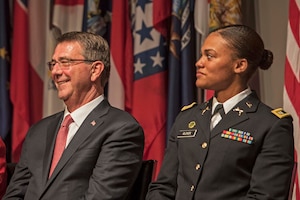
Defense Secretary Ash Carter reacts to a light moment during the 19th annual Veterans Day ceremony at the Women in Military Service for America Memorial at Arlington National Cemetery in Arlington, Va., Nov. 11, 2016. DoD photo by Air Force Tech. Sgt. Brigitte N. Brantley

Defense Secretary Ash Carter reacts to a light moment during the 19th annual Veterans Day ceremony at the Women in Military Service for America Memorial at Arlington National Cemetery in Arlington, Va., Nov. 11, 2016. DoD photo by Air Force Tech. Sgt. Brigitte N. Brantley
The secretary was keynote speaker at a Veterans Day ceremony at the Women in Military Service for America Memorial at Arlington National Cemetery today.
“Today, we honor every American who has stepped forward to serve,” he said of the more than 20 million living veterans and more than 2 million Americans still serving in uniform around the world.
Force of the Future
“The men and women of the force of the future will inherit a remarkable legacy,” Carter said in prepared remarks. “Since the nation’s founding, each of our soldiers, sailors, airmen, Marines, Coast Guardsmen and veterans -- men and women -- active, Guard, and reserves -- has done one of the noblest things a person can do, which is to help defend our country and make a better world for our children.”

China's New Copy of Russian Supersonic Missile Has US Pacific Fleet Worried

China's new CM-302 supersonic anti-ship cruise missile is a variation on Russia's Yakhont missile, and the development will worry the US as it tries to impose its authority in the Pacific region, military expert Vasiliy Kashin told Sputnik. 

At the Zhuhai air show earlier this month, China Aerospace Science and Industry Corp (CASC) unveiled its CM-302 supersonic anti-ship cruise missile.  According to CASC, the missile system can carry a 250kg warhead and has a range of around 290 km. Traveling faster than the speed of sound, it has an accuracy rate of 90 percent.  

There are only two other supersonic anti-ship cruise missiles on the market, Russia's P-800 Onyx (Yakhont) and the joint Russian-Indian BrahMos supersonic missile, for which the P-800 served as the basis for development.  The Yakhont is capable of traveling at up to 2.6 times the speed of sound and has a 300km range. It can carry a warhead weighing up to 200kg, and can be launched from land, sea, air and submarine. The sea-skimming missile is able to fly at altitudes between 5 and 15 meters above sea level, avoiding radar and infrared detection as it approaches its target. 

What does Trump's win mean for the Asia Pacific region?

8:04 pm on 11 November 2016 
Analysis: Donald Trump is unlikely to take the US back to its pre-1941 isolationism, but a change in attitude to Asia and the Pacific is inevitable.
As governments around the globe come to terms with the title 'President Donald Trump', trade and security experts in the Asia-Pacific region are considering the implications of a lurch away from the status quo in their dealings with the US.

The Latest: Italian ex-premier Berlusconi lauds Trump

LONDON -- The latest on world reaction to the U.S. presidential election (all times local):
1:25 p.m.
Silvio Berlusconi is congratulating his fellow billionaire businessman-turned-politician, saying he is convinced President-elect Donald Trump will guarantee U.S. leadership in the free world "with authority and equilibrium."
Berlusconi's parallels to Trump are well known: A showman with a reputation as a womanizer who charmed Italians by speaking his mind, Berlusconi had a Trump-like improbable rise from cruise ship crooner to media mogul to three-time premier. He calls Vladimir Putin a friend.
A tax fraud conviction knocked Berlusconi out of parliament in 2013 and seriously hobbled his Forza Italia party. But Berlusconi, 80 and recovering from heart surgery, is still a political force in Italy and sent his "best wishes" to the president-elect in a Facebook message.
"I have always been and will always be the most loyal ally of the United States in Europe, recognizing the country that guaranteed our freedom for the 20th century," he wrote. "I'm convinced that the president chosen by the American people will, with authority and eqilibrium, guarantee the difficult role of the United States as the leader of the free world in today's complex and delicate global balance."

Philippine President Duterte continues US military basing deal, hails Trump election

By Joseph Santolan 
11 November 2016
On November 7, the administration of Philippine President Rodrigo Duterte officially announced that Manila would continue the Enhanced Defense Cooperation Agreement (EDCA) military basing deal with Washington, as well as most joint military exercises, but would discontinue naval and amphibious assault drills. The decision represents a reversal of previous statements made by Duterte that he would end the basing deal as part of his “separation” from the United States.

Global Views of Trump

LONDON (AP) - The latest on world reaction to the U.S. presidential election (all times local):
9:45 p.m.
British Foreign Minister Boris Johnson says that "it's time that we snapped out of the general doom and gloom" about the outcome of the U.S. presidential election.
Johnson said Thursday in the Serbian capital of Belgrade that "people should focus on the opportunities ... and not the problems."
Johnson added that U.S. President-elect Donald Trump had a "very, very good conversation" Prime Minister Theresa May earlier in the day.
He says Trump has spoken of a "spectacular relationship" with the U.K. and "wants to sign a free trade deal."
Johnson says Trump's election "is a great opportunity for us in the U.K. to build a better relationship with America that is of fundamental economic importance for us, but also of great importance for the stability and prosperity of the world."
___

Australian PM Turnbull says Trump will project 'enhanced military power' in Asia Pacific

Malcolm Turnbull has said the US will project “enhanced military power” after a discussion with Donald Trump about his plans to expand the US navy into the region.
The US president-elect and the Australian prime minister spoke on Thursday afterTrump’s upset victory in the US presidential race and Turnbull told reporters he had emphasised the importance of the postwar alliance to maintaining regional security.
Given Trump campaigned on a platform of foreign policy isolationism and protectionism, the Australian government has moved quickly to publicly assert its desire that the US remain engaged in the region.
While Trump questioned the value of several of America’s traditional alliances while on the campaign trail, his advisers have flagged the incoming administration’s desire to expand the US navy from 274 ships to 350 and to deploy more extensively in the region to counter China’s growing assertiveness.

Trump Advisor: "Donald Trump’s Peace Through Strength Vision for the Asia-Pacific"


In 2011, then-Secretary of State Hillary Clinton announced with great fanfare in Foreign Policy that the United States would begin a military “pivot” to the Asia-Pacific. This beating of the American chest was done against the backdrop of China’s increasing assertiveness in the region and the sense among many longtime American allies that the United States had lost sight of Asia’s strategic importance during 10 years of Middle Eastern wars.
President Barack Obama’s administration was right to signal reassurance to our Asian allies and partners. However, this pivot (and later “rebalance”) failed to capture the reality that the United States, particularly in the military sphere, had remained deeply committed to the region. This pivot has also turned out to be an imprudent case of talking loudly but carrying a small stick, one that has led to more, not less, aggression and instability in the region.
Initially, Clinton’s pivot and the Obama administration’s stated interest in countering China’s rising clout were met with general bipartisan agreement in Congress. Inside the Beltway, the analyst community also appeared to share a similar consensus that the global financial crisis had emboldened China. As one of Washington’s leading experts on Chinese foreign and security policy, Bonnie Glaser, told one of the authors in an on-camera interview: “The Chinese saw the United States as weakened by the financial crisis; and it created opportunities for China to test the United States and to try and promote its interests in its periphery in the hopes that the United States would not respond forcefully.”
With China’s multi-decade military modernization program bearing fruit—fueled ironically in no small part by the fruits of its large trade surplus with the United States—Beijing was in a prime position to flex its muscles. Washington’s pivot seemed to be an appropriate and timely response.
It did not take long, however, for the pivot to falter. Initially, it would mostly feature token gestures of American diplomatic and military support, for example, sending littoral combat ships to Singapore and2,500 Marines to Darwin, Australia. However, over time, the administration would drastically cut the U.S. military—particularly by shrinking a U.S. Navy expected to be the tip of the pivot spear. Upon doing the pivot math, U.S. Naval War College professor Toshi Yoshihara soberly concluded in an interview that a “shrinking fleet” would “nullify our attempts to pivot to Asia.” His colleague and co-author James Holmes would more bluntly say in a separate interview that the pivot was “bush league.”
Curiously, the one aspect of the rebalance that seemed to most energize the administration was an economic rather than military gambit. This was pushing for passage of the Trans-Pacific Partnership (TPP), a trade mega-deal involving 12 Pacific Rim countries accounting for “nearly 40 percent of global GDP.” Clinton herself called it the “gold standard” of trade deals. Against the backdrop of the pivot, the TPP deal was sold to the American public not as a way to increase urgently needed economic growth. (Voters have become increasingly immune to that failed siren song as millions of American jobs have beenshipped overseas.) Rather, Obama and Clinton billed the TPP as a national security measure to help contain a rising China. As Ash Carter, Obama’s current defense secretary, asserted, passing TPP is as “important to me as another aircraft carrier.”
Of course, none of this—neither the shrinking “small stick” U.S. Navy nor a new “talk loudly” pivot—was lost on a rapidly militarizing China. While the United States continues to endure both a shrunken force and a readiness crisis brought about by sequestration, Beijing has created some 3,000 acres of artificial islands in the South China Sea with very limited American response. Beijing has also unilaterally declaredan “air defense identification zone” in the East China Sea, expanded its illegitimate territorial claims everywhere from India to Indonesia, and further worsened its already loathsome human rights record.
It’s not just that Secretary Clinton’s weak pivot follow-through has invited Chinese aggression in the East and South China Seas. She also faithfully executed the Obama administration’s failed policy of “strategic patience” with North Korea—a foreign-policy doctrine that has produced nothing but heightened instability and increased danger.
Indeed, since Obama took office, the North has conducted four nuclear tests and sunk a South Korean navy vessel. It has also pursued a vigorous ballistic missile program that has put Pyongyang on the path to both miniaturizing a warhead and developing a missile capable of reaching America’s West Coast. Today, despite repeated American warnings and U.S. entreaties to China to bring its wild child under control, the Kim regime remains firmly in power, the North Korean people remain oppressed and poverty-stricken, and the danger to America and its allies is more acute. So much for patience.
American allies and partners in the region have been disheartened by a foreign policy that has veered from feckless to mendacious.American allies and partners in the region have been disheartened by a foreign policy that has veered from feckless to mendacious. The Philippines’ recent high-profile rejection of American leadership, and open courtship with China, is a further setback in Asia for the Obama-Clinton foreign policy. This setback may be traced directly back to Hillary Clinton. Few in Washington remember that the Obama administration pointedly refused to intervene in 2012 when China blatantly violated a diplomatic agreement brokered by Secretary Clinton’s right-hand man in the region, Kurt Campbell; Beijing shredded that agreement by brazenly seizing the Scarborough Shoal from the Philippines after agreeing to stand down. Washington’s utter failure to uphold its obligations to a longtime, pivotal ally during one of its most humiliating crises has no doubt contributed to Philippine President Rodrigo Duterte’s low opinion of American security guarantees—and his recent move toward a China alliance.
Obama’s infamous “red line” pronouncement in Syria likewise was perceived throughout the Asia-Pacific region as an open invitation for aggression against U.S. allies and partners. Obama’s meekness cast doubt on Washington’s willingness to enforce long-standing security commitments in the face of Chinese or North Korean aggression. This disastrous mistake has been further compounded by a string of failures in our bilateral relations with key countries since 2009. Indeed, the litany of allies and partners mistreated under this administration is distressingly long, and the cumulative effect has been a clear diminution in U.S. regional clout relative to China.
For example, Thailand, a key U.S. treaty ally with a chaotic and unstable domestic political situation, was unceremoniously booted from Washington’s embrace following a military coup. It is now aligning itself more closely with Beijing, even in security matters.
The Obama administration’s treatment of Taiwan has been equally egregious. This beacon of democracy in Asia is perhaps the most militarily vulnerable U.S. partner anywhere in the world. As far back as 2010, the U.S. Defense Intelligence Agency warned that the balance of power in the skies above the Taiwan Strait was shifting toward Beijing. Yet Taiwan has been repeatedly denied the type of comprehensive arms deal it needs to deter China’s covetous gaze, despite the fact that such assistance is guaranteed by the legally binding Taiwan Relations Act.
Fortunately, the United States has tremendous opportunities to reclaim its geostrategic position in Asia.Fortunately, the United States has tremendous opportunities to reclaim its geostrategic position in Asia.This is due mainly to China’s own miscalculations and the overplaying of its hand.
Almost in spite of the Obama administration’s repellent policies, U.S. partners like Japan, South Korea, India, and even Myanmar and Vietnam continue to seek closer ties with Washington across the spectrum. They view Beijing as a bully and potential aggressor that must be balanced against. The next administration will be well-placed to seize these strategic opportunities—if it has the will and vision to do so.
To turn this situation around, the White House will require a leader who understands the challenges we face while boldly seizing openings to further our interests. If past is prologue, Hillary Clinton’s position overseeing the failed pivot has revealed that she is wholly unsuited to rebuild an Asia policy that she has already helped severely wound.
Donald Trump has been clear and concise on his approach to U.S. foreign policy. It begins with a clear-eyed appraisal of U.S. national interests and a willingness to work with any country that shares our goals of stability, prosperity, and security.
Trump’s approach is two-pronged. First, Trump will never again sacrifice the U.S. economy on the altar of foreign policy by entering into bad trade deals like the North American Free Trade Agreement, allowing China into the World Trade Organization, and passing the proposed TPP. These deals only weaken our manufacturing base and ability to defend ourselves and our allies.
Second, Trump will steadfastly pursue a strategy of peace through strength, an axiom of Ronald Reagan that was abandoned under the Obama administration. He knows, however, that this will be a difficult task. As former Air Force Secretary Mike Wynne has warned:
Under the Obama administration, the Navy has shrunk to its smallest size since World War I. The Army is the smallest it has been since before World War II. The Air Force is the smallest in its history, and its aircraft are the oldest. Readiness levels across the services are the worst in a generation, with pilots facing significantly reduced cockpit time and deferring critical maintenance, Navy ships and crews deploying as long as 10 months, and Army units are deferring critical training before deployments. The horror story of naval aviators taking spare aircraft parts from museums to keep their planes flying is simply unacceptable for those who wear our nation’s uniform.
Trump has pledged to work with Congress to repeal defense sequestration, a cause with bipartisan support in both chambers.Trump has pledged to work with Congress to repeal defense sequestration, a cause with bipartisan support in both chambers. He has laid out the most detailed plan for rebuilding our military of any recent presidential nominee. This is in stark contrast to Clinton’s near total silence on the issue.
Lee Kuan Yew, the legendary founder of Singapore, was candid about what the U.S. military presence in the Asia-Pacific meant for security. Noting that the stability provided by the U.S. defense presence benefited the entire region, including China, Lee once said the U.S. military presence is “very necessary” and essential for liberal values like freedom of the seas to prevail.
Trump will rebuild the U.S. Navy, now at 274 ships. His goal is 350 ships, a fleet in line with the up to 346 ships endorsed by the bipartisan National Defense Panel.
The U.S. Navy is perhaps the greatest source of regional stability in Asia. It currently protects $5 trillion of annual trade across the South China Sea and acts as an albeit faltering check on China’s growing ambitions. With the Chinese already outnumbering the U.S. Navy in Pacific-based submarines andprojected to have 415 warships and nearly 100 submarines by 2030, the mere initiation of the Trump naval program will reassure our allies that the United States remains committed in the long term to its traditional role as guarantor of the liberal order in Asia.
Much has been made of Trump’s suggestion that U.S. allies like Japan and South Korea contribute their fair share to the cost of sustaining a U.S. presence in their countries. Japan is the world’s third-largest economy, with a GDP of more than $4 trillion. South Korea is the world’s 11th-largest economy, with aGDP of more than $1.3 trillion. The U.S. taxpayer not only rebuilt both countries after devastating wars, but American money and blood has allowed these allies the space to grow into mature democracies and advanced economies over the last half-century. It’s only fair—and long past time—for each country to step up to the full cost-sharing plate.
There is no question of Trump’s commitment to America’s Asian alliances as bedrocks of stability in the region. Trump will simply, pragmatically, and respectfully discuss with Tokyo and Seoul additional ways for those governments to support a presence all involved agree is vital—the same discussions will occur in Europe to bolster the critical NATO alliance.
Trump has demonstrated during his candidacy for the presidency a clear understanding of the building blocks for a successful foreign policy in Asia and globally. A cornerstone is undiminished American strength in support of U.S. national interests, where words have meaning and allies and competitors alike can be confident that the U.S. president stands by what he says. In a Donald Trump administration, these qualities will contribute to a far more stable Asia-Pacific—one that fully and peacefully serves the interests of America and its allies and partners.

Two US military fighter jets collide over Pacific Ocean

LOS ANGELES: Two F/A-18 Hornet fighter jets collided over the Pacific Ocean near the Marine Corps Air Station at Miramar, California, military officials said on Wednesday.
One of the pilots was able to land safely following the collision, the base said in a written statement posted on Twitter.
The second pilot ejected safely from his jet and rescue crews were en route to recover him, the statement said. 

'An epochal change': what a Trump presidency means for the Asia Pacific region

From China and Japan to India and the countries of south-east Asia, leaders are being confronted by the unknowns of a new American president Donald Trump’s victory has the potential to radically redraw the geopolitical landscape in Asia, where Barack Obama has been trying to counterbalance China’s growing regional influence with his “pivot” strategy.

Some believe a Trump presidency could represent the biggest threat to Washington’s security ties with its two biggest allies in the Asia-Pacific – Japan and South Korea – since the end of the second world war.
Bashar al-Assad and Vladimir Putin will be celebrating Trump’s defeat of Hillary Clinton, but it’s not such good news for Mexico, Iran, Japan and Europe “There is a sense that this is a big epochal change, that this is the end of the old order and we are not sure what is coming,” said Nick Bisley, an international relations expert from La Trobe University in Melbourne. “And I think this is especially true in Asia because it is the place where you have seen American influence most obviously challenged, politically and economically, by a rising China.