Friday, August 05, 2016

Obama: Okinawa Murder by US Military is "Inexcusable"

President Obama calls Okinawa crime 'inexcusable'

TOKYO — Japanese Prime Minister Shinzo Abe expressed "strong indignation" to President Obama during a face-to-face meeting Wednesday about the death of a young Japanese woman allegedly murdered by a U.S. military worker.
"As Japanese prime minister, I protested sternly to President Obama over the recent incident in Okinawa," Abe said at a joint news conference after their meeting. "I feel strong indignation about the selfish and extremely mean crime," Abe said, according to the Kyodo News Service.
Obama, who arrived in Ise-Shima, Japan, for the meeting of the Group of Seven industrialized nations, called the Okinawa crime “inexcusable” and said the United States is "committed to doing everything that we can to prevent any crimes from taking place of this sort.”

U.S. Military to Return 4,000 Hectares to Okinawa

U.S. Military Prepares For Biggest Okinawa Land Return Since 1972

“We are respectful of the feelings of Okinawans that our footprint must be reduced.”

 07/29/2016 07:46 am ET
REUTERS STAFF / REUTERS
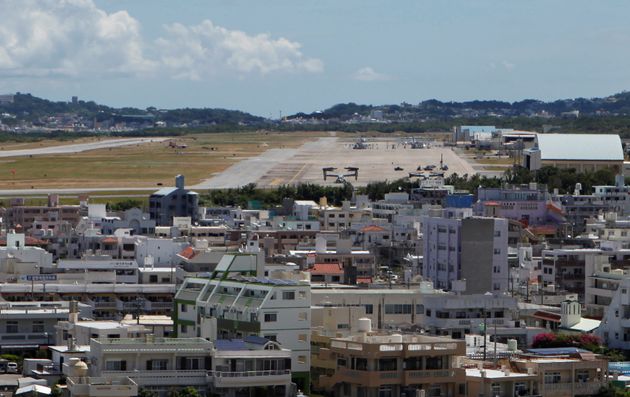
Osprey military aircraft are seen at the U.S. Futenma airbase in Ginowan, on the southern Japanese island of Okinawa, July 26, 2013.
The United States military said on Friday it was preparing for the biggest land return in Okinawa since 1972, as it faces a surge in opposition to its presence following the arrest of one its civilian contractors for the murder of a local woman.
Okinawa is the U.S. military’s key base in Asia where it faces an increasingly assertive China. It hosts 30,000 military personnel on bases that cover a fifth of the island.
“We are respectful of the feelings of Okinawans that our footprint must be reduced,” Lieutenant General Lawrence D. Nicholson, the U.S. commander on the island, said in a press release.
Once new helipads are completed, the U.S. military will hand back 4,000 hectares (40 square kilometers) of land to the Japanese government, which is 17 percent of the area it controls.
The tract is part of the U.S. Marine Corp jungle training camp known as Camp Gonsalves in Northern Okinawa.
Okinawa was under U.S. occupation until 1972.
The return of the land was agreed in 1996, but has been delayed by protesters blocking the construction of the helipads. The Japanese government recently resumed work at the site.
Local resentment over the U.S. military presence surged after an American civilian working at a U.S. base, Kenneth Franklin, was arrested last month in connection with the murder of a local 20-year-old Japanese woman, Rina Shimabukuro.
Nicholson announced a 30-day mourning period after the murder and temporarily banned marines from drinking off base. Washington and Tokyo agreed to limit legal protections and benefits to some U.S. civilians working for the military.
The murder and a subsequent arrest of a U.S. Navy sailor for drunk driving spurred large scale demonstrations and calls, backed by Okinawa Governor Takeshi Onaga, for Washington to move military personnel off the island.
After the rape of a Japanese schoolgirl by three U.S. servicemen in 1996, the U.S. and Japanese governments agreed to relocate some troops outside Okinawa but said others would be moved to less populated parts of the island.
(Reporting by Tim Kelly; Editing by Clarence Fernandez and Michael Perry)

Japan Torn Between Interests of US Military and of Local Citizens

Japanese Gov't Torn Between Interests of US Military and Local Citizens

© REUTERS/ Kyodo
ASIA & PACIFIC
Get short URL
6103891

Japan’s Chief Cabinet Secretary Yoshihide Suga has filed a fresh lawsuit against Okinawa Governor Takeshi Onaga over his failure to retract his revocation of an earlier permission for the landfill work to station a US Marine Corps airbase on the southern island.

The majority of people in Okinawa fear that the Futenma base could cause irreparable harm to the island’s flora and fauna and the local tourism industry, which is the island’s sole source of income.
Earlier this week Okinawans staged a series of sit-ins  protesting the resumption of the construction of six helipads. They fear that the Osprey “transformer” heli-planes could start falling down on their heads.

US, South Korean Naval Leaders Meet Day after North Fires Missiles

CNO Adm. John Richardson met with his South Korean  counterpart, Adm. Jung Ho-sub at the Pentagon for a discussion on the strengthening partnerships throughout the Indo-Asia Pacific (U.S. Navy photo by Mass Communication Specialist 1st Class Elliott)

CNO Adm. John Richardson met with his South Korean counterpart, Adm. Jung Ho-sub at the Pentagon for a discussion on the strengthening partnerships throughout the Indo-Asia Pacific (U.S. Navy photo by Mass Communication Specialist 1st Class Elliott)
The U.S. Navy's top officer told the head of the South Korean Navy on Thursday that the two leaders should communicate "as brothers" amid heightened tensions in the Pacific.
Chief of Naval Operations Adm. John Richardson met with Adm. Jung Ho-sub of South Korea at the Pentagon during Jung's week-long trip to the United States as both nations participate in the Rim of the Pacific multinational exercise.
The meeting took place just a day after U.S. and South Korean officials confirmed North Korea had fired two medium-range ballistic missiles Tuesday evening, one into waters near Japan. The other missile exploded after launch. STRATCOM officials said the missile launches did not pose a threat to North America.

Army secretary Eric Fanning visits Guam-based missile shield

Army secretary Eric Fanning visits Guam-based missile shield


Army Secretary Eric Fanning visited Guam for the first time Friday and looked at the Terminal High-Altitude Area Defense missile shield, which has been stationed at Andersen Air Force Base since North Korea made Guam-specific threats in 2013.
Placement of the THAAD battery will be key to what the Army’s presence will be like in Guam in the future, he said.

Asia-Pacific may be next front in ISIS fight

U.S. admiral warns Asia-Pacific may be next front in ISIS fight

 1181 203LINKEDIN 1COMMENTMORE
As the U.S. launches Operation Odyssey Lightning against the Islamic State group in Libya, a fourth front in the war against the brutal militant group, U.S. commanders are casting a wary eye on a possible fifth front: the Asia-Pacific.
The U.S. is launching strikes in Syria, Iraq, Afghanistan and now Libya, but military leaders and strategists are alarmed by waves of violence and signs that countries with large Muslim populations like the Philippines and Bangladesh could be ISIS’s next global stronghold.

Thursday, August 04, 2016

Democratic and Republican Party Platforms on Guam's Quest for Self-Determination

Wednesday, 03 August 2016
How is Guam's Quest for Self-Determination Viewed by U.S. Political Parties?
Written by Timothy Mchenry

The Commission on Decolonization is scheduled to meet sometime in August.

Guam - With the republican and democratic conventions now over, the Commission on Decolonization's independence task force is analyzing how stateside republicans and democrats view Guam’s quest for self- determination. This is part of a continuing effort by the commission on decolonization task forces to educate the public about self-determination and the three status options available to Guam’s residents.

Dr. Michael Bevacqua, co-chair of the independence for Guam task force, says knowing where these parties stand is important because the quest for self-determination is does not end at a plebiscite vote, the real work he says begins after the plebiscite, where there will be negotiations with the U.S. government.

Bevacqua says there is a difference in the way U.S. republicans and democrats look at self-determination for us territories. He says both republicans and democrats have very different tones and positions when talking about U.S. territories.

 "The republican party platform was very business focused. So they were saying we should undue any harsh economic restrictions on the territories such as the jones act, but in terms of their support explicitly for self determination, they don’t use the word self determination in it, in fact they only have two lines which refer to how that they acknowledge that the people of Guam or the territories have the right to seek the extension of American rights to them," says Bevacqua. "Basically [they were] saying you can ask for us to give you more rights but we don’t recognize anything outside of that."

Bevacqua says U.S. democrats stand in contrast to republicans in terms of how they view self-determination for U.S. territories. "There position is [to] support self determination for the people of the territories and self governance and that they support the people of the territories have the right to determine their future, so its general as well but it is also very clear that they recognize this is an issue and the people in the territories take it seriously, and they will, in a general way back them up on that," says Bevacqua.

 The Commission on Decolonization is scheduled to meet sometime in August. Governor Calvo has informed the commission that he will not seek a plebiscite vote in the November elections.

Tuesday, August 02, 2016

The Guardian: Proposed US military buildup on Guam angers locals who liken it to colonization

Proposed US military buildup on Guam angers locals who liken it to colonization
Proposal to bring an additional 5,000 marines to territory already 28% occupied by US military stirs frustrations – but many support the idea in a ‘fragile’ economy

Jon Letman in Hagåtña Monday 1 August 2016 14.43 BST

Source: https://www.theguardian.com/us-news/2016/aug/01/guam-us-military-marines-deployment?CMP=Share_AndroidApp_Facebook

Tourists pose for selfies on a white-sand beach, or splash in the aquamarine waters off Ritidian Point, the northernmost tip of Guam, the Pacific island territory “where America’s day begins”.

 It’s an idyllic scene, but just out of sight, hidden behind high limestone cliffs, the US military is poised for war. If tensions between the US and China or North Korea ever boiled over into a military confrontation, American forces here would likely be among the first to know: Guam is roughly the same distance from both the South China Sea and the Korean Peninsula. 

The island is a non-self-governing territory – or as some put it, a colony – whose strategic importance is underscored by the degree to which it is militarized. Roughly 28% of the island is occupied by the military, and many of the 165,000 inhabitants fear that Guam’s infrastructure will be overwhelmed if plans go ahead to nearly double the US military presence.

 Six thousand US military personnel are currently stationed on the island, but a long-delayed expansion plan would involve an additional 5,000 marines (two-thirds on a rotational basis) and 1,300 dependents beginning in 2022.

“The story of militarization on Guam is inseparable from the story of colonization,” said the human rights attorney Julian Aguon in his office in Hagåtña, the island’s capital. “Honestly, it’s hard to respond to the question of how the military impacts people on Guam because it’s way too big. The military-industrial complex is in full swing here.”

The planned marine redeployment is in part an effort to reduce tensions on the Japanese island of Okinawa, where there is fierce opposition to the US military presence. In June, some 65,000 protesters called for the closure of US bases on the Japanese island.  

But while a troop reduction may be welcome on Okinawa, not everyone on Guam is eager to see a buildup.

“The thing is, it’s not reducing the burden, it’s simply shifting it somewhere else – in this case to Guam,” said Dr Vivian Dames, host of Beyond the Fence, a Guam Public Radio program that examines the impacts of the US military.

“We’re not Okinawa, we’re not a foreign country, we’re not a state. We’ve been a US colony since 1898 and US citizens since 1950. Thus, the relationship between the civilian community with the military is very complex and very entangled and contradictory,” Dames said. 

“It’s not simply a matter of being for or against the buildup,” she said.

After the United States forced Japan from Guam in the summer of 1944, the US assumed the role of liberator, earning both admiration and anger that is evident today: Guam’s military enlistment rate remains among the highest in the nation.

The US also seized land for its own use. In the south, Naval Base Guam is home port to four fast-attack nuclear submarines and an expeditionary helicopter squadron. Nearby, the Naval Ordnance Annex covers 18,000 acres. The island is also home to a Naval Computer and Telecommunications Station and Joint Region Marianas headquarters, which oversees a 984,000-square-mile testing and live-fire training area. In the north, Andersen air force base houses a continuous bomber presence and bomber assurance and deterrence missions, including six B-52s which the air force says provide “strategic global strike capability [to] deter potential adversaries and provide reassurance to allies”.

A short drive past a fenced-off wilderness of invasive tangan-tangan trees, a terminal high-altitude area defense (THAAD) missile defense battery was deployed in 2013. Recently, North Korea claimed it could strike US Pacific bases and China has developed a missile called “Guam Killer”.

 For some Guam residents, the miles of razor-wire fences surrounding bases are a source of esentment – and a constant reminder of the US military’s dominance. “You have to understand the psychology of the fences,” says Hope Cristobal, a former senator in the Guam legislature. “There’s a barricade telling you, on the outside, are not welcome to come in.”

Other points of discontent include the segregated education system (children from military families go to separate Department of Defense-run schools), decades old land seizures, military housing allowances that opponents say unfairly skew real estate and housing costs, discounted prices for food, gasoline and other goods (limited to military personnel), environmental contamination and restricted access to private, public and ancestral lands.

But while some residents resent the military presence, many in Guam’s business community say it is essential for the island’s future. “It’s important to understand that as an island economy, Guam’s is very fragile. We really only have tourism and the military – and we need both,” says Jeff Jones, chairman of Guam Chamber of Commerce’s armed forces committee. Like other supporters, Jones says Guam’s military presence not only provides security and stability, it brings direct financial benefits in the form of employment and Section 30 funds (over $100m annually), which are military-generated tax revenues diverted to Guam. In an email, Jones pointed to almost $250m in pending military projects such as munitions storage igloos, surveillance drone hangars, satellite communications facilities and personnel housing (the marine buildup calls for the construction of 535 single-family homes and up to ten new barracks). According to Jones, Guam’s most important issues include employment, education, the economy, healthcare, crime and infrastructure. “The buildup wasn’t even in the top of voter’s concerns,” Jones said.

But critics describe Guam’s relationship with the military as a lopsided dependency, arguing the military is an intrusive force that runs roughshod over political sovereignty and cultural identity. Nonetheless, military service is frequently a multi-generation, multi-branch tradition for many of Guam’s families. Each year on 21 July, throngs of Guam residents gather along Hagatna’s Marine Corps Drive (renamed from Marine Drive in 2004) for a parade to celebrate Guam’s annual Liberation Day and honor the military.

“We’ve always had a military presence,” said the Guam legislature’s speaker, Judith Won Pat, who has relatives serving in every branch of the armed services. “[The military] is so ingrained into our communities, into our lives. It’s like second nature to everyone.”

On Guam, representatives from the army, navy, and air force all declined requests to be interviewed, but in an email, the US Pacific command public affairs spokesman Cmdr Dave Benham said, “We are operationalizing and cementing the rebalance to the Asia-Pacific. The military’s forward presence and engagement play an essential role in strengthening the capabilities of Pacific nations and partners to defend and secure themselves.”

Even as Guam mulls the future of its political status and relationship with the United States, many mainland Americans remain unaware of the island’s central role in US defense posture. Dr Robert Underwood, University of Guam president and former delegate to Congress, addressed the lack of appreciation for Guam’s sacrifices. “For those people who care, [Guam] is a military stronghold and allows the United States to project its power in this part of the world. For people who don’t know much about Guam, it’s a throwaway line for someplace distant or remote: ‘You’re going where?’”

He continued, “The concern is not American public perception. The concern really is: does Guam have a coherent policy about its future and its relationship to the military. And if you’re going to have a continuing relationship with the military, how do you use it to your advantage? Because the whole nature of the relationship is based on the assumption that Guam has a military role.”

Monday, August 01, 2016

Buildup on Guam likely to continue even following South China Sea ruling

Some Pacific island countries' claims to lucrative fishing and seabed mining resources could be limited by a landmark ruling on the South China Sea.

CNMI Groups Sue U.S. Military over Buildup

Military sued over buildup plan

28 Jul 2016 
By Raquel C. Bagnol - raquel@mvariety.com - Variety News Staff
Source: http://www.mvariety.com/cnmi/cnmi-news/local/88011-military-sued-over-buildup-plan

The Tinian Women’s Association and three other groups have filed a complaint against the U.S. Navy and the Department of Defense over their decision to relocate thousands of Marines from Okinawa to Guam and conduct live-fire training on Tinian and Guam.
Attorney Kimberlyn K. King-Hinds represents the plaintiffs in this case that also includes the Guardians of Gani, a Saipan-based organization whose members include NMI residents with but not limited to Chamorro and Carolinian heritage; PaganWatch, a Saipan-based association that includes members who are of Chamorro and Carolinian descent and who are past or current residents of Pagan; and the Center for Biological Diversity, a non-profit conservation organization with over 45,000 members, some of whom reside in the NMI.  
Named defendants were Ray Mabus, U.S. secretary of the Navy, and Ashton Carter, U.S. secretary of Defense.
King-Hinds said the plaintiffs are asking the federal court to enter a declaratory judgment that the defendants have violated and are violating the National Environmental Policy Act or NEPA and the Administrative Procedure Act by adopting and relying on the legally deficient Final Environmental Impact Statement or EEIS and Single Environmental Impact Statement or SEIS to issue records of decision regarding the relocation of Marines from Okinawa to the Mariana Islands.
The plaintiffs are also asking the court to vacate and set aside the 2010 and 2015 Records of Decision regarding the relocation of Marines from Okinawa to the NMI; to issue any appropriate injunctive relief; to award the plaintiffs the costs of this litigation, including reasonable attorney’s fees; and grant the plaintiffs other relief that the court may deem just and proper.
King-Hinds said the plaintiffs are also asking the court for relief for the defendants’ violations of the NEPA and the Administrative Procedure Act or APC for failure to consider relocation to Guam and associated live-fire training in a Single Environmental Impact Statement or SEIS and for failure to consider alternatives.
King-Hinds said the plaintiffs are informed and believe that the actions on Tinian and Pagan will not proceed unless the relocation of the Marines to Guam takes place.
She said these are connected actions in a single EIS which violates the NEPA.
According to King-Hinds, the defendants violated NEPA by failing to consider in their Environmental Impact Statement the overall cumulative impact of relocating Marines to Guam and the live-fire range construction and operations on Tinian and Pagan.
King-Hinds said the Navy refused to give detailed consideration in its FEIS or SEIS to any alternate location outside the Mariana Islands to station or train the Marines relocated from Okinawa.
Plaintiffs’ concerns
King-Hinds said the Tinian Women’s Association works to protect the environment of Tinian and is opposed to the training on Tinian associated with the Guam and the CNMI military relocation project.
King-Hinds said the association members are concerned that the proposed military training on Tinian would cause damage that would drive the residents out of Tinian; would cause devastating noise, pollution and health risks as well as loss of native species, loss of agricultural land, damage to coral reefs and other marine resources, loss of traditional fishing areas and lost productivity of traditional fisheries, loss and damage of access to cultural and historical resources; and harm to the tourism industry that is vital to the economy.
King-Hinds said the association is concerned that the travel restrictions brought about by the military training would affect the healthcare access of the people of Tinian to Saipan, Guam or the Philippines in a timely manner, and that travel restrictions would isolate families and inhibit the practice of important occasions like weddings and others.  
King-Hinds said the Guardians of Gani are concerned that the training would affect the environmental health of the people and the islands, and that it would be a threat to the traditional, fulfilling lifestyle on Pagan.
The Guardians of Gani said the people of the CNMI already experience high cancer rates which they attribute to the chemicals and other contamination as a result of U.S. military activities during World War II and this could worsen.
King-Hinds said PaganWatch’s mission is to protect the rights and interests of people of Northern Marianas descent on the CNMI’s public land, including Pagan.
King-Hinds said in 2015, PaganWatch submitted comments on the CNMI Joint Military Training draft EIS and pointed out the Navy’s failure to comply with the NEPA’s mandate to consider in a single EIS the environmental impacts of both the proposed training for Pagan and the relocation of Marines to Guam.
King-Hinds said the Center for Biological Diversity has worked to protect the wildlife of Guam and the CNMI since 2000 including filing petitions with the U.S. Fish and Wildlife Service to designate species that are endangered or threatened.
The center filed a suit against the Navy in Dec. 2000 to stop the killing of migratory birds as result of live-fire training exercises on Farallon de Medinilla.
King-Hinds said in March 2002 the court found that the Navy violated the Migratory Bird Treaty Act by killing birds without a permit through the live-fire training exercises.    
King-Hinds said there are currently no Marines stationed on Guam or in the CNMI and the training done by Marines in the Marianas occurs on a transient basis.
King-Hinds said in July 2010 the Navy issued a final EIS to evaluate the relocation of approximately 8,600 Marines from Okinawa to Guam.
She said the Navy refused to look for an alternate location despite numerous public comments, and claimed that Guam is the only location for the realignment of forces that could satisfy national security needs and treaty obligations.
As Guam could not accommodate all the required live-fire training ranges, Tinian was chosen as the only suitable location.
King-Hinds said the Navy issued its Record of Decision based on the final EIS on Sept. 20, 2010 to build and operate live-fire ranges on Tinian.
In 2012, the U.S. and Japan modified their agreement and only 5,000 Marines would be relocated to Guam, but the Navy concluded that the ramped-up training also required their use of Pagan for live-fire training.
King-Hinds said on Aug. 28, 2015, the Navy issued its Record of Decision based on the supplemental EIS of 2015 which reaffirmed the Navy’s 2010 decision to relocate Marines from Okinawa to the Mariana Islands, despite lack of any final NEPA analysis of the live-fire training on Tinian and Pagan.
She added that the Navy announced its plan to issue a revised draft EIS, but the revised draft is not expected to be released until March 2017. The Navy stated it does not expect to issue a record of decision until sometime in 2018.