Showing posts with label Climate Change. Show all posts

Sunday, May 15, 2016

'Warning for the World': Five Pacific Islands Officially Lost to Rising Seas

The event is the first official confirmation of what the future could be under climate change, researchers say

Published on May 10, 2016 by Commondreams.org


Rates of sea level rise in the Solomons are almost three times higher than the global average.
(Photo:
 ILO in Asia and the Pacific/flickr/cc)

By Nadia Prupis,

Five Pacific Islands have been swallowed by rising seas and coastal erosion, in what Australian researchers say is the first confirmation of what climate change will bring.

The submerged region, which was part of the Solomon Islands archipelago and was above water as recently as 2014, was not inhabited by humans.

However, a further six islands are also experiencing "severe shoreline recession," which is forcing the populations in those settlements—some of which have existed since at least 1935—to flee, according to a study published last week in Environmental Research Letters.

Researchers used aerial and satellite images dating back to 1947 to track coastal erosion across 33 islands. At least 11 islands across the northern region of the archipelago "have either totally disappeared over recent decades or are currently experiencing severe erosion," the study found.

"This is the first scientific evidence...that confirms the numerous anecdotal accounts from across the Pacific of the dramatic impacts of climate change on coastlines and people," the researchers wrote at Scientific American on Monday. Lead author Dr. Simon Albert, a senior research fellow at the University of Queensland, told Agence France-Presse that rates of sea level rise in the Solomons are almost three times higher than the global average.

The five that sank ranged in size from one to five hectares (roughly two to 12 acres) and supported "dense tropical vegetation that was at least 300 years old," the researchers wrote for Scientific American, calling the event "a warning for the world."

Rates of sea level rise were substantially greater in areas exposed to high wave energy, the researchers found, "indicating a synergistic interaction between sea-level rise and waves."

That means islands exposed to higher wave energy in addition to sea level rise face faster and more widespread loss than sheltered islands.

They wrote: These higher rates are in line with what we can expect across much of the Pacific in the second half of this century as a result of human-induced sea-level rise. Many areas will experience long-term rates of sea-level rise similar to that already experienced in Solomon Islands in all but the very lowest-emission scenarios.

Understanding the factors that put certain regions at greater risk for coastal erosion is vital to help frontline communities adapt, the study concluded.

The families that have already been forced to relocate did so using their own limited resources and received little to no assistance from their government or international climate funds, the researchers noted. The exodus had the additional impact of fragmenting established communities of hundreds of people.

Melchior Mataki, who chairs the Solomon Islands' Natural Disaster Council, told the researchers, "This ultimately calls for support from development partners and international financial mechanisms such as the Green Climate Fund. This support should include nationally driven scientific studies to inform adaptation planning to address the impacts of climate change in Solomon Islands."


The Solomon Islands were among the 175 nations that signed the Paris climate agreement in New York last month.

Sunday, December 13, 2015

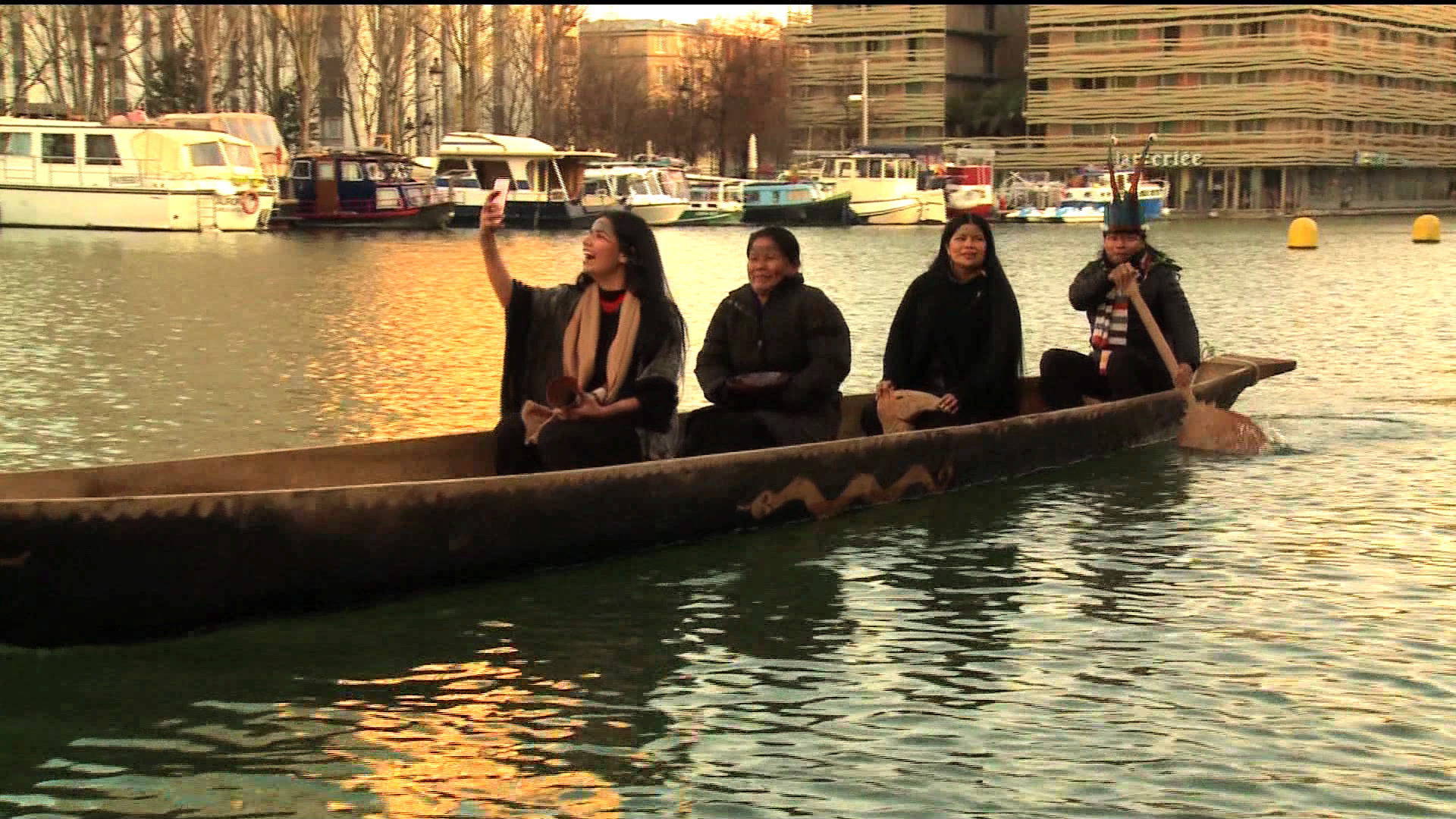
Indigenous Group Brings "Canoe of Life" 6,000 Miles from Amazon to Paris to Call for Climate Action

Published Dec. 11, 2015 by Democracynow.org


On Tuesday, as the sun rose in Paris, a delegation of indigenous people from Sarayaku, in the Ecuadorean Amazon, set out in a handmade, wooden canoe along the Villette Canal. The Kichwa people of Sarayaku have been fighting oil exploitation on their lands for many years; in 2012 they won a case at the Inter-American Court of Human Rights against the Ecuadorean government for permitting oil drilling on their land. Democracy Now!'s Juan Carlos Dávila and Amy Littlefield were there as the Sarayaku launched their canoe after its 6,000-mile journey from the Amazon. "Those who are actually negotiating right now, they might not have to live with the consequences of climate change, but I will," Nina Gualinga, a Kichwa activist from Sarayaku, says of the COP21 negotiations. "Who are they to decide over my future, over my sister's future, over my children’s future?"


TRANSCRIPT
This is a rush transcript. Copy may not be in its final form.

AMY GOODMAN: We wrap up our broadcast with an action earlier this week. On Tuesday, as the sun rose in Paris, a delegation of indigenous people from Sarayaku, in the Ecuadorean Amazon, set out in a handmade, wooden canoe along the Villette Canal. The Kichwa people of Sarayaku have been fighting oil exploitation on their lands for many years. In 2012, they won a case at the Inter-American Court of Human Rights against the Ecuadorean government for letting an Argentine oil company explore for oil on their land. This is the piece.

JOSÉ GUALINGA: [translated] For the first time in history, a canoe, that we call the "Canoe of Life," named after the hummingbird fish in our territory, a canoe from Sarayaku, from the Ecuadorean Amazon, has arrived here to Paris, France.

NINA GUALINGA: My name is Nina Gualinga, and I am here with a delegation from Sarayaku. And Sarayaku is situated in the Ecuadorean Amazon. And we have brought a canoe all the way to Paris, here to the COP, with a message of peace, of hope, and a proposal called Kawsak Sacha. That means "The Living Forest." And it is a proposal to make sure that nature’s rights are being respected, indigenous peoples’ rights are being respected, and also a way to combat climate change.

The whole community has been involved, pretty much. There’s one person who shapes the canoe, and then there are others also helping to burn it and things like that. And then you make like a big party. You gather all of your friends and family and community members to drag the canoe all the way from the mountain down to the river. We had to take it all the way to the nearest port, which is in Canelos, by canoe, so that took, I think, a day or so. And then, from Puyo, we had to take it to the capital of Ecuador, Quito, and then from Quito, on a plane—or from Guayaquil, maybe, to Paris. But first, it got stuck in Ecuador because of troubles with the flight, I think. And then it got stuck in customs here in Paris. So, it’s been quite hard to get it all the way here.

AMY LITTLEFIELD: Could you talk about the negotiations here at the COP? And do you feel your voice is being heard inside the summit?

NINA GUALINGA: I think that indigenous peoples’ voices are the voices that should be heard. Indigenous people should be inside the actual negotiations, but we are not. Those who are actually negotiating right now, they might not have to live with the consequences of climate change, but I will. I will have to live with it. My sister, my little brother and my children, they’re all going to have to live with the consequences of climate change. And who are they to decide over my future, over my sister’s future, over my children’s future?

AMY GOODMAN: Nina Gualinga of the Sarayaku of the Ecuadorean Amazon, speaking to Democracy Now!'s Amy [Littlefield]. Special thanks to Mike Burke and to Carla Wills, to Nermeen Shaikh and to Deena Guzder, to Denis Moynihan. I'm Amy Goodman. This is Democracy Now! I’ll be speaking tonight at 9:00 at The Place to B here in Paris.

Thursday, October 06, 2011

Sinking Pacific Island Kiribati Considers Moving to a Man-Made Alternative

By Kathy Marks, Asia-Pacific Correspondent from Independent.co.uk

Posted on Thursday, 8 September 2011

The future for Kiribati, one of the low-lying Pacific nations threatened by rising seas, is so dire that the government is contemplating relocating the entire population to man-made islands resembling giant oil rigs.

"We're considering everything... because we are running out of options," the President of Kiribati, Anote Tong, said yesterday in Auckland, where he is attending the Pacific Islands Forum. He said that his small, impoverished country – where the highest land is no more than two metres above sea level – urgently needed the world to take action on climate change.

Vulnerable Pacific nations have acquired a powerful new ally, the UN Secretary-General, Ban Ki-moon, who visited Kiribati on his way to the Auckland conference. In a speech on Tuesday, Mr Ban warned: "For those who believe climate change is about some distant future, I invite them to Kiribati. Climate change is not about tomorrow. It is lapping at our feet – quite literally in Kiribati and elsewhere." Beachside villages in Kiribati – which consists of 33 coral atolls sprinkled across two million square miles of ocean – have already had to move to escape the encroaching waves. Water supplies have been contaminated by salt water, and crops destroyed. Erosion, caused partly by storms and flooding, is increasingly serious.

Mr Tong said he had seen models of a man-made floating island, similar to an offshore oil platform and costing US$2bn (£1.25bn). While it sounded "like something from science fiction", he said radical ideas had to be considered. "If you're faced with the option of being submerged with your family, what would you do?" he asked. "Would you jump on the rig... on a floating island or not? I think the answer is yes."

Other ideas included building a series of sea walls, at a cost of nearly $1bn. But Mr Tong said it would be up to the international community to fund such projects, and he complained that Kiribati had received little financial aid despite pledges from wealthier nations.

A former British colony called the Gilbert Islands, Kiribati is home to 103,000 people, most of them crammed into the main atoll, Tarawa, a horseshoe-shaped chain of islets surrounding a central lagoon. Like other pancake-flat Pacific nations such as Tuvalu and the Marshall Islands, and Indian Ocean nations such as the Maldives, it faces oblivion as a result of global warming-induced rising sea levels.

Mr Tong said that for i-Kiribati, as his countrymen are known, it was no longer a case of adapting to a changing environment, but of survival. He said Kiribati desperately needed the world to act to reduce carbon emissions.

Mr Ban said his visit to Kiribati had strengthened his view that "something is seriously wrong with our current model of economic development". He said: "We will not succeed in reducing emissions without sustainable energy solutions."

Saturday, January 30, 2010

PNC :: Well Known Environmentalist to Address Climate Change Impact On Guam

PNC :: Well Known Environmentalist to Address Climate Change Impact On Guam

Tuesday, 26 January 2010

Guam - Jose Ma. Lorenzo “Lory” Tan, CEO and Vice Chairman of WWF-Philippines (World Wildlife Fund), will discuss the impacts of climate change on Guam and Micronesia. At the invitation of Sen. James Espaldon, Mr. Tan will be a

1. UOG guest lecturer on Thursday, Jan. 28 at 6 PM in the Jesus and Eugenia Leon Guerrero CBPA Building,
2. Guam Visitors Bureau Membership Luncheon guest speaker on Friday, Jan. 29 at 11:30 AM, Pacific Islands Club, and
3. Father Duenas Memorial School speaker to 9th and 10th graders.

“Mr. Tan delivered a powerful presentation on climate change and its impacts on tourism during an eco-tourism conference I attended in Manila. Visualizing the disaster that would affect many Asian destinations, I felt it was important to bring Lory on island to give a similar presentation that focuses on Guam and Micronesia,” said Senator Espaldon. Mr. Tan examines how Guam and the region will be affected by climate change, its impact on low lying areas as well as potential impacts to consider with the Guam build-up.

“I inquired during a DEIS briefing whether the impacts of climate change was considered in the military’s planning stages and the answer was no. It is alarming that we are investing billions to meet the military’s growth demands but did not even consider the repercussions of global warming and the potential of seeing hundreds of millions of dollars of infrastructure improvements go underwater in the future,” said Espaldon. It was because of this that Espaldon invited Tan to Guam. Espaldon added, “Global warming and the rising water levels are already affecting Guam and parts of Micronesia.”

Please see the attached biography for more information on Mr. Tan. For additional details on Mr. Tan’s visit, please contact Senator Espaldon at 475-5437.

Written by : News Release

Tuesday, January 26, 2010

Principles of U.S. Engagement in the Asia-Pacific

Principles of U.S. Engagement in the Asia-Pacific

Kurt M. Campbell
Assistant Secretary, Bureau of East Asian and Pacific Affairs
Before the Subcommittee on East Asian and Pacific Affairs Senate Foreign Relations Committee
Washington, DC

January 21, 2010

Excerpt:

U.S. Principles for Engagement in the Asia-Pacific Region – The Asia-Pacific region is of vital and permanent importance to the United States and it is clear that countries in the region want the United States to maintain a strong and active presence. We need to ensure that the United States is a resident power and not just a visitor, because what happens in the region has a direct effect on our security and economic well-being. Over the course of the next few decades climate change, proliferation of weapons of mass destruction, and widespread poverty will pose the most significant challenges to the United States and the rest of the region. These challenges are and will continue to be most acute in East Asia. This situation not only suggests a need for the United States to play a leading role in addressing these challenges, but it also indicates a need to strengthen and broaden alliances, build new partnerships, and enhance capacity of multilateral organizations in the region. Fundamental to this approach will be continued encouragement of China’s peaceful rise and integration into the international system. A forward-looking strategy that builds on these relationships and U.S. strengths as a democracy and a Pacific power is essential to manage both regional and increasingly global challenges.

With the positive outcomes of renewed engagement as a backdrop, I would like to discuss a series of principles that will guide our efforts moving forward. Intrinsic to our engagement strategy is an unwavering commitment to American values that have undergirded our foreign policy since the inception of our Republic. In many ways, it is precisely because of the emergence of a more complex and multi-polar world that values can and should serve as a tool of American statecraft. Five principles guide the Obama administration’s engagement in East Asia and the Pacific. In her January 12speech in Honolulu, Secretary Clinton detailed the five principles for how we view the Asia-Pacific architecture and U.S. involvement evolving. These include the foundation of the U.S. alliance system and bilateral partnerships, building a common regional economic and security agenda, the importance of result-oriented cooperation, the need to enhance the flexibility and creativity of our multilateral cooperation, and the principle that the Asia-Pacific’s defining institutions will include all the key stakeholders such as the United States.

For the last half century, the United States and its allies in the region – Japan, the Republic of Korea, Australia, the Philippines, and Thailand – have maintained security and stability in East Asia and the Pacific. Our alliances remain the bedrock of our engagement in the region, and the Obama Administration is committed to strengthening those alliances to address both continuing and emerging challenges. The United States, therefore, must maintain a forward-deployed military presence in the region that both reassures friends and reminds others that the United States will remain the ultimate guarantor of regional peace and stability. There should be no mistake: the United States is firm in its resolve to uphold its treaty commitments regarding the defense of its allies.

Our alliance with Japan is a cornerstone of our strategic engagement in Asia. The May 2006 agreement on defense transformation and realignment will enhance deterrence while creating a more sustainable military presence in the region. The Guam International Agreement, signed by Secretary Clinton during her February 2009 trip, carries this transformation to the next stage. As part of our ongoing efforts to assist the Government of Japan with its review of the Futenma Replacement Facility (FRF) Agreement, a high-level working group met in Tokyo in November and December, and the Government of Japan is continuing its review. In addition to our focus on these issues, we are working to create a more durable and forward-looking vision for the alliance that seizes upon Japan’s global leadership role on climate change and humanitarian and development assistance programs, to name a few. As we approach the 50th anniversary of the alliance, we will work closely with our friends in Japan to think creatively and strategically about the alliance.

Friday, October 23, 2009

Rising Seas, Rising Awareness

Published on Thursday, October 22, 2009 by The Baltimore Sun
Rising Seas, Rising Awareness
Climate change threatens to drown Maryland's coasts and islands, but it's not too late to act
by Mike Tidwell

Here's an idea: Why don't the residents of Smith Island - at the fragile center of the Chesapeake Bay - rent a few scuba-diving suits and hold a town hall meeting under water?

Scientists say a huge part of the Chesapeake region could be below water in a few decades due to rapid global warming. So why not practice up? Just grab a few wetsuits and goggles and rehearse for the aquatic life to come.

A similar rehearsal took place last week in another island area: the archipelago nation of the Maldives in the Indian Ocean. Sitting at underwater tables, atop underwater chairs with fish darting about, the country's president and Cabinet ministers held a "global warming summit" to ask the world to stop the rising seas that could eventually submerge their entire country.

But as TV networks broadcast this bizarre meeting back to the U.S., you could almost hear the "tsk, tsk." We comfortable Americans tend to view really big catastrophes - things like famines and tsunamis - as far-away matters involving people usually too poor or under-educated to plan better.

This mindset helped blind us to the pre-Hurricane Katrina dangers of New Orleans. And it's blinding us today to the shared threat of climate change in places like Smith Island, not to mention Manhattan Island and most of south Florida.

Smith Island - just 80 miles east of the White House in the main stem of the Chesapeake - is home to 300 fishermen, artists, boat-builders, shopkeepers and retirees. The island covers four square miles and is, on average, less than 2 feet above sea level.

If, thanks to global warming pollution, the Greenland ice sheet continues its satellite-verified meltdown, then Smith Island will almost certainly disappear even faster than the Maldives and faster than several much-publicized South Pacific island nations. The whole eastern third of Maryland, in fact, is in big trouble, from Ocean City to Solomons Island to Annapolis. James Hansen, the top climate scientist at NASA, says we'll be measuring sea-level rise in meters by 2100 if current trends continue.

That's a lot to take in, for sure, and skepticism might be the natural response to such climate predictions. So don't take it from Greenpeace or Al Gore or even James Hansen. Listen instead to Allstate Insurance Co.

In 2006, Allstate announced it was no longer issuing new homeowners' policies in states up and down the East Coast. In Maryland, the company shut its doors to new customers across 11 eastern counties, including parts of Anne Arundel and Prince George's counties. Why? First, the company said, sea levels are definitely rising worldwide based on irrefutable science. Second, Atlantic hurricanes are getting bigger and more intense as the planet warms. Hence, Smith Island and much of the rest of eastern Maryland just aren't good insurance risks anymore, Allstate acknowledged. The potential for catastrophe is too great.

Allstate is not a Republican corporation. It's not a Democratic corporation. This is rational private capital talking. The idea of an underwater town hall meeting near Smith Island seems less alarmist when a major insurance company is abandoning customers just a stone's throw from our nation's capital.

Thankfully, the Maryland General Assembly has done its part on global warming. It passed a statute last spring mandating a 25 percent reduction in greenhouse gas emissions statewide by 2020. But like the tiny nation of the Maldives, Maryland can't solve global warming by itself. The U.S. Senate must pass an even stronger federal carbon cap by mid-December, ahead of international climate talks in Copenhagen, Denmark. With a congressional bill in hand, President Barack Obama must then go to Copenhagen and push China and the rest of the world for a strong global treaty to replace the expiring Kyoto Protocol.

The good news is that this Saturday, for the first time ever, activists from Maryland and the Maldives - as well as Greenland, Australia and myriad places in between - will be speaking with one voice on global warming. The much-heralded "International Day of Climate Action" involves more than 4,000 events in more than 170 countries, including a "human circle of hope" outside the White House. (Learn more at www.350.org/dc).

And while there's no word yet about an aquatic town hall meeting at Smith Island, there are rumors of wetsuits and goggles available for loan from the president of the Maldives. It's time to follow in his wake.

Copyright © 2009, The Baltimore Sun
Mike Tidwell is executive director of the Chesapeake Climate Action Network based in Takoma Park. His e-mail is mtidwell@chesapeakeclimate.org.

Saturday, September 26, 2009

FSM President Mori Tells U.N. Micronesian Climate Change Threatens His Nation's Survival

FSM President Mori Tells U.N. Micronesian Climate Change Threatens His Nation's Survival

Pacific News Center
Kevin Kerrigan

Guam - In his address to the United Nations General Assembly Saturday, the President of the Federated States of Micronesia, Emanuel Mori, emphasized the critical danger Micronesia is facing from climate change.

With sea-levels rising, changing weather patterns and increased storms and disasters, he called for urgent and immediate action by the international community.

"There is simply no more time to waste," he said. "Talk is cheap, action speaks louder. Let's go to Copenhagen to 'seal the deal.'"

In a deeply personal appeal, Mori called climate change "a matter of survival, as a people, culture and as nations" for Micronesians and "our fellow Pacific islanders, including islanders in other parts of the World.

"For centuries, the people of Micronesia have lived on their small islands, many less than a meter above sea level. They have enjoyed a life dependent on the bounties of the sea and the harvest from the land. They have developed a culture of respect for nature and lived in harmony with their natural surroundings. They built outrigger canoes and rigged them with sails from pandanus leaves."

But that same ocean that has nurtured Micronesia for centuries has now become "the very instrument of our destruction," Mori said.

Mori also pointed out to the General Assembly that climate change is undermining Micronesia's development efforts, including its abilities to meet the Millennium Development Goals. Micronesia's overall fragility is compounded by climate change impacts such as increased droughts, excessive rainfall and saltwater intrusion into taro patches and other staple crops, he said. Yet he added that advances in development are being made, including Micronesia's continued work with its fellow Pacific governments on the Micronesia Challenge to conserve the area's biodiversity. Micronesia is also seeking to acquire a fiber-optic cable network that reaches the entire country, as the improved communications will improve its efforts on health, education and private sector development.

In addition to the speech's strong focus on climate change, Mori also stressed his concern over illegal and unsustainable fishing practices in the waters of coastal island nations, and he stated support for United Nations Security Council reform in the form of expansion in both permanent and non-permanent membership, with support for permanent seats for Japan, Germany and India.